
Strait of Hormuz Crisis 2026: Oil Prices, US Warships, Iran Threats & Global Trade Impact
Full analysis of the 2026 Strait of Hormuz crisis: US Navy deployment, Iran warnings, oil prices above $100, OPEC+ output, and global trade disruption. Detailed breakdown.
Raja Awais Ali
5/4/20266 min read
Strait of Hormuz Crisis 2026: U.S. Warships, Iran Warnings, “Project Freedom,” Oil Price Reaction and Global Trade Disruption
In 2026, the ongoing U.S.–Iran conflict has entered a critical phase where every new development is directly impacting not only the region but the entire global economy, and at the center of this crisis stands the Strait of Hormuz, one of the most sensitive and strategically important maritime chokepoints in the world, through which nearly one-fifth of global seaborne oil and gas flows, making even minor disruptions capable of triggering major shocks in global energy markets, and in the latest escalation, the deployment of two U.S. Navy guided-missile destroyers into the Gulf along with the successful transit of two U.S.-flagged merchant vessels through the strait has emerged as a significant turning point that has intensified military tensions while simultaneously causing sharp volatility in oil prices.
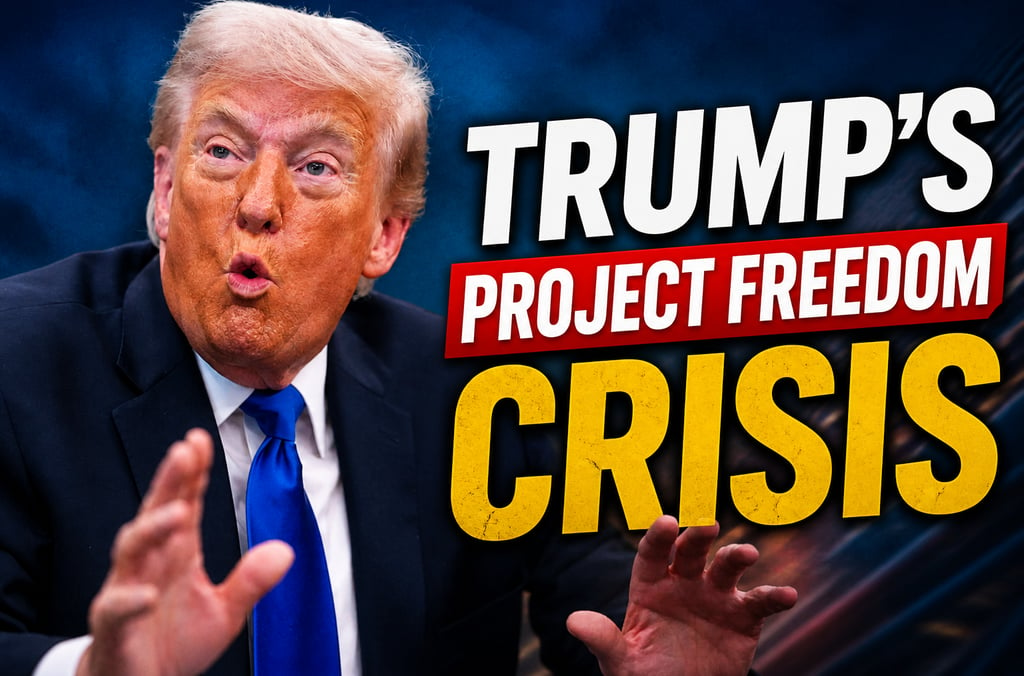
According to U.S. Central Command (CENTCOM), this operation is part of President Donald Trump’s announced initiative “Project Freedom,” which is designed to provide safe passage to commercial vessels stranded in the Gulf, and CENTCOM explicitly stated that American forces are “actively assisting efforts to restore transit for commercial shipping,” indicating a direct and ongoing military role in reopening this vital trade route, and for this purpose, not only have two guided-missile destroyers been deployed, but a large-scale military framework has also been activated, including approximately 15,000 personnel, more than 100 land- and sea-based aircraft, along with warships and drones, clearly demonstrating that the United States is approaching this crisis not as a limited tactical issue but as a broader strategic operation with regional and global implications.
The United States also confirmed that two U.S.-flagged merchant ships successfully crossed the Strait of Hormuz, signaling that limited maritime movement is being restored, however, this development came amid conflicting claims from Iran, which earlier asserted that it had prevented a U.S. warship from entering the Gulf, with Iran’s semi-official Fars news agency reporting, citing local sources, that Tehran had struck a U.S. warship near the port of Jask with two missiles and forced it to retreat, a claim that was swiftly denied by U.S. officials, who maintained that no American naval vessel had been hit, while a senior Iranian official later acknowledged that only a “warning shot” had been fired, leaving uncertainty over whether any actual damage occurred, and highlighting the ongoing information warfare accompanying the physical confrontation.
These conflicting narratives did not remain confined to the military domain but immediately impacted global oil markets, where prices initially surged by around 5% following reports of the alleged attack, only to retreat after the U.S. denial, creating a classic “spike and pullback” pattern driven by market psychology and uncertainty, and by 1307 GMT in London trading, Brent crude futures were up $2.05, or 1.9%, at $110.22 per barrel after earlier reaching a session high of $114.30, while U.S. West Texas Intermediate (WTI) rose by 47 cents, or 0.5%, to $102.41 after climbing as high as $107.46 earlier in the day, clearly illustrating how rapidly sentiment can shift in response to evolving geopolitical signals.
Analysts emphasize that the outlook for oil prices remains tilted to the upside as long as flows through the Strait of Hormuz remain restricted, with UBS analyst Giovanni Staunovo stating that “the path for prices remains skewed to the upside as long as flows through the strait remain restricted,” reinforcing the idea that even partial disruptions in this critical corridor can sustain elevated price levels, and despite the pullback, prices remaining above $100 per barrel underline the severity of the ongoing supply risk.
The crisis has had its most profound impact on the global shipping industry, where hundreds of commercial vessels have been stranded in the Gulf for nearly two months, with as many as 20,000 seafarers stuck onboard under increasingly difficult conditions, facing shortages of food and essential supplies, turning what began as a strategic blockade into a growing humanitarian concern, and in response, President Trump announced that the United States would begin efforts to “guide out” these stranded ships, assuring that vessels would be safely escorted through restricted waterways so they could “freely and ably get on with their business,” a statement that reflects both economic urgency and political pressure.
Despite these assurances, the shipping industry remains unconvinced about the safety of the route, with major companies expressing reluctance to resume operations under current conditions, and German container shipping giant Hapag-Lloyd clearly stating that transit through the strait is still not considered possible, while shipping and oil executives have stressed that military convoys alone are insufficient to restore normal traffic, emphasizing the need for a comprehensive and agreed cessation of hostilities before confidence can return to the market.
Meanwhile, the United States has established an “enhanced security area” to support transit through the strait, with maritime authorities advising vessels to use Omani waters on the western side of the passage to avoid potential mines and urging operators to carefully reassess risks and routing before attempting transit, but despite these measures, uncertainty persists due to the ongoing threat environment and lack of a broader resolution.
Iran, for its part, has maintained a firm and confrontational stance, asserting that the security of the Strait of Hormuz remains under its control and that any safe passage must be coordinated with its armed forces, with its navy declaring that it had prevented “American-Zionist” warships from entering the area with a “swift and decisive warning,” and issuing a clear warning that any foreign military presence attempting to approach or enter the strait would be met with force, underscoring Tehran’s intention to use the waterway as a strategic lever in the broader conflict.
Adding to tensions, the United Arab Emirates accused Iran of carrying out a drone attack on an empty crude oil tanker belonging to Abu Dhabi’s state oil company ADNOC as it attempted to transit the strait, a development that highlights the vulnerability of commercial shipping even when not directly involved in military operations, and further complicates the security landscape.
In parallel, the Organization of the Petroleum Exporting Countries and its allies, known as OPEC+, announced an increase in oil output targets by 188,000 barrels per day for June across seven member countries, marking the third consecutive monthly increase, with the rise matching May’s adjustment minus the share of the United Arab Emirates, which exited OPEC on May 1, however, analysts note that these additional barrels are likely to remain largely theoretical as long as the ongoing conflict continues to disrupt Gulf supply routes, limiting their real impact on global markets.
U.S. Treasury Secretary Scott Bessent stated that the United States has “absolute control” over the strait, yet this assertion appears to contrast with on-the-ground realities, where Iranian forces remain active and capable of influencing events, contributing to continued market uncertainty and cautious behavior among traders and investors.
Diplomatic efforts have also struggled to gain traction, with the United States and Iran having held one round of face-to-face talks following the suspension of U.S. and Israeli bombing campaigns four weeks earlier, but subsequent attempts to arrange further negotiations have stalled, while Iran has submitted a 14-point proposal that reportedly envisions ending the conflict across all fronts, including Israeli actions in Lebanon, prioritizing resolution of the shipping standoff before addressing nuclear issues, a sequencing that differs significantly from Washington’s approach.
The United States, on the other hand, continues to demand that Iran relinquish its stockpile of more than 400 kilograms (900 pounds) of highly enriched uranium, which it views as a potential pathway to nuclear weapon capability, while Iran maintains that its nuclear program is peaceful but has expressed willingness to discuss certain limitations in exchange for sanctions relief, referencing its prior acceptance of similar constraints under the 2015 nuclear agreement that was later abandoned by President Trump.
Amid these tensions, Pakistan has played a limited but notable diplomatic role, announcing that the United States handed over 22 crew members from an Iranian container vessel that had been seized the previous month, describing the move as a “confidence-building measure,” suggesting that despite the broader deadlock, some channels for de-escalation remain open.
From a broader analytical perspective, the Strait of Hormuz crisis represents far more than a localized military confrontation, evolving instead into a complex geo-economic and geo-strategic struggle, where the United States seeks to restore global supply chains and maintain control over critical maritime routes, while Iran leverages its geographic position to exert pressure and gain negotiating advantage, creating a feedback loop that continues to destabilize energy markets and prolong uncertainty.
Looking ahead, the central question remains whether this confrontation will escalate into a direct military clash or transition toward a diplomatic resolution, with further escalation likely to push oil prices even higher, intensify global inflation, and deepen disruptions in supply chains, while a negotiated settlement could reopen the strait and provide much-needed relief to the global economy, but as of now, uncertainty remains the defining feature of this crisis, with the world closely watching every development in this narrow yet immensely consequential waterway.
Stay informed with the latest national and international news.
© 2026. All rights reserved.