
Strait of Hormuz Crisis 2026: Iran Fair Deal Demand, Trump Naval Mission Pause & Global Oil Impact
Full analysis of the May 6, 2026 Strait of Hormuz crisis as Iran demands a fair deal, Trump pauses naval operations, ship attacks escalate, and US-Iran peace talks approach a critical 48-hour deadline impacting global oil markets and security stability.
Raja Awais Ali
5/6/20265 min read
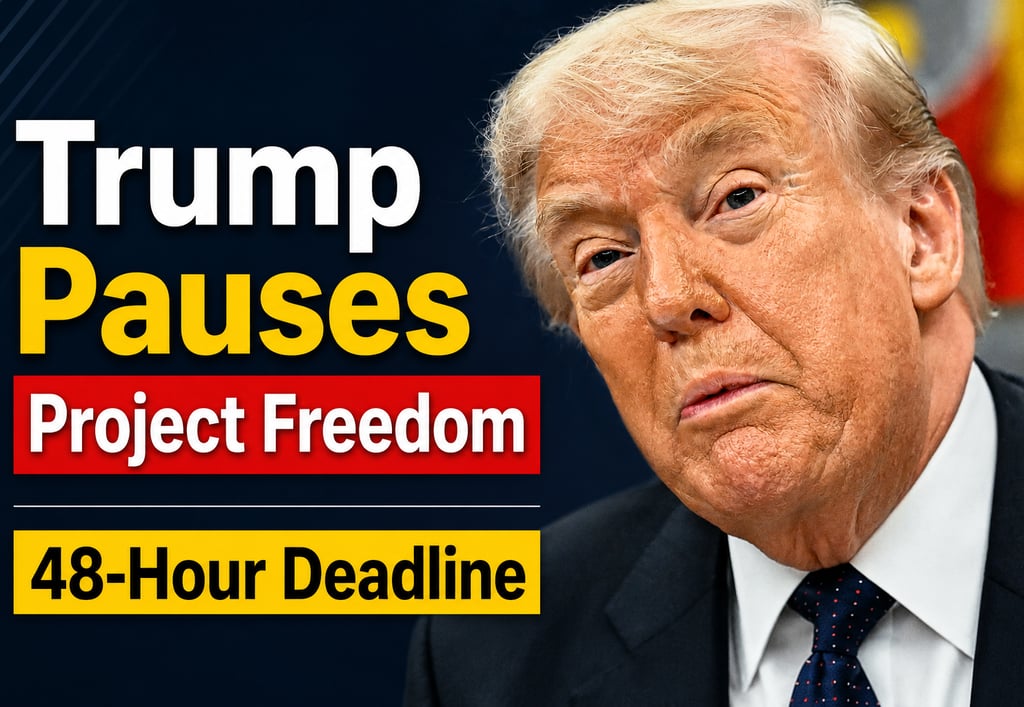
Strait of Hormuz Crisis 2026: Iran Demands a “Fair Agreement” as Trump Halts Naval Mission Amid Escalating War, Diplomacy, and Global Energy Shock
The Middle East is currently standing at a critical and highly volatile turning point where war, diplomacy, and the global economy have become deeply interconnected realities. At the center of this situation is the Strait of Hormuz, widely regarded as one of the most important energy supply routes in the world. On May 6, 2026, Iran made it clear that it would only accept any peace agreement if it is “fair and comprehensive,” while U.S. President Donald Trump abruptly paused a three-day-old naval mission that had been launched to reopen the critical maritime passage. This decision comes at a time when a one-month-old ceasefire is already under severe pressure and instability is increasing across the region.
The naval operation, known as “Project Freedom,” was launched on Sunday with the primary objective of using the U.S. Navy to provide safe passage for commercial vessels through the Strait of Hormuz. However, the mission failed to achieve any meaningful results. There was no significant recovery in maritime traffic, and international shipping companies continued to avoid the route due to ongoing security threats. Instead, Iran described the initiative as provocative and escalated its operations, increasing attacks not only within the Strait of Hormuz but also in nearby regions, further intensifying the crisis.
During this period, a major incident occurred when a French shipping company reported that one of its container vessels was struck while passing through the Strait of Hormuz. Several crew members were injured and were immediately evacuated, highlighting the extreme risk conditions in the region. Earlier, a South Korean cargo vessel also reported an explosion inside its engine room, adding further evidence of rising instability and serious threats to global maritime trade routes.
President Trump stated on social media that there had been “significant progress” in negotiations with Iran, and on that basis, both sides agreed to temporarily pause “Project Freedom” to assess whether a final agreement could be reached. However, he confirmed that the broader blockade would remain in place. Despite this announcement, the White House did not provide any specific details regarding what progress had been made or how long the pause would last. Critics have also pointed out that Trump has previously made similar claims about diplomatic breakthroughs without presenting clear evidence.
Iran’s official position was presented by Foreign Minister Abbas Araqchi during his visit to China. He stated that Tehran remains committed to a “fair and comprehensive agreement” and avoided directly responding to U.S. political statements. He further emphasized that regional diplomacy is essential to reducing tensions and preventing escalation. In this context, he also held a phone call with Saudi Arabia’s foreign minister, stressing that regional countries must work together to prevent further deterioration of the situation.
The meetings in China suggest that China may play an increasingly important mediation role in the crisis. As a major global energy importer, China has a strong strategic interest in ensuring that the Strait of Hormuz remains open and stable to protect its supply chains. As a result, diplomatic activity in Beijing is drawing significant global attention.
Since February 28, following the outbreak of war involving the United States and Israel against Iran, the Strait of Hormuz has been effectively closed to most international shipping, with only Iranian vessels being allowed passage. In April, the United States separately imposed a blockade on Iranian ports, further complicating the already tense situation. During this period, Iran expanded its operational reach beyond the Strait of Hormuz into coastal areas of the United Arab Emirates, targeting strategic locations including a major oil export facility that operates outside the strait-based route.
During “Project Freedom,” Iranian drones and missiles reportedly targeted multiple vessels. Among them was a South Korean cargo ship that reported an explosion in its engine room. Iran also carried out repeated strikes in the United Arab Emirates. In response, the U.S. Navy claimed it had targeted several Iranian boats, confirming that military escalation between both sides remains active and ongoing.
Following the announcement that the naval mission had been paused, global oil markets reacted immediately. Brent crude oil prices fell by approximately 1.7 percent, dropping below 108 dollars per barrel. This decline reflects market expectations that tensions may ease and that supply disruptions could eventually stabilize if diplomatic efforts succeed.
At the same time, a significant diplomatic development has emerged. Reports suggest that the United States and Iran are close to finalizing a one-page memorandum of understanding consisting of 14 key points. The proposed agreement aims to formally end the war and establish a 30-day negotiation framework for a detailed settlement. Under the proposal, Iran would temporarily suspend uranium enrichment, while the United States would ease sanctions and release billions of dollars in frozen Iranian funds. Additionally, both sides would gradually lift restrictions on shipping through the Strait of Hormuz.
These negotiations are being conducted by U.S. envoys Steve Witkoff and Jared Kushner, through both direct talks and mediated channels. According to reports, the United States is expecting Iran’s response within the next 48 hours, making this a decisive moment for the future of the conflict. If successful, the agreement could mark a major shift toward de-escalation. If it fails, the United States could reimpose stricter blockades or resume military operations.
The humanitarian impact of the conflict is extremely severe. In Iran, thousands have reportedly been killed due to U.S. and Israeli strikes. In Lebanon, Israeli operations targeting Iran-backed Hezbollah have led to mass casualties and the displacement of over one million people. Iranian retaliatory attacks have also resulted in deaths across Gulf countries and Israel, significantly expanding the geographical scope of the conflict.
U.S. Secretary of State Marco Rubio and other senior officials have repeatedly stated that Iran cannot be allowed to control maritime traffic in the Strait of Hormuz. After the April 8 ceasefire, one round of talks was held between the United States and Iran in Pakistan, but efforts to organize further negotiations have stalled due to disagreements over key demands.
President Trump has claimed that Iran’s military capability has been significantly reduced, stating in the Oval Office that Tehran is now limited to using “peashooters.” He has also argued that Iran wants peace despite its public statements. However, the reality on the ground remains highly unstable, with ongoing tensions and no clear resolution in sight.
This conflict is also creating increasing political pressure in the United States ahead of the November midterm elections, particularly as rising fuel prices continue to impact domestic consumers. This domestic political factor is adding urgency to diplomatic efforts.
Overall, the Strait of Hormuz crisis has evolved into a major global strategic confrontation involving military escalation, diplomatic negotiations, and economic instability. Every development in this situation carries significant consequences not only for the region but for the entire global economy. The next 48 hours are expected to be decisive in determining whether the world moves toward de-escalation and a fragile peace, or further escalation into a wider conflict.
Stay informed with the latest national and international news.
© 2026. All rights reserved.