
SpaceX Ties Elon Musk Salary to Mars Colonization Plan 2026: Full Breakdown of $7.5 Trillion Goal, Space Data Centers & Human Settlement on Mars
SpaceX ties Elon Musk’s compensation to Mars colonization, a $7.5 trillion valuation goal, and space-based data centers in a major 28 April 2026 corporate strategy shift.
Raja Awais Ali
4/28/20263 min read
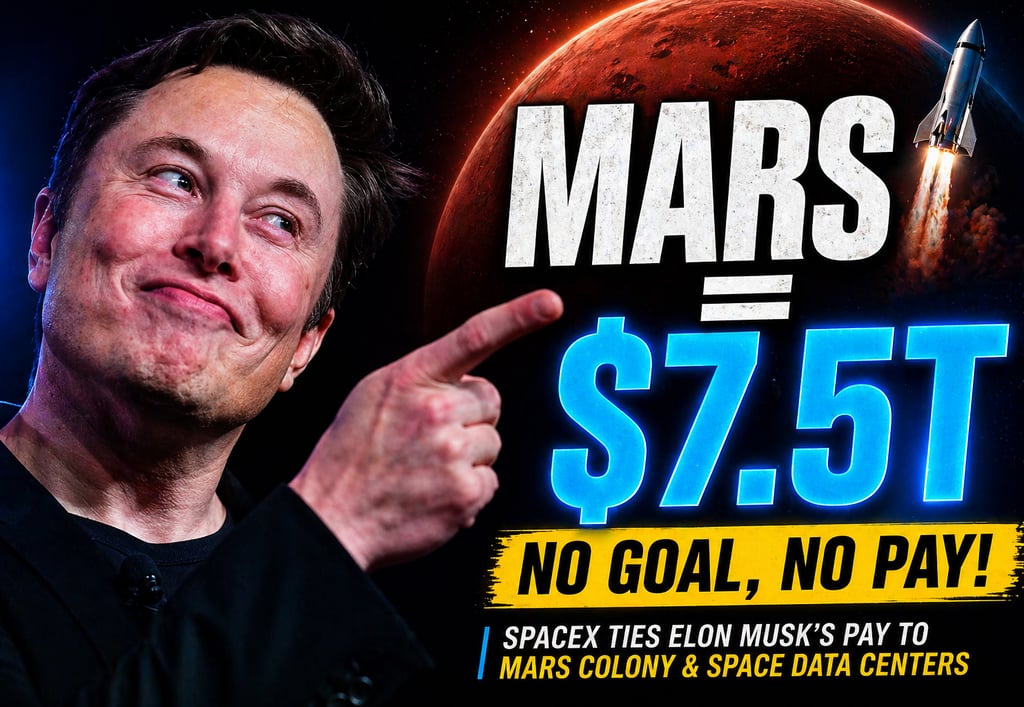
SpaceX Ties Elon Musk Compensation to Mars Colonization Goal — Full Analysis of April 28, 2026 Development
On 28 April 2026, a major and unusual development emerged in the global technology and business sector when internal records from SpaceX revealed that the company has linked the compensation of its founder and chief engineer Elon Musk to extremely ambitious long-term goals that were previously considered science fiction. This plan combines financial performance with humanity’s future expansion into space, with the most significant objective being the establishment of a permanent human settlement on Mars.
Under this new compensation structure, Elon Musk will not receive any major financial rewards or stock grants unless the company achieves highly demanding performance milestones. The most critical requirement is that SpaceX must reach an estimated valuation of approximately 7.5 trillion US dollars, a figure that places it far beyond current global corporate benchmarks. Alongside this financial target, the company must also succeed in building a permanent population of at least 1 million humans on Mars, marking the first large-scale interplanetary human settlement in history.
In addition to these targets, the plan includes another extraordinary condition requiring SpaceX to develop space-based data centers capable of delivering at least 100 terawatts of computing power. In practical terms, this is equivalent to approximately 100,000 gigawatts of energy capacity, comparable to the combined output of thousands of nuclear power plants on Earth. This reflects the company’s broader vision of shifting not only transportation but also global digital infrastructure beyond Earth.
A key element of this compensation package is that Elon Musk will receive super-voting restricted shares, meaning each share carries ten times the voting power of standard shares. If the targets are achieved, Musk’s financial wealth and control over the company would increase significantly. However, if the milestones are not met, he will receive no additional shares at all, making the entire plan strictly performance-based.
It is also important to note that Musk has been receiving a very minimal salary from SpaceX for several years, approximately 54,000 US dollars annually. His real wealth is primarily tied to equity ownership and long-term stock performance. Currently, his net worth is already valued in the hundreds of billions of dollars, and this new compensation structure could further multiply his financial position if successful.
This development comes at a time when Musk is also leading Tesla, where he is pursuing equally ambitious goals in the electric vehicle and artificial intelligence sectors. This has raised important questions about whether both companies are competing for his time and strategic focus. Corporate governance experts view this as a rare case where a single individual simultaneously drives two major companies toward extreme long-term objectives.
Historically, Musk’s vision of Mars colonization is not new. He has long argued that humanity must become a multi-planetary species to ensure long-term survival. SpaceX’s Starship program has been designed specifically for this purpose, aiming to reduce the cost of interplanetary travel and make Mars habitation technically possible. However, this is the first time that the vision has been directly integrated into a formal compensation structure, turning it from an aspirational goal into a measurable corporate mandate.
From a financial perspective, SpaceX is already valued at approximately 1.75 trillion dollars, placing it among the most valuable private companies in the world. However, the new 7.5 trillion dollar target represents a significant leap that would require breakthroughs not only in space technology but also in global internet infrastructure, energy systems, and data computing industries.
Another important aspect of this plan is that no fixed timeline has been set. This gives Musk complete flexibility in achieving the objectives while ensuring he remains actively involved with the company over the long term. The structure is designed to promote sustained leadership and long-term strategic commitment rather than short-term performance.
Business analysts and industry experts have expressed mixed opinions about the plan. Some consider it a bold and visionary approach that pushes the boundaries of innovation, while others believe the targets are extremely difficult and may be nearly impossible to achieve. In particular, the goal of building a 1 million population on Mars presents significant technological, economic, and biological challenges that currently have no real-world precedent.
Overall, this decision reflects a broader shift in corporate thinking, where success is no longer measured only by revenue or profit but also by long-term human advancement and technological evolution. The Elon Musk compensation plan at SpaceX represents a unique example of how modern technology companies are beginning to integrate interplanetary and future civilization-scale goals into their business strategies.
Stay informed with the latest national and international news.
© 2026. All rights reserved.