
SpaceX’s $75 Billion IPO Explained: How Elon Musk Is Changing Wall Street’s Rules
SpaceX’s historic $75 billion IPO is set to reshape Wall Street. Learn how Elon Musk is challenging traditional IPO rules, giving retail investors access, retaining control, and betting on Starlink, Starship, and Mars colonization.
Raja Awais Ali
6/8/20264 min read
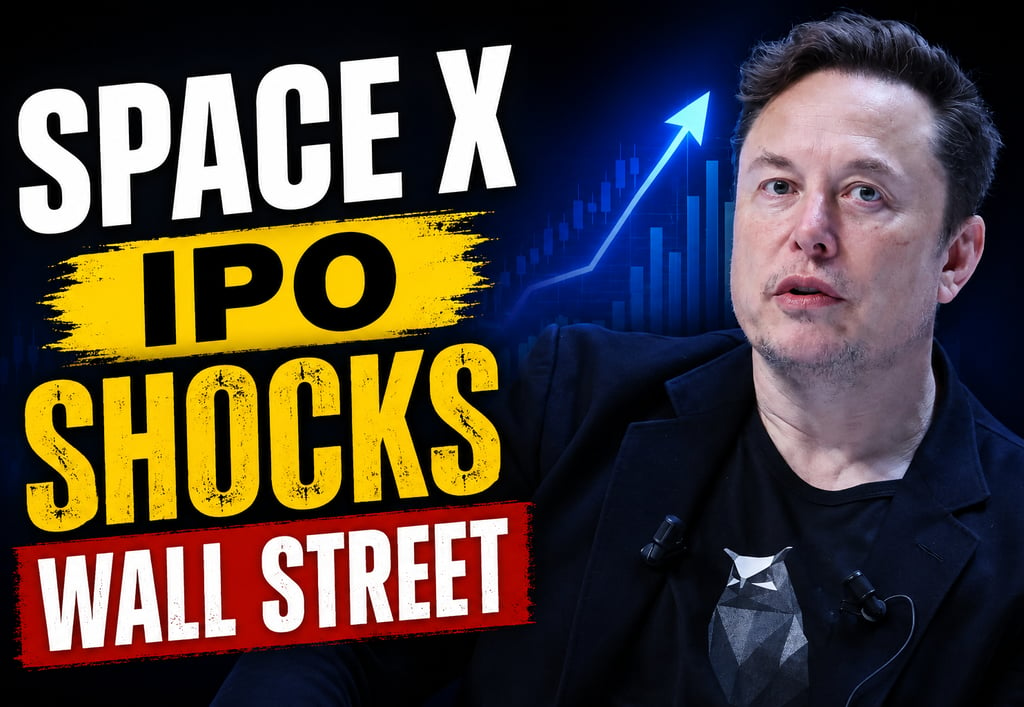

SpaceX’s Historic $75 Billion IPO: How Elon Musk Is Rewriting Wall Street’s Rulebook
The world’s most prominent private space company, SpaceX, is approaching a historic moment that could transform not only the space industry but also the traditions of global financial markets. Led by Elon Musk, the company is preparing to enter the public markets through a record-breaking $75 billion Initial Public Offering (IPO), while its expected valuation has climbed to approximately $1.8 trillion.
This is not just another IPO. It is a financial experiment in which Elon Musk is challenging decades-old Wall Street conventions. Investors are not simply buying into a company; they are investing in a vision that aims to take humanity beyond Earth.
Price First, Negotiations Later: The End of Traditional IPO Pricing?
Traditionally, companies conduct extensive meetings with institutional investors before an IPO. Investment banks gather feedback, assess market demand, and then determine a final share price.
SpaceX, however, has largely ignored that process.
The company has set a target share price of $135, signaling that the valuation is largely non-negotiable. This approach transforms the IPO roadshow from a price-discovery exercise into a marketing and sales campaign.
According to market analysts, this is a significant departure from the standard IPO model, where investor feedback typically plays a major role in determining the final price. Attention is now focused on June 11, when the final IPO price is expected to be confirmed, with trading scheduled to begin on Nasdaq the following day.
From Wall Street to Main Street: Expanding Access for Retail Investors
Another groundbreaking aspect of the SpaceX IPO is its effort to provide broader access to individual investors.
Reports indicate that the company could allocate as much as 30% of the offering to retail investors. In most major IPOs, the majority of shares are reserved for institutional investors, hedge funds, and large financial firms.
Given Elon Musk’s enormous global following, SpaceX appears confident that retail demand will provide a strong support base for the stock.
Adding to the excitement, recent Nasdaq rule adjustments could allow SpaceX to join the Nasdaq 100 relatively quickly. If that happens, index-tracking funds and investors would be required to purchase SpaceX shares.
However, the company is unlikely to join the S&P 500 immediately because it does not currently meet the profitability requirements needed for inclusion.
Early Liquidity for Employees and Insiders
In a typical IPO, employees and insiders are prohibited from selling their shares for approximately six months after the listing through what is known as a lock-up period.
SpaceX is taking a different approach.
The company plans to allow employees to sell portions of their holdings in stages before the traditional lock-up period expires, giving them earlier access to liquidity.
This move suggests that management is confident enough in investor demand to avoid significant selling pressure from insiders.
Elon Musk Keeps Firm Control
Many founders gradually lose influence after taking their companies public, but that will not be the case at SpaceX.
According to the company’s prospectus, Elon Musk will retain approximately 85.1% of the company’s voting power following the IPO. This effectively gives him overwhelming influence over major corporate decisions.
In addition, SpaceX has introduced governance provisions that could make it more difficult for shareholders to challenge management decisions. Certain legal actions would require higher ownership thresholds, and removing Musk from the CEO position would be extremely difficult under the company’s structure.
In short, investors may be buying shares, but Elon Musk will continue to control the company’s direction.
Betting on the Future More Than the Present
Perhaps the most unusual aspect of the SpaceX IPO is that many investors are placing their bets on the company’s future ambitions rather than its current financial performance.
Reports suggest that demand for the offering has already reached approximately $150 billion, double the amount the company intends to raise.
Despite its remarkable growth, SpaceX remains unprofitable. Much of that is due to heavy spending on artificial intelligence computing infrastructure and other long-term projects.
Among its most ambitious plans is the development of solar-powered data centers in space, an idea that remains largely conceptual today.
The company is also pursuing the long-term goal of establishing a human presence on Mars. Financial incentives built into its corporate structure are designed to encourage progress toward that objective.
Starlink and Starship: The Keys to SpaceX’s Future
At present, SpaceX’s most successful and profitable business segment is Starlink, its rapidly expanding satellite internet service.
However, the company’s long-term future depends on more than Starlink alone.
A significant portion of its growth strategy is tied to Starship, the next-generation rocket system that remains in the testing phase. Starship is expected to serve as the foundation for future Mars missions, large-scale space infrastructure, and potentially interplanetary travel.
If Starship succeeds, SpaceX could reshape not only the space industry but also multiple sectors of the global economy. If it fails to meet expectations, the company’s long-term ambitions could face substantial challenges.
Is SpaceX a Company or a Movement?
For many investors, SpaceX is no longer simply a rocket manufacturer. It has become a unique investment opportunity that combines advanced technology, artificial intelligence, satellite communications, the emerging space economy, Mars colonization, and the influence of Elon Musk himself.
This $75 billion IPO will test whether investors remain focused solely on current profitability or whether they are willing to fund visions that may take years—or even decades—to become reality.
SpaceX’s official mission reflects that ambition: to make humanity a multiplanetary species, deepen our understanding of the universe, and extend the light of consciousness to the stars.
If investors continue to believe in that vision, SpaceX’s IPO may ultimately be remembered not only as one of the largest public offerings in history, but also as one of the most influential.
Stay informed with the latest national and international news.
© 2026. All rights reserved.