
Samsung AI Boom Sparks Historic Worker Crisis and Massive Strike Threat in South Korea 2026
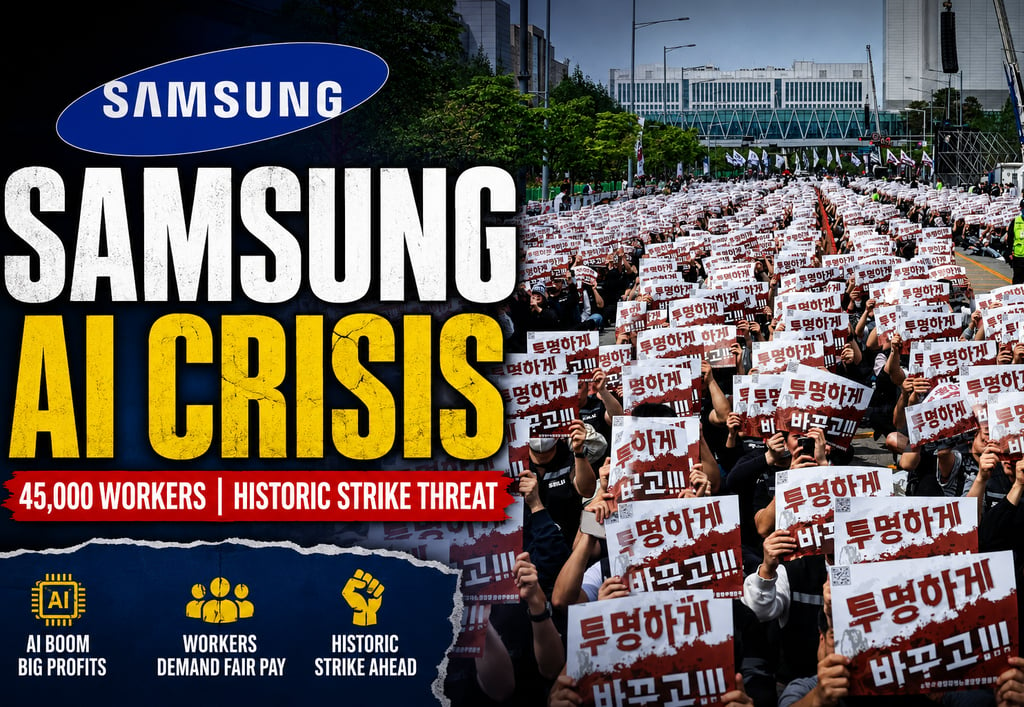
Samsung is facing its biggest worker crisis in history as more than 45,000 employees prepare for a major strike over AI chip bonuses, internal divisions, talent loss, and growing pressure on South Korea’s economy in 2026.
Raja Awais Ali
5/15/20265 min read
Samsung AI Boom Sparks Historic Worker Crisis and Massive Strike Threat in South Korea
The global artificial intelligence boom has pushed the semiconductor industry into a new era of profits and competition, but it has also created a serious internal crisis inside Samsung Electronics. South Korea’s technology giant is now facing growing tensions between employees and management as nearly 45,000 workers prepare for what could become the largest strike in the company’s history. The dispute has already raised concerns among investors, government officials, and global technology companies because Samsung plays a major role in the worldwide supply chain for memory chips, AI hardware, smartphones, and advanced computing systems.
At the center of the conflict is one major question: who should benefit the most from the profits created by the AI revolution? Samsung’s memory chip business has earned huge profits during the global AI boom because demand for memory chips used in AI data centers, cloud servers, laptops, and smartphones has increased rapidly. The company now plans to reward workers in its memory chip division with record-breaking bonuses. However, employees working in Samsung’s logic chip and foundry businesses say they are being left behind even though they also contribute to the company’s AI ambitions and often work in the same facilities as memory chip employees.
According to internal wage discussions reviewed during negotiations, Samsung proposed bonuses for around 27,000 employees in its memory chip division that could reach as high as 607% of annual salary. The proposal is considered one of the largest bonus offers in the company’s recent history and would even exceed compensation levels offered by rival chipmaker SK Hynix. Meanwhile, employees working in Samsung’s logic chip and foundry divisions were reportedly offered bonuses between 50% and 100% of annual salary.
This huge gap in compensation has created anger inside the company because many workers believe the divisions are deeply connected. Employees in the foundry and logic chip businesses help produce advanced AI chips and components for major global clients including Tesla and NVIDIA. Some workers argue that it is unfair for one group to receive massive rewards while another group receives far lower compensation despite contributing to the same long-term AI strategy.
Union leaders have warned that the widening bonus gap could damage Samsung’s future by encouraging skilled engineers to leave the company. During wage discussions, labor representatives questioned how employees in weaker-performing divisions could remain motivated if workers in another division received several times more money. One union leader reportedly said that if memory division workers received hundreds of millions of won while foundry workers received far less, there would be little reason for talented employees to stay.
The growing frustration has increased fears of a talent drain inside Samsung. Several employees said engineers have already started moving from Samsung’s foundry division into its more profitable memory business or leaving for competitors. A foundry engineer working in Pyeongtaek reportedly explained that his team had become much smaller over the past two years because many experienced workers transferred internally or joined rival companies.
Other employees also claimed that many Samsung workers are currently applying for jobs at competing semiconductor companies, including Micron Technology. Some workers believe Samsung no longer values employee loyalty or recognizes the contributions made by long-serving engineers and researchers. One senior chip researcher with three decades of experience reportedly said he attended a labor rally because he felt deeply frustrated and no longer felt proud of working at Samsung.
Samsung management, however, argues that performance-based bonuses should reflect actual business results. Company negotiators reportedly pointed out that Samsung’s logic chip and foundry businesses have suffered major financial losses worth trillions of won in recent years. According to management, the profits generated by the memory chip division are helping support continued investments in the company’s struggling logic chip operations. Executives believe it would not make financial sense to provide equal bonuses across divisions with very different levels of profitability.
Samsung also stated that its logic chip business remains strategically important for the company’s future and that long-term investments in advanced chip manufacturing will continue. The company emphasized that it still aims to provide some of the best employee compensation packages in the semiconductor industry. However, Samsung also warned that a large-scale strike could damage customer trust if production schedules are disrupted and chip deliveries are delayed.
The possible strike has become a major concern not only for Samsung but also for South Korea’s wider economy. Analysts estimate that a prolonged strike could significantly reduce Samsung’s profits and sales at a time when global demand for AI hardware remains extremely strong. Financial analysts at JPMorgan estimated that the dispute could impact Samsung’s operating profit by between 21 trillion won and 31 trillion won, while sales losses could reach approximately 4.5 trillion won.
These numbers show how important Samsung has become to the global technology industry. The company is not only the world’s largest memory chip producer but also one of South Korea’s most important economic pillars. Any disruption inside Samsung’s semiconductor business could create ripple effects across international supply chains, especially as technology companies race to secure enough AI chips and computing hardware.
The dispute has also drawn attention from political leaders and international business organizations. South Korean President Lee Jae-myung recently warned that some labor groups may be making excessive demands, comments widely interpreted as a message directed toward Samsung’s unions. At the same time, the American Chamber of Commerce in Korea expressed concern that ongoing labor uncertainty could damage South Korea’s reputation as a reliable global manufacturing partner.
Industry experts believe Samsung’s current problems are partly linked to its complex business structure. Unlike some competitors that focus on only one area of semiconductor production, Samsung operates memory chips, logic chips, and foundry manufacturing under the same broader semiconductor division. Some analysts argue that this structure creates internal competition, conflicts over resources, and tensions between employees working in businesses with very different financial performance.
Samsung Chairman Jay Y. Lee has repeatedly stated that the company wants to become the global leader in logic chips and advanced semiconductor manufacturing by 2030. However, experts warn that achieving this goal could become far more difficult if Samsung continues losing experienced engineers and technical talent to rivals.
The situation now represents one of the biggest tests in Samsung’s modern history. The company is trying to balance record profits from the AI boom while managing employee expectations, internal divisions, and global competition. At the same time, workers believe they deserve a fair share of the success created by the rapidly growing AI industry.
As negotiations continue, the world’s technology sector is closely watching the outcome. If Samsung and its unions fail to reach an agreement before the planned strike begins on May 21, the impact could extend far beyond South Korea. The dispute has already become a powerful example of how the AI revolution is not only changing technology and business, but also reshaping labor relations, corporate culture, and the future of the global semiconductor industry.
Stay informed with the latest national and international news.
© 2026. All rights reserved.