
Russia at a Crossroads: War, Peace, and Putin’s Defining Decision for the Future
Russia faces a critical turning point as competing visions of war and peace emerge within its political and economic elite. Explore how the Ukraine conflict, economic pressures, security concerns, and global tensions could shape Vladimir Putin’s next move and Russia’s future.
Raja Awais Ali
6/4/20264 min read
Russia at a Crossroads: War, Peace, and Putin’s Defining Decision for the Future
The St. Petersburg International Economic Forum (SPIEF), once known as a gathering place for global investors, Western banks, and international business leaders, has taken on a very different role in 2026. Rather than serving solely as an economic conference, it has become a platform for a broader debate about Russia’s future.
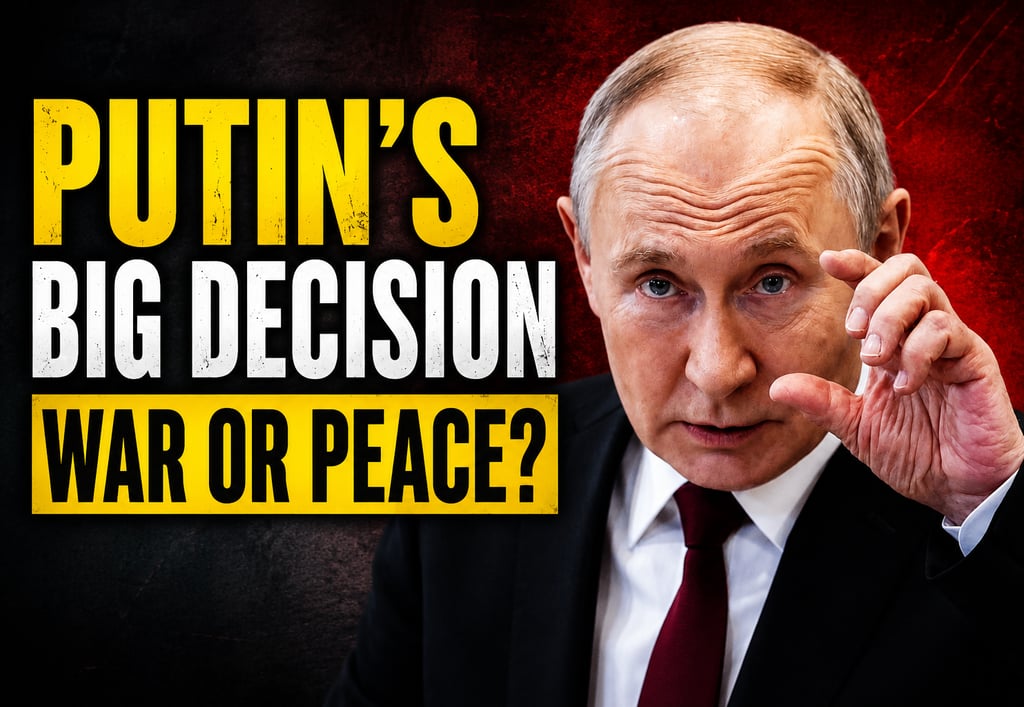
At the center of that debate stands President Vladimir Putin, facing two competing visions for the country. One camp argues that Russia must prepare for years, perhaps decades, of confrontation with the West, while another believes that ending the war in Ukraine could unlock economic opportunities and help stabilize the country’s long-term outlook.
This debate comes after more than four years of conflict in Ukraine, a war that continues to shape Russia’s economy, society, and international relationships.
The reality of the conflict was brought closer to home when Ukrainian drone strikes targeted an oil terminal and a naval facility near St. Petersburg shortly before the forum began. Smoke rising over parts of the city served as a reminder that the war is no longer confined to distant battlefields. It has increasingly become a factor affecting Russia’s major economic and political centers.
At 73 years old, Vladimir Putin remains the dominant figure in Russian politics after more than twenty-five years as the country’s paramount leader. Throughout his time in power, one of his defining political skills has been balancing competing factions within the Russian establishment.
Today, that balancing act appears more challenging than ever. On one side are nationalist voices who view the war as essential to Russia’s security and status as a global power. On the other are economic and business figures who warn that prolonged conflict could limit growth and create long-term financial pressures.
Russia’s economy, estimated at around $3 trillion, has demonstrated resilience despite extensive international sanctions. However, concerns about slowing economic growth have become increasingly difficult to ignore.
Business leaders and economists point to challenges including reduced investment, technological restrictions, labor shortages, and limitations on international trade. For some influential figures, these pressures strengthen the argument that a negotiated settlement could provide economic benefits and create opportunities for renewed development.
Supporters of a harder line, however, see the situation very differently. Former Russian intelligence operative Andrey Bezrukov argued that Russia should accept the possibility of living in a state of conflict for many years to come.
According to this view, future confrontations may not always take the form of traditional warfare. Instead, they could involve a combination of military pressure, economic competition, cyber operations, and geopolitical rivalry. Advocates of this perspective believe that Russian society must adapt to an era in which security concerns dominate national priorities.
Nationalist thinkers and government supporters at the forum suggested that the international system is undergoing a major transformation. In their view, Western influence is gradually declining while a new multipolar world order is emerging.
From this perspective, Russia must strengthen its institutions, accelerate technological development, improve strategic decision-making, and reinforce public support for its armed forces in order to compete successfully in an increasingly uncertain environment.
The atmosphere at SPIEF reflected these changing priorities. In previous years, exhibition halls were filled with representatives from major Western financial institutions and multinational corporations.
In 2026, displays of drones, military technologies, cybersecurity solutions, and artificial intelligence-based defense systems attracted significant attention. Russian technology companies showcased facial recognition platforms, digital monitoring systems, and advanced cyber-defense capabilities.
The shift highlighted how national security considerations have become increasingly integrated into Russia’s economic and technological planning.
On the battlefield, Russia currently controls approximately 20 percent of Ukrainian territory. Since the large-scale military operation launched in February 2022, fighting has reshaped the map of eastern and southern Ukraine.
However, Russia’s advances have slowed considerably during 2026. Moscow controls most of the Donbas region, yet a small portion representing less than 10 percent of Donbas remains under Ukrainian control.
Ukraine has repeatedly stated that it will not withdraw from the territory it continues to hold in Donbas and will never recognize Russian sovereignty over areas seized during the conflict.
These positions have contributed to a prolonged diplomatic stalemate. Efforts aimed at reaching a negotiated settlement have produced limited progress, while both sides remain committed to their core strategic objectives.
Complicating matters further is the broader international environment. Russian officials argue that global attention has increasingly shifted toward other geopolitical crises, including tensions involving Iran and the United States.
As a result, the diplomatic momentum that once surrounded peace negotiations has weakened, making a breakthrough more difficult to achieve.
Within Russia itself, influential voices continue to highlight the economic costs of a prolonged war. Some policymakers and business leaders believe that a future peace agreement could encourage investment, improve trade opportunities, and reduce uncertainty across key sectors of the economy.
Their argument is not necessarily based on ideology but on practical concerns about long-term economic competitiveness and national development.
At the same time, many supporters of the current strategy insist that security considerations must remain the top priority. They argue that ending the conflict without achieving Russia’s objectives could create new risks and leave underlying disputes unresolved.
For these voices, the challenge is not simply winning a war but shaping a geopolitical environment that they believe will remain unstable for years to come.
One participant at the forum summarized the dilemma facing Russia by asking a simple but important question:
Does the conflict eventually end through negotiation, or is the country entering a more difficult and uncertain era?
That question reflects a wider debate taking place among political leaders, business executives, analysts, and policymakers.
Adding to the discussion, nationalist philosopher Alexander Dugin argued that the conflict will either conclude with a Russian victory or continue indefinitely. He called for greater national unity, stronger public commitment, and a recognition that the country faces long-term strategic challenges.
While emphasizing that Russia does not seek direct conflict with the West, he described future relations as likely to remain confrontational and competitive.
Taken together, these competing perspectives reveal a country standing at a historic crossroads.
One path points toward diplomacy, economic recovery, and a gradual easing of tensions.
The other points toward a prolonged period of geopolitical rivalry, higher defense spending, and continued confrontation with Western powers.
The decision facing Russia’s leadership is not simply about the next phase of the Ukraine conflict but about the broader direction of the country in the years ahead.
For now, Russian officials continue to project confidence and determination. Yet the discussions emerging from St. Petersburg suggest that important questions remain unresolved within influential circles.
The coming months could prove decisive not only for the future of the war in Ukraine but also for Russia’s political, economic, and strategic trajectory.
As a result, international observers are watching not only developments on the battlefield but also the debate unfolding inside Russia itself, where competing visions of the future may ultimately shape the country’s next chapter.
Stay informed with the latest national and international news.
© 2026. All rights reserved.