
Russia Launches Massive Attack on Kyiv as Historic Monastery Burns and Death Toll Rises
Russia launched one of its largest attacks on Ukraine in weeks, killing nine people and damaging Kyiv's historic Pechersk Lavra monastery. Learn how the strikes affected Kyiv, Kharkiv, Crimea, Russia's Tula region, and ongoing peace efforts involving Donald Trump and Volodymyr Zelenskyy.
Raja Awais Ali
6/15/20265 min read
Russia Launches Massive Attack on Kyiv as Historic Monastery Burns and Death Toll Rises
The war between Russia and Ukraine entered another dangerous phase on June 15, 2026, after one of the largest Russian air assaults in recent weeks struck multiple regions across Ukraine. The attacks killed at least nine people, wounded dozens more, damaged critical infrastructure, and set fire to one of Ukraine’s most important religious and cultural landmarks. The latest escalation came at a time when diplomatic discussions about a possible end to the war were once again gaining international attention, highlighting the widening gap between battlefield realities and ongoing peace efforts.
According to Ukrainian authorities, Russia launched a massive overnight barrage consisting of 70 missiles and 611 drones. Ukraine’s Air Force reported that it successfully intercepted 50 missiles and 582 drones of various types. However, officials acknowledged that ballistic missiles remain a significant challenge. Out of 34 ballistic missiles launched during the attack, only 15 were shot down, demonstrating both the scale of Russia’s offensive capabilities and the limitations facing Ukraine’s air defense systems.
Kyiv suffered some of the heaviest damage. Multiple residential high-rise buildings were struck, electricity infrastructure was damaged, and thousands of residents were forced to seek shelter in underground stations and bunkers as air raid sirens echoed throughout the capital. Ukrainian authorities reported that four people were killed and 30 others were injured in Kyiv alone. The strikes also disrupted power supplies for approximately 140,000 residents, although emergency crews later restored electricity to most affected areas.
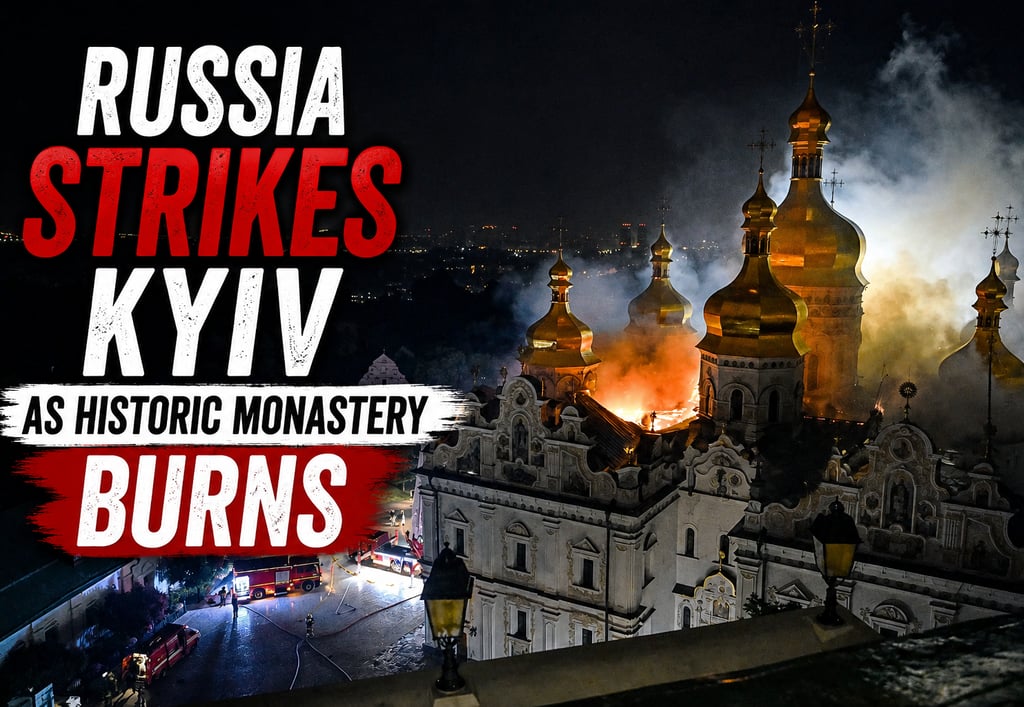
The most symbolic and internationally significant incident of the attack was the damage caused to the Kyiv Pechersk Lavra monastery. Founded in 1051, the monastery is one of the oldest and most important religious sites in Eastern Europe and is recognized as a UNESCO World Heritage Site. During the attack, the Dormition Cathedral caught fire, sending flames into the night sky and prompting emergency services to rush to the scene.
Images of firefighters battling the blaze quickly spread across international media, drawing widespread concern from religious leaders, historians, and foreign governments. Ukrainian President Volodymyr Zelenskyy described the attack as one of the most serious assaults on Christian cultural heritage since the beginning of the war. He argued that targeting a site with nearly a thousand years of history represented not only an attack on Ukraine but also on a significant part of Europe’s cultural and spiritual legacy.
Metropolitan Epifaniy, head of the Orthodox Church of Ukraine, condemned the strike and called for stronger international action. He questioned how much more destruction would be required before the global community took decisive measures to stop what he described as Russian terror against Ukraine and its people.
Ukraine’s Foreign Minister Andrii Sybiha announced that Kyiv would immediately begin procedures through UNESCO and other international organizations to seek formal responses to the attack on the historic monastery. Several European leaders also reacted strongly. Estonia’s Foreign Minister Margus Tsahkna joined international condemnation of the strikes and emphasized the importance of protecting cultural and religious heritage during armed conflicts.
The attacks were not limited to the capital. In Kharkiv, Ukraine’s second-largest city, a second Russian strike reportedly hit an area where emergency crews were already responding to earlier damage. According to Interior Minister Ihor Klymenko, four emergency rescuers and one municipal official were killed, while at least five additional people were injured. Such incidents have become increasingly controversial throughout the conflict because emergency workers often arrive before the threat of additional strikes has passed.
Further north in the Sumy region, local authorities reported that three people, including a child, were wounded in separate attacks. Air raid alerts remained active across large portions of Ukraine for several hours as officials monitored incoming threats throughout the night and early morning.
The scale of the Russian assault also triggered security concerns beyond Ukraine’s borders. Neighboring Poland, a member of both NATO and the European Union, temporarily scrambled fighter jets as a precaution against a possible violation of its airspace. Although Polish authorities later confirmed that no airspace breach had occurred, the move highlighted growing concerns that the conflict could create wider regional security risks.
While Ukraine was defending against the Russian offensive, it continued conducting its own long-range operations inside Russian-controlled territory. In recent months, Kyiv has increasingly targeted industrial facilities, military infrastructure, fuel depots, and logistics networks in an effort to weaken Russia’s war capabilities and increase pressure on Moscow.
Russian officials reported that a Ukrainian drone attack struck the city of Tula, an important industrial center south of Moscow. According to regional authorities, three people were killed and three others were injured, including a one-year-old child. Tula has long been associated with Russia’s defense industry, making it a strategic target in Ukraine’s campaign against military-related infrastructure.
Ukraine also carried out strikes aimed at disrupting supply routes to Crimea, the Black Sea peninsula annexed by Russia in 2014. Ukrainian forces reportedly targeted two bridges connecting Crimea to Russian-controlled territories. The operation comes as Crimea faces increasing logistical difficulties and fuel shortages. Military analysts believe that disrupting transportation networks could complicate Russia’s ability to move supplies and equipment into the region.
The latest escalation occurred against a backdrop of renewed diplomatic activity. Just one day before the attacks, President Zelenskyy said he had spoken with U.S. President Donald Trump about efforts to end the war. Their discussion took place ahead of a G7 meeting in France, where Ukraine is expected to remain a major topic of discussion among world leaders.
In recent weeks, Zelenskyy has publicly proposed direct talks with Russian President Vladimir Putin as part of a broader ceasefire initiative involving the United States and European partners. Britain, Germany, and France have expressed support for diplomatic efforts aimed at ending the conflict. However, the Kremlin has shown little willingness to embrace the proposal.
Russian officials stated that Trump also discussed Ukraine with Putin and emphasized the importance of ending the conflict. According to the Kremlin, the American president indicated that he was prepared to assist in efforts aimed at reaching a settlement. Despite these contacts, meaningful progress toward a peace agreement remains limited.
Many international observers believe the war has entered a particularly complex stage. Military operations continue to intensify, while diplomatic initiatives struggle to produce tangible results. At the same time, global attention has frequently shifted toward developments in the Middle East, creating concerns that the urgency of the Ukraine conflict could receive less international focus than in previous years.
The events of June 15 serve as a reminder that the war is no longer defined solely by battles on the front lines. Critical infrastructure, residential neighborhoods, industrial facilities, and even cultural and religious landmarks have increasingly become part of the conflict’s broader impact. The damage to Kyiv Pechersk Lavra has added a new cultural dimension to the ongoing war, raising questions about the protection of historical heritage during modern military conflicts.
With civilian casualties continuing to rise, infrastructure suffering repeated damage, and diplomatic negotiations making little visible progress, the path toward peace remains uncertain. The latest attacks on Kyiv, Kharkiv, Tula, and Crimea demonstrate that both Russia and Ukraine remain committed to pursuing military objectives even as international leaders continue searching for a political solution.
More than four years after the war began, Europe’s largest security crisis remains far from resolution. The violence witnessed on June 15 underscores how deeply the conflict continues to affect not only Ukraine and Russia but also regional stability, international diplomacy, cultural heritage, and global security as a whole.
Stay informed with the latest national and international news.
© 2026. All rights reserved.