
Russia Faces Fuel Crisis as Massive Kyiv Attack Escalates Ukraine War in 2026
Russia's brutal attack on Kyiv killed 13 and injured 90 while Ukraine's drone strikes sparked a growing fuel crisis in Russia. Explore the military, economic, and political impact of this latest phase of the Russia-Ukraine war.
Raja Awais Ali
7/2/20266 min read
Russia Under Growing Pressure from Ukraine as Devastating Kyiv Attack and Fuel Crisis Reshape the Balance of War
The Russia-Ukraine war has entered a complex phase in its fifth year. Developments far from the front lines are starting to influence the outcome of the conflict. Military operations dominate the battlefield, but economic pressure, infrastructure damage, public morale, and domestic stability are now becoming equally important in determining the war's direction.
On one side, Russia launched one of its largest aerial assaults of 2026 against Kyiv on the night of July 2. This attack resulted in at least 13 deaths and around 90 injuries. On the other side, Ukraine’s long-range drone campaign against Russian oil infrastructure has reportedly caused fuel shortages in parts of Russia. Farmers, transportation systems, public services, and ordinary citizens are affected across several regions.
These two major developments occurred almost simultaneously and highlighted a crucial reality: the war now impacts the economies, societies, and political structures of both countries, not just the military positions near the border.
During the night of July 2, Russia launched a massive aerial assault against Ukraine. According to Ukrainian military officials, Russia fired 496 drones and 74 missiles during the attack. The barrage included ballistic missiles, cruise missiles, and various long-range drones aimed at overwhelming Ukrainian air defenses.
Ukraine stated that its air defenses intercepted 476 drones and 48 missiles. However, despite these efforts, not every incoming target was stopped. Ukrainian authorities reported that 25 ballistic missiles and 12 drones successfully hit 33 locations across the country.
Kyiv was the primary target. Explosions echoed throughout the city for hours as air raid sirens blared. Thousands of residents sought safety underground in metro stations, shelters, and bunkers.
Families spent the night below ground, many bringing children, elderly relatives, pets, tents, blankets, and emergency supplies while waiting for the attacks to end.
Ukrainian Prime Minister Yulia Svyrydenko called the operation a brutal Russian assault. She noted that dozens of ballistic missiles had been launched, resulting in the heaviest damage to Kyiv.
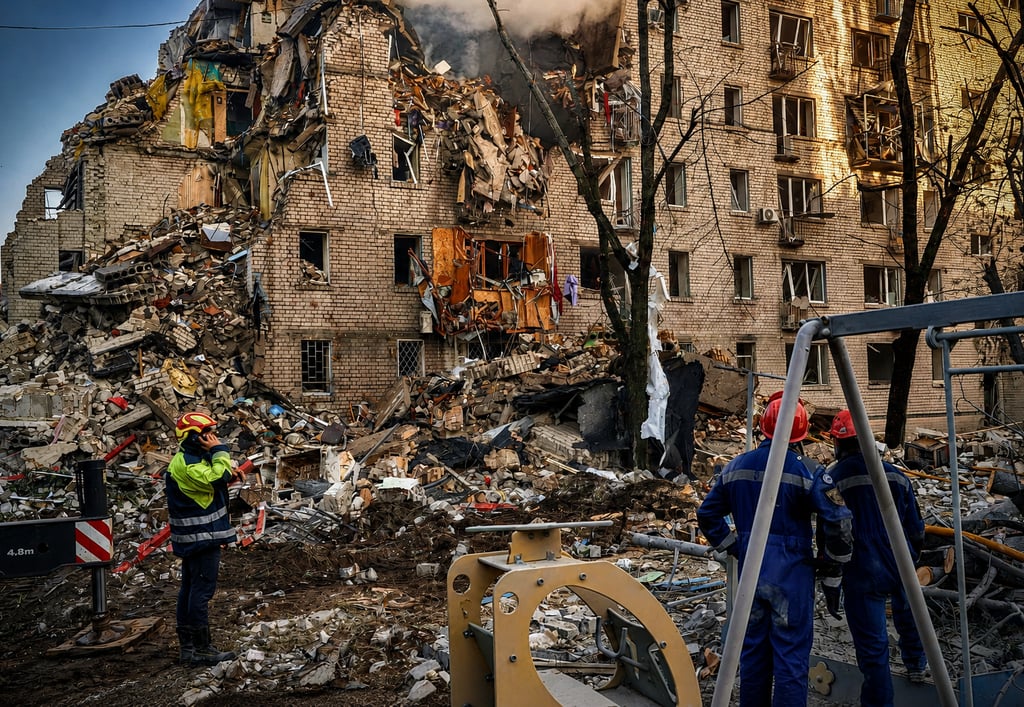
Authorities initially confirmed at least 13 fatalities and nearly 90 injuries. Among the victims were children, ambulance station staff, paramedics, and drivers. Rescue teams searched through damaged buildings throughout the night and into the morning, as several residents remained trapped under collapsed structures.
Kyiv Mayor Vitali Klitschko declared a day of mourning for the city, stating that nearly every district within the metropolitan area of almost three million residents suffered damage. Several apartment buildings were completely destroyed, while dozens of vehicles were buried under rubble or engulfed in flames.
A nine-story residential building on the eastern side of the Dnipro River suffered severe destruction, forcing emergency workers to clear debris until sunrise. Fires broke out in several districts, and significant damage was reported near Shevchenko Boulevard, where flames consumed the upper floors of a high-rise building.
Kyiv resident Iryna Plekhova posted pictures of her destroyed home on social media. She described her apartment burning amid the attack. She said her husband helped neighbors escape while she contacted emergency services. According to her, her family had no home to return to.
Only hours before the attack began, Ukrainian President Volodymyr Zelenskyy shortened his visit to Dublin, Ireland, and returned to Ukraine after warning citizens about the potential for a major Russian strike.
Russia's Ministry of Defense later claimed the operation targeted only military facilities, energy infrastructure, and airfields. Moscow described the strikes as retaliation for recent Ukrainian attacks on Russian civilian infrastructure.
Russian authorities also claimed they intercepted 327 Ukrainian drones during the same night.
At the same time, Ukraine confirmed it attacked the Kstovo oil refinery in Russia’s Nizhny Novgorod region. Ukraine's General Staff stated the refinery was successfully targeted. Russian officials admitted the attack killed one person, injured four others, and damaged an industrial facility.
For months, Ukraine has been adjusting its military strategy with long-range drone strikes deep into Russian territory. These attacks have mainly focused on oil refineries, fuel storage sites, depots, and critical energy infrastructure that supports both civilian and military operations.
Moscow initially dismissed the attacks as minor disruptions. However, the consequences are becoming increasingly visible across Russia.
Damage to refineries and storage facilities has disrupted domestic fuel production and distribution networks, leading to gasoline and diesel shortages in several regions. Supplies have become more restricted, and local authorities struggle to maintain stable deliveries.
Russia's agricultural sector is particularly worried. Farmers fear that delayed fuel supplies could significantly impact harvesting during this crucial farming season. In some areas, agricultural workers reportedly had to buy fuel from regular gas stations to run tractors and harvesting equipment. Certain places have even restricted customers from filling fuel containers altogether.
Across Russia, people have started sharing maps and updates on social media about which petrol stations still have fuel available and where waiting times are shorter.
Videos circulating online show drivers standing in long lines, arguing, and competing for limited fuel supplies.
One widely shared video titled "The Ultimate Luxury 2026" featured a man pouring gasoline from a jerry can into a lawn mower. He joked that simply having fuel had become one of the greatest luxuries in the country.
Online search trends reflect growing public concern. Reports show searches for "How to siphon fuel" skyrocketed, jumping from about 697 to more than 9,300 searches in a month.
The situation has worsened enough to impact public services.
In Russia's eastern Zabaykalsky region, local authorities suspended several bus routes due to fuel shortages. A waste management company temporarily halted garbage collection in four districts due to supply issues.
Residents worry that if shortages continue, food prices could surge since much of Russia's domestic supply chain relieson road transport to move goods between regions.
Russian President Vladimir Putin publicly acknowledged the issue for the first time. He stated that the government is taking steps to stabilize the market, emphasizing that fuel supplies for agriculture are vital for successful harvests.
Deputy Prime Minister Alexander Novak also stated that authorities are working to control the situation.
The crisis is so severe that Russia, despite being one of the world's largest oil producers, started importing gasoline from abroad.
Russia has begun purchasing fuel from India through maritime routes, while Kazakhstan agreed to provide 50,000 metric tons of gasoline in July and August.
This situation is unusual, given Russia's status as a top energy producer. However, ongoing Ukrainian strikes against refining infrastructure appear to have greatly reduced domestic processing capacity.
Economic pressure continues to grow. Recent surveys suggest that Russian citizens are experiencing the worst economic sentiment in nearly two decades.
Analysts believe that if fuel shortages persist, the effects may reach beyond the economy and logistics, potentially impacting public support for the war itself.
Meanwhile, European Union foreign policy chief Kaja Kallas announced plans for more sanctions against companies, suppliers, and organizations supporting Russia's military and defense sectors following the latest attacks on Ukraine.
She stated that further attacks on civilian areas would face stronger international restrictions and penalties.
Ukrainian Foreign Minister Andrii Sybiha again urged Western allies for additional air defense systems. He argued that Kyiv endured another horrendous night and that modern defense capabilities are critical to protect civilians.
There has been little progress in diplomatic efforts.
President Volodymyr Zelenskyy renewed his offer for direct talks with Russian President Vladimir Putin to end a conflict that has lasted over four years. However, the Kremlin has consistently rejected similar proposals and shows little interest in direct presidential negotiations under current conditions.
Since Russia launched its full-scale invasion in February 2022, thousands of Ukrainian civilians have died during missile and drone attacks.
Russia continues to deny it intentionally targets civilian populations, claiming its military operations focus only on infrastructure that aids Ukraine's war effort.
At the same time, Ukraine has continued to carry out drone strikes against Russian territory and Russian-controlled areas; however, the scale of these attacks is much smaller than Russia's air campaigns.
Recent events suggest that the conflict has entered a new phase. Russia is trying to keep strong pressure on Ukraine through large missile and drone attacks, while Ukraine is increasingly focused on undermining Russia's economy, supply networks, and public confidence by hitting energy infrastructure deep within Russia.
The brutal attack on Kyiv and the rising fuel crisis in Russia show that this war is no longer just about battlefield advances and land gains.
Instead, it has become a wider struggle that directly impacts daily life, economic stability, political decisions, and the long-term future of both countries. As military pressure increases and economic effects reach deeper into civilian life, the conflict seems to be moving into a phase where endurance, resilience, and domestic stability might be just as crucial as military power in shaping the eventual outcome of the war.
Stay informed with the latest national and international news.
© 2026. All rights reserved.