
Putin’s Scaled-Back Victory Day Parade Reflects Growing Pressure of Ukraine War in 2026
Russia marked Victory Day 2026 with a reduced military parade in Moscow as the Ukraine war continues to strain the Kremlin politically, militarily, and economically. Vladimir Putin used the event to project strength while Donald Trump pushed for a temporary ceasefire between Russia and Ukraine.
Raja Awais Ali
5/9/20264 min read
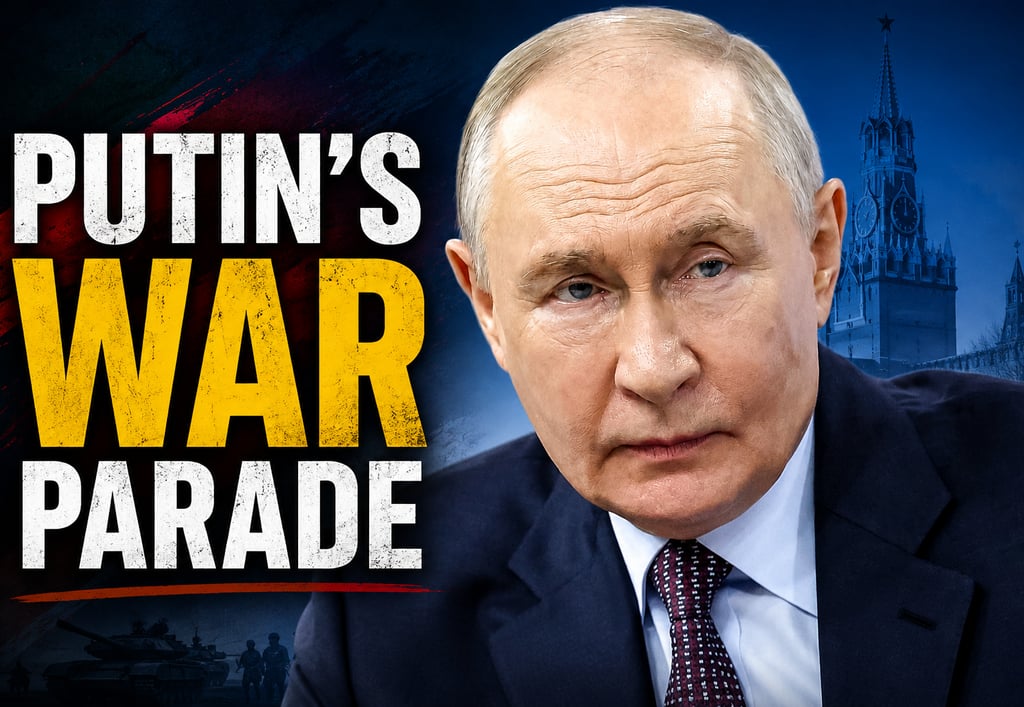
Putin’s Scaled-Back Victory Day Parade Reflects Growing Pressure of Ukraine War in 2026
Russia marked its annual Victory Day celebrations on May 9, 2026, with one of the most limited military parades seen in Moscow in recent years as the ongoing Ukraine war continues to reshape the country’s political and military reality. The event, traditionally designed to showcase Russian military strength and national pride, took place under the shadow of a prolonged conflict that has now entered its fifth year and remains the deadliest war in Europe since World War Two.
Victory Day is Russia’s most important national ceremony, commemorating the Soviet Union’s victory over Nazi Germany in 1945. Millions across Russia remember the enormous sacrifices made during what Russians call the Great Patriotic War, when around 27 million Soviet citizens lost their lives. For decades, the annual Red Square parade symbolized Soviet and later Russian military power, often featuring tanks, missile systems, and advanced strategic weapons moving through the center of Moscow.
This year’s event, however, looked noticeably different.
For the first time in years, no tanks or large military vehicles rolled through Red Square. Instead of displaying heavy military hardware in person, Russia presented many of its advanced weapons systems on giant digital screens placed around the parade grounds and on state television broadcasts. The presentation included the Yars intercontinental ballistic missile, the Arkhangelsk nuclear submarine, the Peresvet laser weapon, Su-57 stealth fighter jets, the S-500 air defense system, drones, and modern artillery systems.
The scaled-back display highlighted how the Ukraine war has changed Russia’s military priorities. Large amounts of military equipment remain deployed near the battlefield, while security concerns and the threat of possible Ukrainian attacks have forced Moscow to organize a more controlled and cautious ceremony compared to previous years.
Russian soldiers and sailors marched across Red Square during the parade, including troops who had served in Ukraine. North Korean soldiers who reportedly fought alongside Russian forces in the Kursk region were also seen participating in the ceremony, underlining the growing military cooperation between Moscow and Pyongyang during the conflict.
Russian President Vladimir Putin attended the event and delivered an eight-minute speech focused heavily on the Ukraine war. Standing near Lenin’s Mausoleum, Putin compared today’s conflict with the Soviet struggle against Nazi Germany during World War Two. He claimed Russian troops were once again defending the country against what he described as an aggressive Western-backed threat supported by NATO.
Putin praised Russian soldiers fighting in Ukraine and said their actions reflected the courage and sacrifice shown by Soviet troops during the Second World War. His speech was aimed at strengthening domestic support for the war while reinforcing the Kremlin’s message that Russia remains engaged in a historic struggle against Western influence.
At the same time, the ceremony also reflected the pressure building around the Kremlin as the war continues without a decisive outcome.
Despite Russia controlling significant territory in eastern and southern Ukraine, the conflict has become extremely costly for both sides. Hundreds of thousands of soldiers and civilians have been killed or injured since the invasion began in 2022. Entire Ukrainian cities and infrastructure networks have been heavily damaged, while Russia’s economy continues to face growing pressure from military spending, sanctions, and international isolation.
Although the Russian economy has avoided collapse and continues to operate through energy exports and wartime industrial production, many analysts believe the long-term economic burden of the war is becoming increasingly difficult for Moscow to manage. Rising military costs and political uncertainty have also created concerns among some nationalist and pro-war groups inside Russia.
Former Russian intelligence officer and nationalist figure Igor Girkin, who has frequently criticized the Kremlin’s handling of the war, warned that the crisis could deepen further if the current situation continues. His comments reflected broader frustration among hardline Russian voices who believe the war has not delivered the decisive victory that many expected at the start of the invasion.
Meanwhile, diplomatic efforts to reduce tensions showed limited progress.
U.S. President Donald Trump announced a temporary three-day ceasefire between Russia and Ukraine from Saturday through Monday. Both Moscow and Kyiv agreed to support the pause in fighting and also approved an exchange of 1,000 prisoners.
Speaking in Washington, Trump described the Russia-Ukraine war as the worst conflict in terms of loss of life since World War Two. He said approximately 25,000 young soldiers were dying every month and expressed hope that the temporary ceasefire could eventually lead to a larger peace agreement.
So far, there were no major reports of ceasefire violations during the first phase of the agreement, offering a small sign that both sides may be open to limited diplomatic engagement despite the ongoing conflict.
Ukrainian President Volodymyr Zelenskyy responded cautiously to the Moscow parade and issued a sarcastic statement suggesting Ukraine would “allow” Russia’s Victory Day celebrations to proceed without interference. His comments reflected the continuing political hostility between Kyiv and Moscow even as temporary ceasefire discussions moved forward.
The 2026 Victory Day parade ultimately became more than a military ceremony. It served as a reflection of modern Russia itself — a country still determined to project strength and national unity, yet increasingly shaped by the realities of a long and exhausting war.
While the Kremlin attempted to present confidence and resilience during one of Russia’s most symbolic national events, the reduced scale of the parade revealed the growing impact of the Ukraine conflict on Russia’s military image, economy, international position, and political future.
As the war continues with no clear resolution in sight, even Russia’s most powerful national celebration now carries visible signs of uncertainty beneath the traditional display of patriotism and strength.
Stay informed with the latest national and international news.
© 2026. All rights reserved.