
Pakistan-Afghanistan Tensions 27 February 2026: Airstrikes, Open War, Refugees & Historical Analysis
Explore the latest Pakistan-Afghanistan crisis on 27 Feb 2026: airstrikes on Taliban forces, declaration of open war, refugee expulsions, security concerns, and historical context in a detailed analysis.
Raja Awais Ali
2/27/20263 min read
Pakistan-Afghanistan Tensions 27 February 2026: Airstrikes, “Open War” Declaration, Refugees, and Historical Analysis
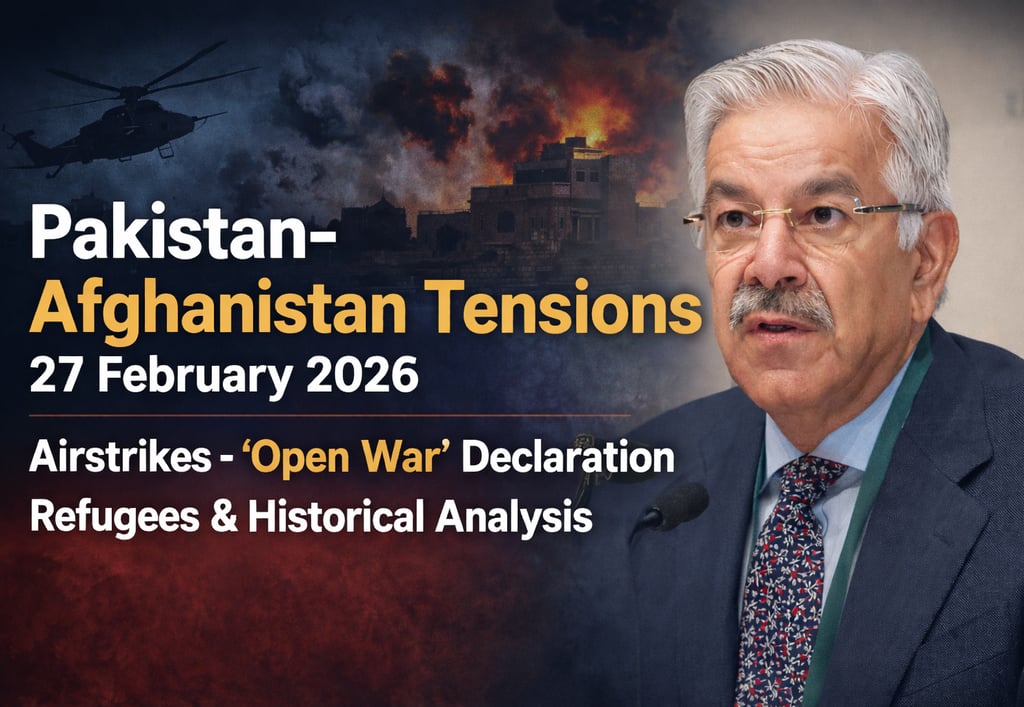
On 27 February 2026, relations between Pakistan and Afghanistan reached an extremely dangerous turning point when Pakistan carried out direct air and ground operations on Afghan soil, targeting Taliban government military centers. This marked the first time Pakistan directly attacked Taliban forces, rather than just alleged militant groups or Tehrik-e-Taliban Pakistan (TTP) hideouts, creating a historic rift between the neighboring countries. Pakistan’s Defence Minister Khawaja Muhammad Asif stated, "Our cup of patience has overflowed. Now it is open war between Pakistan and Afghanistan." Meanwhile, Taliban spokesperson Zabihullah Mujahid condemned the attack as a violation of Afghanistan’s sovereignty and announced retaliatory operations.
The Pakistani Air Force targeted Taliban military installations in Kabul, Kandahar, and Paktia. According to Pakistan, the strikes resulted in 133 Taliban fighters killed and over 200 injured, with 27 posts destroyed and 9 captured. In response, the Taliban claimed 55 Pakistani soldiers killed, 19 posts seized, 8 Taliban fighters killed, and 11 wounded. Afghan monitoring sources confirmed 13 civilian deaths, highlighting the human toll. As often happens in wartime, the figures reported by both sides vary significantly.
Reports emerged of intense artillery, air raids, and drone exchanges along border areas. The Taliban claimed to have launched drone strikes on Pakistani military positions, while Pakistan’s Minister of Information, Attaullah Tarar, stated all drones were shot down with no casualties. An eyewitness in Kabul described hearing a plane at night, dropping two bombs, followed by spontaneous explosions in an ammunition depot, causing widespread panic among residents.
Pakistan’s Punjab province was placed on high alert, with 90 Afghan nationals moved to detention centers. Afghan media also shared images of suicide attack squads in Nangarhar, prepared for major attacks on strategic targets.
The crisis poses a serious threat to refugees. Millions of Afghans live in Pakistan, mostly having fled war over the last two decades. Following the escalation, Pakistan expelled or relocated over 90,000 Afghan nationals to temporary detention facilities. Government sources indicated that some were allegedly involved in terrorist activities or extremist networks inside Pakistan. Security agencies claim certain Afghan refugees were assisting militant operations, bombings, or extremist groups across Pakistani cities. Consequently, border and urban security measures were intensified, including stricter surveillance, monitoring, and arrests. While these steps raised humanitarian concerns, Pakistan deemed them necessary for national security.
This escalation did not occur suddenly. After the Taliban returned to power in 2021, relations initially seemed stable, but terrorist attacks in Khyber Pakhtunkhwa and tribal districts surged. Pakistan accused TTP elements of operating from Afghan territory, while Kabul rejected the claim.
In 2022 and 2023, skirmishes occurred along Torkham and Chaman borders, causing casualties on both sides. The Durand Line border dispute further complicated relations. In 2024, Pakistan conducted limited airstrikes, with Afghan forces responding at border posts. By 2025, TTP and other extremist attacks increased, heightening Pakistan’s internal security concerns. In October 2025, dozens of soldiers were killed, though Turkey, Qatar, and Saudi Arabia mediated a temporary ceasefire. Yet this only provided a temporary calm, and by February 2026, tensions escalated to the point where an open war declaration became inevitable.
Residents of border villages are fleeing to safer areas. Hospitals have declared emergencies, schools have been temporarily closed, and civilian fear is widespread. Casualties and injuries continue to rise. The refugee crisis has intensified, adding social and economic pressure in an already strained region. The movement of displaced people affects food, healthcare, education, and employment, complicating the humanitarian crisis further.
Significantly, some Afghan refugees residing in Pakistan were reportedly involved in extremist activities, compelling Pakistan’s security forces to implement mass arrests, drone monitoring, and strict checks. These actions highlight the delicate balance between humanitarian concerns and national security.
The conflict has raised global concerns. The United Nations called for an immediate ceasefire and negotiations. Russia, China, Turkey, and Saudi Arabia are mediating, while Iran has offered assistance, particularly amid its ongoing nuclear talks with the United States. Analysts warn that continued escalation could result in prolonged border clashes, civilian casualties, economic disruption, and a worsening refugee crisis, destabilizing South and Central Asia.
Pakistan is a nuclear power with superior military capabilities, while Afghanistan lacks such resources. However, the Taliban’s expertise in guerrilla and drone warfare makes them a formidable opponent. Experts caution that uncontrolled escalation could lead to continuous border skirmishes, civilian harm, and increased refugee movements, threatening regional peace and long-term economic stability.
The events of 27 February 2026—including airstrikes, drone attacks, refugee expulsions, and the declaration of open war—represent the culmination of five years of rising tension, failed negotiations, border clashes, terrorism allegations, and refugee security concerns. These developments mark a decisive turning point for the region. The coming days will determine whether both countries move towards peace negotiations or if the conflict evolves into a long-term military confrontation, with serious humanitarian, political, and regional consequences.
Stay informed with the latest national and international news.
© 2026. All rights reserved.