
Pablo Escobar: The Man Who Burned Money, Challenged the State, and Built the World’s Deadliest Drug Empire
A fully researched true story of Pablo Escobar—his rise, wealth, violence, politics, burning millions in cash, and how he was finally tracked and killed.
Raja Awais Ali
1/5/20264 min read
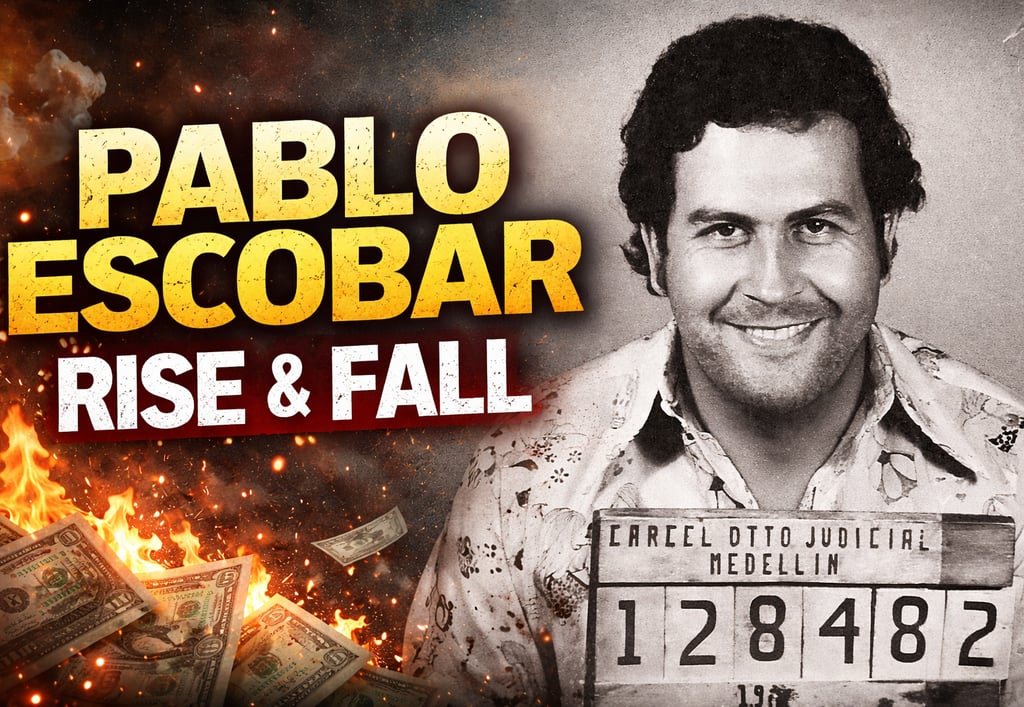
Pablo Escobar: The Man Who Burned Money, Bought Fear, Challenged the State, and Died Trapped by His Own Power
Pablo Emilio Escobar Gaviria’s life is not merely the story of a drug trafficker; it is a dark chapter in modern history that exposes how unchecked wealth, violence, political weakness, and global demand for narcotics can create a monster powerful enough to paralyze an entire nation. Escobar was a man who rose from poverty to unimaginable wealth, commanded fear stronger than law, and ruled not only criminal networks but also politicians, judges, and institutions. At his peak, he was wealthier than many governments, yet he died alone on a rooftop, hunted and cornered by the very terror he had created.
Born on December 1, 1949, in Rionegro, Colombia, Pablo Escobar was the son of a farmer and a schoolteacher. His upbringing was modest, but his ambitions were extreme. From a young age, he rejected the idea of a conventional life. Poverty, to him, was humiliation, and wealth was power. As a teenager, he entered crime through petty scams, smuggling, and theft. These early activities were not driven by survival but by a desire to dominate. Colombia at the time was politically fragile, law enforcement was underfunded, and corruption was widespread—conditions that allowed criminal networks to grow unchecked.
In the 1970s, cocaine demand in the United States exploded, and Escobar recognized an opportunity others could not yet see. He established supply chains linking coca farmers in Peru and Bolivia to processing laboratories in Colombia. From there, cocaine was smuggled into the United States using small aircraft, hidden compartments, speedboats, and secret airstrips. This operation soon evolved into what became known as the Medellín Cartel. Unlike traditional criminals, Escobar ran his cartel like a multinational corporation, with logistics, security, accounting, and enforcement divisions.
By the early 1980s, Escobar controlled nearly 80% of the global cocaine trade. At its height, his organization smuggled up to 15 tons of cocaine per day into the United States. His weekly income exceeded $400 million, and his estimated net worth reached $30 billion. Forbes magazine listed him among the world’s richest individuals for several consecutive years—an unprecedented recognition of a criminal enterprise. His wealth was so vast that banks could not absorb it. Cash was buried in fields, hidden in walls, and stored in warehouses, where rats and humidity destroyed billions. It is estimated that over $2 billion annually was lost simply due to poor storage.
Escobar’s relationship with money became almost surreal. One of the most documented and symbolic incidents occurred while he was hiding in the mountains with his family during the manhunt. Temperatures dropped dangerously low, and his young daughter was suffering from hypothermia. With no wood or fuel available, Escobar did something unthinkable—he burned nearly $2 million in cash to keep her warm. The story was later confirmed by family members. It perfectly illustrates how money, once the source of his power, had lost all real meaning.
To maintain control, Escobar enforced a brutal policy known as “Plata o Plomo”—silver or lead. Officials were given a choice: accept bribes or be killed. Judges, police officers, prosecutors, journalists, and politicians were assassinated if they refused cooperation. Fear became institutionalized. Courts stopped functioning, police resigned, and entire cities lived under terror.
Despite his brutality, Escobar carefully crafted a public image. He invested heavily in poor neighborhoods, building housing projects, schools, football fields, and clinics. Entire communities benefited from his money, and many residents viewed him as a benefactor rather than a criminal. This strategy earned him political leverage, and in 1982, he was elected as an alternate member of Colombia’s Congress. However, investigative journalists and reformist politicians exposed his criminal background, leading to his expulsion from politics. From that moment, Escobar declared war on the state.
His greatest fear was extradition to the United States. He believed that American prisons would strip him of his influence forever. To prevent extradition, he launched an unprecedented terror campaign. In 1989, Avianca Flight 203 was destroyed by a bomb, killing 107 civilians. Presidential candidate Luis Carlos Galán, who supported extradition laws, was assassinated. Bombings targeted police stations, government buildings, and public areas. Colombia became one of the most violent countries in the world.
During this period, Escobar made one of the most astonishing offers in modern criminal history. He proposed to pay off Colombia’s entire national foreign debt, estimated at nearly $10 billion, in exchange for immunity from extradition. The government rejected the offer, but the proposal itself revealed how a criminal had accumulated power rivaling that of the state.
In 1991, desperate to reduce violence, the Colombian government reached a controversial deal with Escobar. He surrendered under the condition that he would be imprisoned in a facility of his own design. The prison, known as La Catedral, was a luxury compound featuring private rooms, a football field, a bar, telephones, and Escobar’s own guards. From inside, he continued running his cartel and ordering executions. When authorities attempted to transfer him to a standard prison in 1992, he escaped with ease.
Following his escape, an elite manhunt known as the Search Bloc was launched, involving Colombian special forces with support from the U.S. DEA and intelligence agencies. Advanced surveillance, radio interception, and phone signal tracking were used. Escobar constantly moved, but his emotional dependence on his family became his weakness. He continued making phone calls, especially to his son.
On December 2, 1993, one day after his 44th birthday, a phone call was traced to a neighborhood in Medellín. Security forces surrounded the house. Escobar attempted to flee across rooftops but was shot during the chase. Official reports state he was killed by police, while some family members claim he committed suicide, having sworn never to be captured alive. Either way, his reign ended there—on a rooftop, isolated and hunted.
After Escobar’s death, violence in Colombia decreased, but drug trafficking did not disappear. Other cartels filled the vacuum, though none achieved the same level of power. Today, Escobar is remembered in Colombia not as a hero, but as a terrorist responsible for thousands of deaths and decades of trauma. Many Colombians strongly oppose the romanticization of his life in popular media.
Pablo Escobar’s story is a warning written in blood. He proved that wealth without limits destroys morality, that fear cannot replace law forever, and that power built on violence inevitably collapses. The man who once burned millions to survive a cold night ultimately burned an entire nation—and was consumed by the flames himself.
Stay informed with the latest national and international news.
© 2026. All rights reserved.