
Middle East War 2026: Latest Verified Update – Iran’s Assault on Israel, Casualties, Oil Crisis & Global Impact | 15 March Report
Complete 15 March 2026 report on Iran’s major attack on Israel, Trump briefing, confirmed casualties, Strait of Hormuz oil crisis, global impact, and energy market reactions.
Raja Awais Ali
3/15/20266 min read
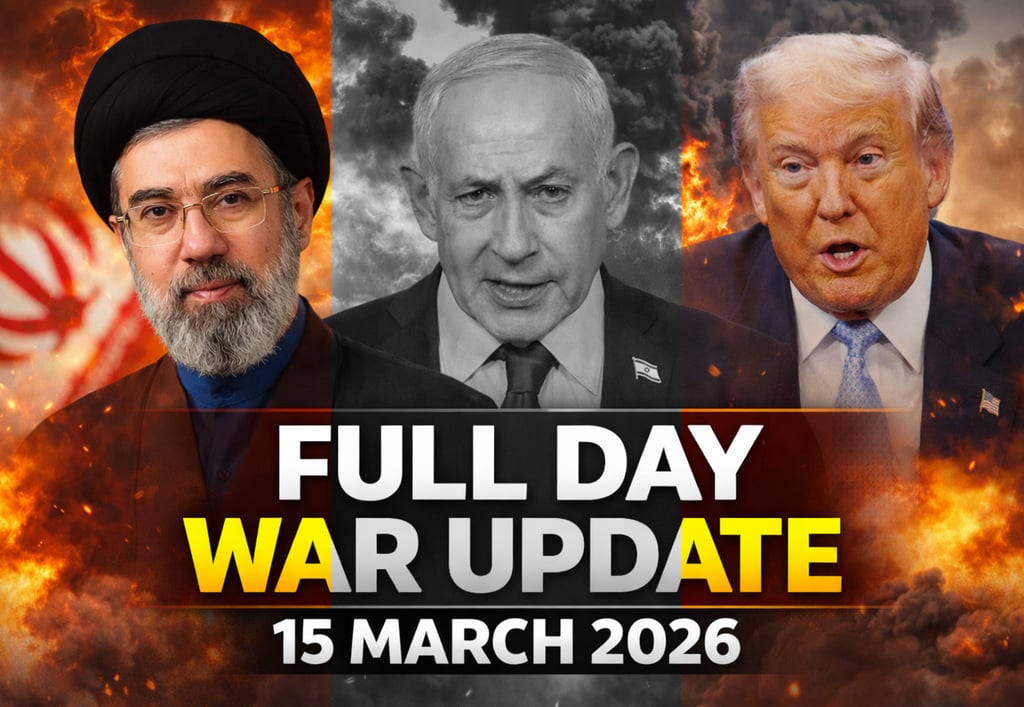
Middle East War 2026: 15 March Latest Update – Iran’s Major Assault on Israel, Trump Briefing, Casualties, Oil Crisis & Global Impact
As of 15 March 2026, the conflict between Iran, the United States, and Israel has escalated far beyond a limited regional confrontation, evolving into one of the most serious geopolitical crises of the decade. What began in late February with targeted strikes has turned into sustained military engagement across multiple fronts, amplifying human suffering, destabilizing global energy markets, and triggering broad diplomatic ramifications.
This report incorporates the most recent verified developments — including the confirmed major attacks Iran launched against Israel on 15 March, the latest casualty figures, the Trump administration’s position, the expanding oil crisis, the unprecedented global energy stock releases, and the broader international impact through economic, strategic, and humanitarian lenses.
On 15 March, several Iranian cities witnessed coordinated and powerful strikes, with explosions reported in Isfahan, Shiraz, Hamadan, Kerman, and the southern suburbs of Tehran. Military installations, missile launch sites, defense command centers, and security depots were primary targets. While these operations focused on strategic sites, several attacks also impacted adjacent residential zones, resulting in civilian casualties and amplifying the crisis’s human toll. The scale and intensity of these explosions indicated a deliberate escalation in Iran’s operational tempo, reflecting a strategic decision to demonstrate both capability and resolve.
In direct response to ongoing U.S. and Israeli military action, Iran launched a massive and sustained airborne offensive against Israel on the same day. This unprecedented attack wave included hundreds of ballistic missiles and unmanned aerial drones targeting Israeli military positions, border infrastructure, critical utilities, and urban centers. The breadth of the assault marked one of the most intense aerial campaigns directed at Israeli territory since the conflict began.
Israeli air defense systems engaged these incoming threats, successfully intercepting many missiles and drones. However, several projectiles breached defensive perimeters and struck populated areas, causing significant damage to civilian infrastructure, including residential districts, major transportation arteries, power grids, and water supply networks. These breaches heightened civilian risk, disrupted daily life, and fueled intense pressure on emergency response systems in multiple cities.
As these attacks unfolded, emergency sirens sounded throughout Israeli cities, prompting residents to seek immediate shelter in secure locations. Initial ground reports indicate dozens of civilian injuries in urban centers where explosive fragments and falling debris caused widespread distress. First responders described chaotic and fast-moving scenarios as rescue teams worked relentlessly to evacuate affected districts, treat the wounded, and clear debris to restore basic services.
Alongside the ballistic strikes, Iranian forces deployed a wave of advanced attack drones engineered to bypass conventional air defenses. Some of these drones penetrated deeper into Israeli airspace than previous waves, prompting a multi-layered response from ground-based and aerial defense systems. The scale and sophistication of this drone offensive revealed Iran’s evolving tactical capabilities and its ability to project aerial power beyond its borders, signaling a shift toward more technologically coordinated operations.
The conflict’s theater has grown increasingly complex due to unintended impacts on international actors. In one incident, a fragmented Iranian missile struck a building near a facility used by foreign diplomatic personnel, causing structural damage. While there were no immediate confirmed fatalities tied to that strike, the incident underscored the risks faced by non-combatants, humanitarian staff, and international officials in active war zones.
The cumulative toll of these sustained military exchanges is grim. In Iran, more than 2,000 confirmed fatalities have now been recorded, involving both military personnel and civilians. Thousands more have sustained injuries, with hospitals overwhelmed and healthcare systems in major cities operating under extreme strain. In Israel, confirmed casualties include several dozen deaths and hundreds of injured civilians, many of whom remain in critical condition as emergency services struggle to triage and stabilize victims.
The United States military has also reported significant losses. U.S. defense officials confirmed that at least 13 American service members were killed in the region during the course of operations, with additional personnel wounded. These fatalities highlight the heightened risks associated with forward deployment in a contested and unstable theater of operations, emphasizing the broader strategic stakes for Washington and its allies.
On the political front, U.S. President Donald Trump delivered a high-profile briefing on 15 March, reiterating that the United States is not prepared to agree to a ceasefire at this stage. President Trump emphasized that American and allied operations are focused on degrading Iran’s military infrastructure and protecting regional stability. He warned that further escalatory actions by Tehran would be met with additional military response, underscoring Washington’s commitment to countering Iranian influence in the region.
During the briefing, President Trump also urged allied nations to participate in securing the Strait of Hormuz, a globally crucial energy corridor through which nearly 20% of the world’s crude oil supply transits. The strait has become a flashpoint for economic disruption, with frequent threats to maritime traffic prompting many commercial vessels to avoid transit, leaving more than 150 tankers and cargo ships anchored outside its thresholds.
Reports confirm that at least 11 commercial tankers have sustained damage from missile or drone debris connected to regional hostilities, and several crew members have been reported missing or deceased, further complicating maritime operations and trade logistics.
Energy markets reacted sharply to the conflict’s escalation. As of 15 March, Brent crude oil prices surged to $126 per barrel, soaring to levels not seen in years. Analysts warn that if disruptions persist or if the Strait of Hormuz becomes further restricted, prices could spike to $150–$200 per barrel, exacerbating inflationary pressures and raising energy costs for consumers and industries worldwide.
To mitigate immediate supply disruptions, the International Energy Agency (IEA) and global energy coordinating bodies announced an emergency release of over 400 million barrels of oil from strategic reserves — the largest coordinated release in history. This measure is intended to alleviate market strain and reassure international buyers that supply continuity will be maintained wherever possible.
In addition to the energy supply response, the United States has implemented a temporary relaxation of certain restrictions on Russian crude oil, permitting limited volumes to flow into global markets. This adjustment is framed as a short-term response to Gulf supply volatility and is explicitly intended to bolster market liquidity. Officials have reiterated that this policy shift is temporary, with sanctions expected to be reinstated once regional stability is restored.
Regionally, the conflict’s effects continue to reverberate across Gulf Cooperation Council (GCC) countries — including Saudi Arabia, the United Arab Emirates, Bahrain, and Qatar. Energy infrastructure across these states has been placed on heightened alert, and several export facilities have seen reduced operational capacity due to ongoing security concerns. Ports throughout the region have implemented elevated defensive protocols, and non-essential operations have been temporarily suspended to ensure personnel safety. Drone and missile threats persist at major facilities, including the UAE’s Fujairah oil terminal, intensifying risks to export flows. Additionally, Iran’s Kharg Island, a central oil export hub, remains at risk due to regional hostilities, further heightening global energy supply tensions, even though critical infrastructure has largely been spared.
The broader economic impact of continued hostilities is palpable. Financial markets worldwide have exhibited heightened volatility, with energy sector stocks reaching record valuations while industrial and manufacturing sectors experience downturns tied to rising fuel costs and disrupted supply chains. Economists warn that prolonged conflict could have enduring repercussions for global economic growth, consumer prices, and investor confidence.
Beyond the economic dimension, the war has sparked significant humanitarian displacement. Tens of thousands of Iranians have fled major urban centers under assault. Likewise, many Israeli residents from high-threat areas have relocated to safer districts. Along Gulf coastal cities, evacuation advisories have been issued due to fears of spillover attacks, intensifying stress on already strained civic infrastructures.
International diplomatic channels have redoubled calls for de-escalation. Emergency sessions of global security organizations have emphasized the urgent need for negotiations and protection of civilians. Humanitarian aid convoys have been dispatched to conflict-affected areas, delivering emergency food, medical supplies, and shelter support to displaced families.
Despite diplomatic efforts, analysts warn that unless negotiations begin soon, the conflict may widen. Militant proxy groups allied with Iran, such as Hezbollah, may increase their involvement, potentially drawing additional regional actors into direct confrontation. Tehran has also issued direct threats against Israeli leadership, further heightening political tensions. The continuing threat of closure or partial blockade of the Strait of Hormuz represents one of the greatest risks to the global economy, as such an outcome would severely disrupt energy supplies, trade flows, and financial markets.
As of 15 March 2026, the Middle East remains at a critical juncture. The scale of current hostilities, rising casualties, looming energy crisis, threats to key oil hubs, and widening geopolitical tensions indicate that the conflict’s consequences extend far beyond the immediate region. Without urgent diplomatic intervention, coordinated international action, and a viable pathway to ceasefire negotiations, the crisis risks deepening further, reshaping global political and economic dynamics for years to come.
Stay informed with the latest national and international news.
© 2026. All rights reserved.