
Middle East War 2026: US and Israel Launch Major Strikes on Iran, Missile Retaliation Sparks Flight Chaos
US and Israel begin major combat operations against Iran on Feb 28, 2026. Missile retaliation, 40% flights cancelled, rising global tensions explained.
Raja Awais Ali
2/28/20264 min read
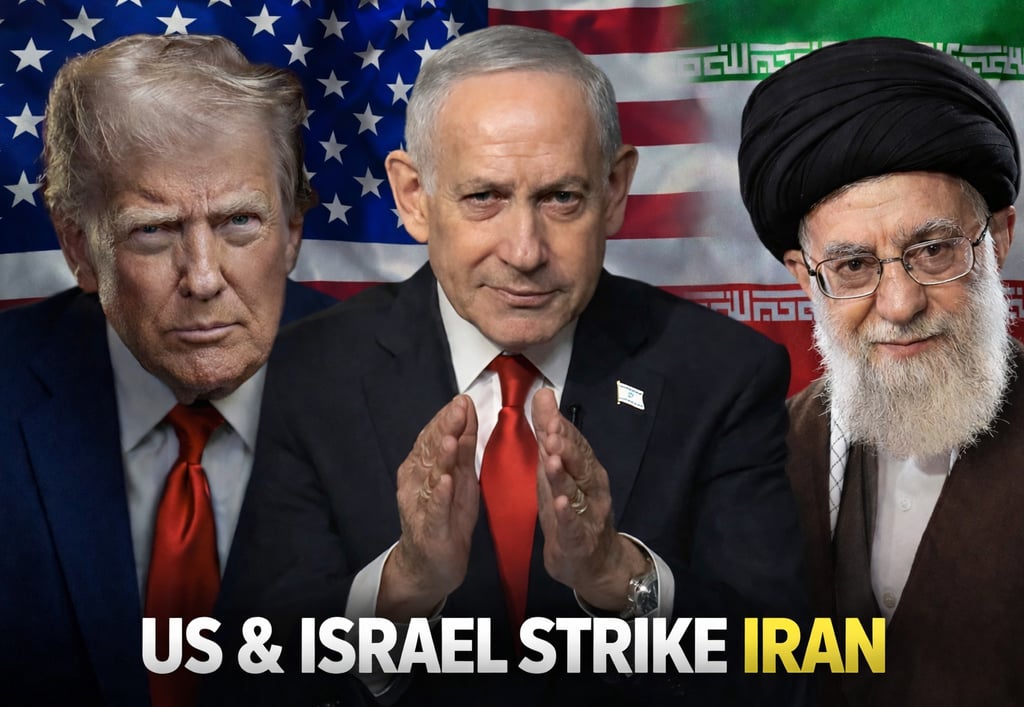
Middle East on the Brink of Open War: United States and Israel Launch Major Strikes on Iran, Missile Barrages Follow, 40% Flights Cancelled
February 28, 2026 has become a defining and explosive moment in the history of the Middle East. After months of rising tensions, covert operations, and diplomatic deadlock, the situation has escalated into open military confrontation. On Saturday morning, U.S. President Donald Trump announced that the United States had initiated “major combat operations” against Iran. According to his statement, the objective of the operation is to dismantle Iran’s ballistic missile capabilities and neutralize its naval forces.
Within hours of the announcement, Israeli officials confirmed that Israel was also conducting strikes on strategic targets inside Iran. What initially appeared to be a limited aerial exchange has now evolved into a coordinated and sustained military campaign.
According to U.S. defense officials, the operation has been named “EPIC FURY” and is expected to continue for several days rather than being a single wave of attacks. Pentagon briefings indicate that targets include missile depots, launch facilities, naval installations, and key military infrastructure. President Trump acknowledged in a video address that American casualties are possible, stating that war carries risks but describing the operation as necessary “to secure the future.”
He emphasized that Iran had been repeatedly warned to halt its nuclear and ballistic missile programs but refused to comply.
Iran swiftly condemned the strikes as an act of aggression and responded with force. The Israeli military confirmed that Iran launched dozens of ballistic missiles toward Israeli territory. While Israel’s multi-layered air defense systems reportedly intercepted many of the incoming missiles, air raid sirens echoed across the country.
Residents in Tel Aviv, Jerusalem, and Haifa were instructed to seek shelter immediately. Thousands of Israeli reservists were mobilized. Schools, universities, and government offices were temporarily closed, while certain hospital departments were relocated to underground facilities as a precaution.
Aviation data shows that at least seven countries — Iran, Israel, Iraq, Bahrain, Qatar, Kuwait, and Jordan — temporarily closed their airspace. Iranian, Iraqi, Kuwaiti, and Jordanian skies appeared nearly empty on flight tracking systems. Approximately 40% of flights to Israel were cancelled, while 6.7% of total Middle Eastern flights were suspended within a single day. These figures demonstrate that the crisis extends far beyond the battlefield and is already affecting global transportation and commerce.
Tensions were also visible across the Gulf region. Witnesses reported defensive aerial activity and explosion-like sounds in several cities. Particular attention has focused on Doha, which hosts one of the largest U.S. military bases in the Middle East. Although no major attack on the base has been officially confirmed, the presence of American military installations throughout the region significantly raises the stakes. Any Iranian retaliation targeting U.S. assets could rapidly expand the conflict.
It is important to note that last year’s 12-day aerial confrontation between Israel and Iran resulted in over 30 deaths in Israel and more than 900 casualties in Iran. Analysts warn that the current escalation could prove far more intense, particularly because the United States is now directly involved.
Military experts suggest that Iran’s use of “salvo strikes” — launching multiple missiles simultaneously — is designed to overwhelm Israeli defense systems. If missile launches increase into the hundreds, questions may arise regarding the sustainability and capacity of interception systems under sustained pressure.
In his address, President Trump also directed remarks toward the Iranian population. He urged members of Iran’s Revolutionary Guard and armed forces to lay down their weapons, offering immunity in exchange. He further told Iranian civilians that once bombing concludes, they should “take over your government,” describing it as potentially a once-in-a-generation opportunity. This rhetoric indicates that the conflict carries not only military objectives but also broader political implications.
Diplomatic channels are now under urgent strain. French President Emmanuel Macron has called for an emergency meeting of the United Nations Security Council. European leaders are urging immediate de-escalation and renewed negotiations concerning Iran’s nuclear program. Tehran, however, argues that the strikes have sabotaged diplomatic efforts and insists that retaliation is its sovereign right.
The economic implications are equally significant. The Persian Gulf is a critical artery for global oil supply. Any disruption near the Strait of Hormuz could impact millions of barrels of oil shipments per day. Early market reactions show volatility in global energy prices. If hostilities persist, rising oil prices could contribute to higher inflation worldwide, increased transportation costs, and pressure on industrial production.
Aviation analysts estimate that rerouted long-haul flights could increase fuel consumption by 10% to 20% per flight, raising operational costs for airlines. Those costs may ultimately be passed on to passengers. Multiple international airlines have suspended routes to Israel, Dubai, Abu Dhabi, Beirut, and Amman. Some have paused operations until March 3, while others have extended suspensions through March 7. Prolonged airspace closures could result in billions of dollars in losses for the global aviation industry.
Inside Israel, security measures have intensified dramatically. Public gatherings are restricted, emergency response systems are fully activated, and police, fire services, and medical teams remain on high alert. Hospitals have expanded emergency capacity, preparing for potential casualties. These measures reflect the government’s expectation that tensions may persist.
Iranian officials have signaled that their retaliation may unfold in phases. Should missile or drone strikes extend toward U.S. bases in Gulf nations, countries such as Bahrain, Qatar, Kuwait, and the United Arab Emirates could face direct security threats. Such a development would transform the conflict from a bilateral confrontation into a broader regional war with global consequences.
Experts describe the situation as “highly fluid,” meaning developments could shift dramatically within hours. The next 24 to 72 hours may prove decisive. If diplomatic pressure intensifies and both sides limit their objectives, escalation might be contained. However, continued exchanges of strikes could lead to a prolonged and costly war.
In summary, the closure of airspace across seven countries, the cancellation of 40% of Israel-bound flights, the suspension of 6.7% of regional air traffic, dozens of missile launches, mass military mobilization, and rising energy market instability all point toward a region standing at a dangerous crossroads. This is no longer a contained dispute between Iran and Israel; it has become an international crisis involving global powers.
The coming days will determine whether this confrontation stabilizes or spirals into a wider war. The world now watches closely as military strategy, diplomatic intervention, and public response shape the future of the Middle East.
Stay informed with the latest national and international news.
© 2026. All rights reserved.