
Middle East War 2026: Iran–Israel Clash, Strait of Hormuz Crisis, U.S. Military Spending, Global Energy Markets, and Trump’s Key March 16 Statement
As of March 16, 2026, the Iran–Israel conflict has escalated into a major regional crisis impacting global energy, trade routes, and financial markets. Latest updates include U.S. military expenditures, Strait of Hormuz security, and President Trump’s statements. Comprehensive coverage and analysis.
Raja Awais Ali
3/16/20265 min read
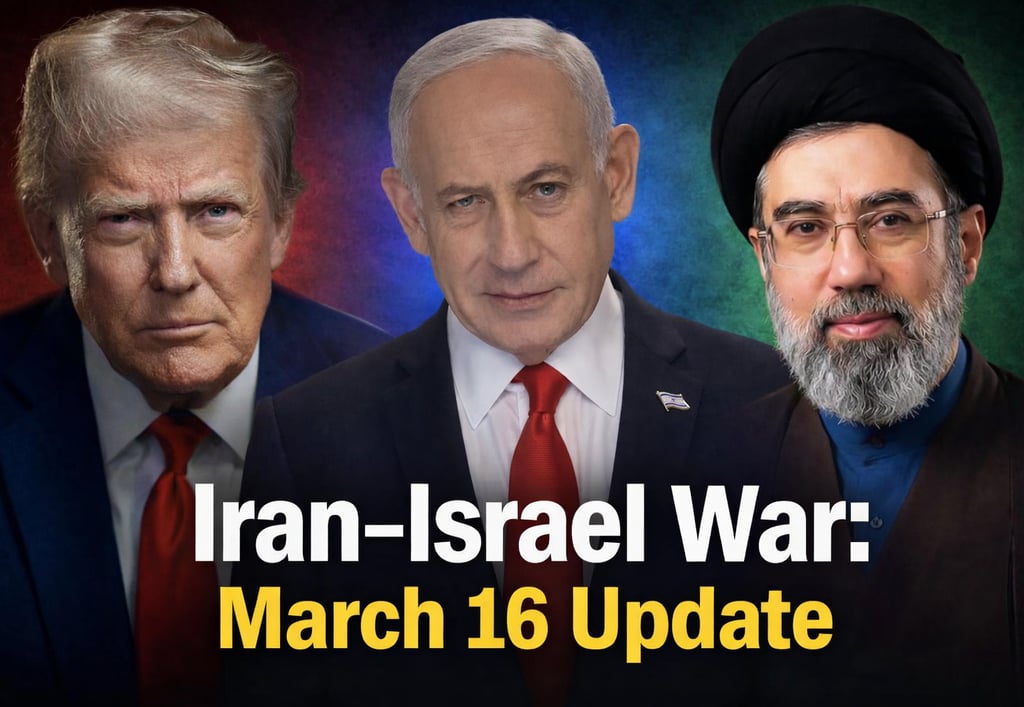
Middle East War 2026: Iran–Israel Escalation, Strait of Hormuz Tensions, and Global Energy Impact
As of March 16, 2026, the ongoing Iran–Israel conflict in the Middle East has expanded far beyond its regional origins, posing a severe crisis for international politics, global energy systems, financial markets, and oil prices. What initially began as a limited exchange of airstrikes and retaliatory attacks has, within days, escalated into a widespread military and geopolitical confrontation. The conflict's effects now extend beyond Iran and Israel, reaching Gulf states, global trade routes, energy supply chains, aviation, financial markets, and oil pricing worldwide.
The conflict intensified dramatically on February 28, 2026, when Israel, in coordination with the United States, conducted a series of airstrikes targeting multiple military and strategic installations inside Iran. According to U.S. officials, the objective of these attacks was to undermine Iran’s missile program and potential strategic capabilities. Washington described the strikes as defensive, asserting that they were necessary to curb Iran’s growing influence in the region and to counter emerging threats.
Iran responded immediately with a series of robust counterattacks. Tehran launched ballistic missiles and drone strikes targeting Israel, while also attempting to strike U.S. military bases in the Gulf region. These operations heightened military tensions across the Middle East, prompting several nations to bolster their defensive readiness and increase troop deployments.
By the third week of the conflict, the situation had become increasingly complex. Israel intensified its air campaign across multiple regions of Iran, targeting missile launch sites, military command centers, air defense systems, and other strategic installations. In response, Iran escalated its own retaliatory measures, employing its regional allied groups to strike various targets across the Gulf.
One of the conflict’s most sensitive and strategically critical aspects has been the Strait of Hormuz. This narrow maritime chokepoint, connecting the Persian Gulf to the Gulf of Oman, is responsible for transporting roughly 20% of the world’s oil supply, making it a backbone of the global energy system. Since the onset of hostilities, security in the Strait has become highly uncertain. Commercial ships and oil tankers have reported drone activity, missile threats, and maritime confrontations. Shipping companies have reduced vessel traffic through the strait due to heightened risk, and insurance premiums for navigating the area have risen sharply.
Amid these tensions, a significant development occurred when an oil tanker carrying crude for Pakistan safely traversed the Strait of Hormuz. Operated by the Pakistan National Shipping Corporation, the vessel had loaded crude oil from Das Island in Abu Dhabi before heading to Karachi. The tanker’s safe passage is seen as a sign that limited maritime navigation remains possible despite the high-risk environment. For Pakistan, this is a critical development, given its heavy reliance on Gulf oil imports. A prolonged closure or disruption of the Strait could trigger a severe energy crisis for Pakistan and other Asian economies dependent on Gulf oil.
In this context, Islamabad has adopted a cautious diplomatic approach. Pakistan maintains close ties with Iran while also sustaining strong political and economic relations with Saudi Arabia, the UAE, and the United States. Consequently, Pakistan has refrained from openly siding with any party in the conflict, emphasizing instead de-escalation and diplomatic solutions. Government officials report continuous monitoring of regional developments and are reviewing alternative strategies to ensure uninterrupted energy supplies. The Pakistan Navy has increased surveillance in the Arabian Sea to safeguard shipping routes leading to the country’s ports.
The Gulf states are also feeling the direct impact of the conflict. In response to Iran’s attempted missile and drone attacks, heightened security alerts have been issued in the UAE, Bahrain, and Saudi Arabia. In one instance, drone activity near Dubai forced temporary suspension of flights at Dubai International Airport. Similarly, reports of explosions near Fujairah port temporarily halted oil loading operations. Fujairah is a key energy export hub for the Gulf, and any disruption here can have immediate ripple effects on global oil markets.
The conflict has further affected global aviation. The Middle East hosts critical air corridors connecting Europe, Asia, and Africa, and thousands of flights traverse these routes daily. Missile and drone threats have forced several nations to reroute air traffic or restrict certain corridors. Airlines now rely on longer alternative routes, increasing flight costs and travel times. Cargo flights have also been impacted, and logistics companies warn that prolonged conflict could disrupt deliveries of medicines and other sensitive goods.
Financially, the conflict’s costs are significant, especially for the United States, which is deploying extensive military power to support Israel and defend its bases in the region. U.S. defense analysts estimate that billions of dollars in weaponry were expended in the conflict’s early days. Initial assessments suggest that approximately $5.6 billion was spent on missiles, bombs, and other military assets within the first two days, with cumulative expenditures surpassing $11 billion within the first six days. High expenses are largely due to advanced defense systems required to intercept Iranian ballistic missiles and drones. Interceptor missiles such as those used in the Patriot and THAAD systems can cost hundreds of thousands to millions of dollars per unit. Analysts estimate that during peak combat, U.S. daily military spending could range between $1 billion and $2 billion, covering aircraft carriers, bombers, missile defense, satellite monitoring, and logistical support.
Amid social media discussions, some political circles claimed that the U.S. had already spent approximately $2 trillion on the conflict. Defense experts have refuted this, noting that current spending is still in the billions, not trillions. The $2 trillion figure reflects projected costs of a prolonged war, similar to the Iraq War, which incurred over $3 trillion over several years. Experts caution that if the conflict with Iran extends further, expenses could rise dramatically.
On March 16, 2026, U.S. President Donald Trump delivered a significant address on the conflict. He stated that the United States possesses “virtually unlimited military resources” to continue operations in the region and emphasized that weakening Iran remains a central strategic priority. Trump also stressed the global importance of securing the Strait of Hormuz, stating that its protection should not fall solely on the U.S. He called on European and Asian allies to deploy warships in the area to ensure uninterrupted global oil supply.
However, one statement sparked debate among political analysts: Trump suggested that the U.S. might not need to intervene directly in the conflict. Critics called this contradictory, given America’s role in initial airstrikes. Analysts note a spectrum of opinions within the U.S., with some leaders viewing the conflict as necessary to maintain regional power balance, while others warn of entanglement in another prolonged Middle East war.
The global economy is closely monitoring the crisis. Rising energy prices threaten to exacerbate inflation, affecting transportation, industry, and food costs. Current reports indicate that Brent crude has reached $125 per barrel, while U.S. West Texas Intermediate (WTI) stands at $121 per barrel. Analyses by the International Energy Agency (IEA) and OPEC suggest that if hostilities continue and the Strait of Hormuz remains insecure, supply disruptions could push oil prices to $150 per barrel.
Defense stocks have surged, while airline and shipping shares face volatility. Diplomatic efforts, though ongoing, face challenges. Regional and global powers are conducting behind-the-scenes negotiations to de-escalate tensions, but immediate resolution appears unlikely given the military dynamics.
The next phase of the conflict will depend on upcoming military actions and diplomatic developments. Israel has indicated that its campaign against Iran may continue for several more weeks, while Iran has pledged to maintain its retaliatory operations. The United Nations has urged protection of civilians and human rights, while the European Union and other international powers continue mediation efforts behind the scenes.
The world remains closely attuned to the crisis, as its implications extend far beyond the Middle East, affecting global energy security, international economics, oil pricing, geopolitics, and the future of international relations.
Stay informed with the latest national and international news.
© 2026. All rights reserved.