
Middle East War 2026: Iran Gas Field Strike, Strait of Hormuz Crisis, Oil Prices Surge & Global Conflict Risk
Latest update 18 March 2026: Iran gas field attack, Strait of Hormuz disruption, oil surge, US response, Israel strategy, and rising global war risk.
Raja Awais Ali
3/18/20266 min read
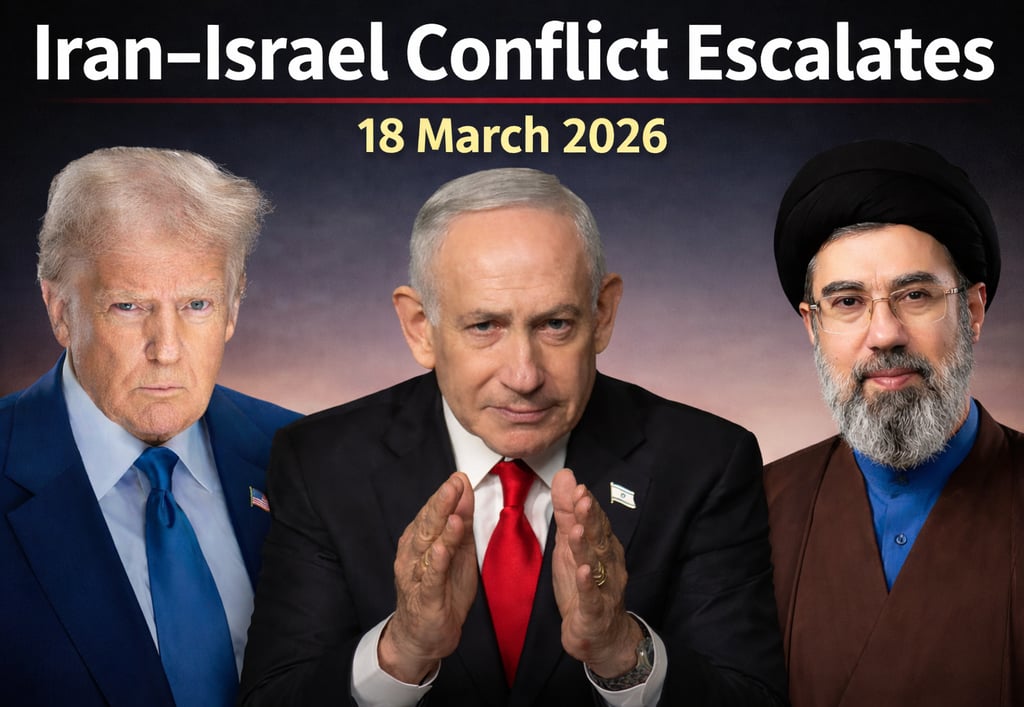
Middle East War 2026: Iran Gas Field Strike, Strait of Hormuz Crisis, Global Energy Shock, and Latest Strategy of Trump, Netanyahu, and Mojtaba Khamenei
As of 18 March 2026, the Middle East conflict has entered one of its most dangerous and strategically sensitive phases, with developments now impacting not only the region but the global economy, energy systems, and geopolitical balance. Each new escalation is reshaping international markets and raising fears of a broader global confrontation.
The most significant recent development is the attack on Iran’s Pars gas field in the country’s south — a move widely described by analysts as a major strategic turning point in the conflict. This field is not only the backbone of Iran’s energy economy but also part of the world’s largest natural gas reserve. Critically, it is jointly shared with Qatar, making the attack far more than a domestic incident. It has immediate implications for global energy stability.
The Pars gas field is part of a massive shared reservoir — known as South Pars in Iran and the North Field in Qatar. This shared infrastructure means that any disruption affects both countries and, by extension, the global liquefied natural gas (LNG) market. Qatar remains the world’s largest LNG exporter, and any prolonged damage to this field could trigger severe gas shortages across Asia and Europe, especially at a time when Europe is already seeking alternative energy sources.
Initial reports indicate that gas storage tanks, processing units, and sections of refinery infrastructure were damaged in the strike. Workers were evacuated immediately, and emergency teams were deployed to contain fires. While large-scale destruction was avoided, the symbolic and strategic significance of the attack is profound. Until now, direct targeting of critical energy infrastructure had largely been avoided in the conflict. That threshold has now been crossed, raising the likelihood that other major oil and gas facilities could become targets in the coming days.
Iran responded swiftly and forcefully, declaring that major energy hubs across the Gulf region are now within its direct strike range. Officials warned that Saudi industrial complexes, gas fields in the United Arab Emirates, and export terminals in Qatar are considered “legitimate targets.” This statement marks a significant escalation, signaling that the conflict is no longer limited to Iran, Israel, or the United States, but could engulf the entire Gulf energy system. If these threats materialize, one of the world’s most critical energy supply networks could face severe disruption.
Following these warnings, Gulf states have initiated emergency measures. Security alerts have been raised in key Saudi industrial cities such as Jubail and Yanbu, while the UAE has tightened protection around major oil and gas installations. Several energy companies have reportedly begun withdrawing non-essential personnel, indicating that the threat is being taken seriously beyond political rhetoric.
At the same time, Iran has effectively restricted access through the Strait of Hormuz, one of the most critical chokepoints in global energy trade. Approximately 20 million barrels of oil pass through this route daily — nearly 20% of global supply. Current estimates suggest that traffic through the strait has dropped by 25% to 30% amid the crisis. A significant portion of global LNG shipments also relies on this route, amplifying the disruption.
Shipping companies have begun halting operations, while insurance premiums for vessels have surged by up to 300%, reflecting the heightened risk. As a result, global trade flows are slowing, with direct consequences for energy, food supplies, and industrial goods.
The shipping crisis is deepening further as major insurers classify Gulf waters as a high-risk zone. This has not only increased operational costs but forced several shipping firms to suspend activities entirely. The impact on global supply chains is becoming increasingly visible.
Financial markets have reacted sharply. Brent crude prices have risen to between $108 and $112 per barrel, with analysts warning that prices could climb to $130–$150 if the situation worsens. Natural gas prices in Europe have increased by 8% to 10%, while LNG contracts in Asian markets have become significantly more expensive. Global stock indices have also declined by 2% to 4%, reflecting growing investor anxiety.
In the United States, the situation is becoming politically and economically sensitive. Diesel prices have exceeded $5 per gallon, with gasoline prices also rising rapidly. In response, the government has authorized the release of 150 to 180 million barrels from strategic petroleum reserves to stabilize the market. Regulatory adjustments have also been introduced to ease domestic supply constraints.
On the military front, the United States has conducted targeted strikes on Iranian missile sites near the Strait of Hormuz, using advanced weaponry including 5,000-pound bunker-buster bombs. The objective is to weaken Iran’s anti-ship and coastal defense capabilities in order to restore safe maritime passage. The U.S. Navy has also expanded its presence in the region, deploying additional warships and aircraft carriers.
Simultaneously, Israel has announced a significant shift in its military strategy. Defense Minister Israel Katz and Prime Minister Benjamin Netanyahu have declared that Iranian leadership figures will now be directly targeted without requiring additional authorization. Under this policy, key Iranian security and intelligence officials — including Esmail Khatib and Ali Larijani — have reportedly been killed. This marks a dangerous escalation, bringing top leadership directly into the battlefield.
In Lebanon, the situation has deteriorated rapidly. Heavy airstrikes in Beirut have intensified what is effectively a proxy front between Iran and Israel. Hezbollah plays a central role in this conflict, possessing a large arsenal of rockets and missiles. Israel’s objective appears to be the degradation of Hezbollah’s military capacity, but the result is the transformation of Lebanon into an active war zone.
Dozens of buildings have been destroyed, hundreds of people have been killed or injured, and more than 800,000 individuals have been displaced. The humanitarian crisis is expanding, with healthcare systems, infrastructure, and food supply chains under severe strain.
Iran has retaliated with large-scale missile and drone attacks targeting Tel Aviv, Haifa, and other cities. U.S. military bases across the Gulf — including in Bahrain, Iraq, Kuwait, and the UAE — have also come under attack. These developments significantly raise the risk of direct confrontation between the United States and Iran.
Some reports indicate that more than 100 missiles and drones were launched in a single night, underscoring Iran’s sustained operational capacity and its preparedness for a prolonged conflict.
Casualty figures continue to rise. Death tolls in Iran have exceeded 3,000, while more than 900 people have been killed in Lebanon. Israel has also reported casualties. Overall, the conflict has displaced hundreds of thousands, creating a large-scale humanitarian emergency.
On the political front, in his 18 March 2026 briefing, U.S. President Donald Trump adopted a firm stance. He announced the formation of a multinational maritime task force aimed at reopening the Strait of Hormuz, stating that the U.S. has contacted at least six to eight allied nations. However, he acknowledged that no major ally has yet committed to full military participation, raising the possibility of unilateral U.S. action.
Trump also confirmed that U.S. naval and air deployments in the region have been increased and warned that further action would be taken if necessary to secure global energy supply routes. He called on China, Japan, and European nations to take a more active role, emphasizing the global dependence on Gulf energy flows.
China, the world’s largest oil importer, has taken a cautious but significant position. Rather than direct military involvement, Beijing is focusing on diplomatic engagement, urging de-escalation from all sides. China’s primary concern remains energy supply stability, given its heavy reliance on Gulf oil.
Meanwhile, Benjamin Netanyahu has reiterated that Israel will continue its operations until Iran’s military capabilities are neutralized, framing the conflict as both an immediate and long-term security necessity.
Within Iran, Mojtaba Khamenei is playing an increasingly prominent role. Reports suggest he is deeply involved in strategic, military, and political decision-making. In a recent statement, he described the Strait of Hormuz as a “strategic pressure point,” indicating Iran’s intention to use it as leverage in the broader conflict.
Globally, the consequences of the war are becoming increasingly clear. Countries are reassessing energy policies, tapping emergency reserves, and accelerating diversification strategies. Asian economies — particularly China, India, and Japan — are among the most vulnerable due to their dependence on Gulf oil. Europe is also under growing pressure, with potential risks to industrial output if the crisis deepens.
Taken together, the conflict has evolved into a full-scale regional confrontation with global implications. Energy markets, economic systems, political alignments, and security frameworks are all under strain.
If current trends continue, this crisis could escalate beyond a regional war into direct confrontation between major global powers. Energy supply chains, economic stability, and international security systems are all at a fragile tipping point. A single miscalculation or major strike could trigger a far wider and more prolonged global crisis.
For now, the situation remains extremely volatile. Each new development adds complexity and risk. If large-scale attacks on Gulf energy infrastructure intensify or the Strait of Hormuz remains restricted for an extended period, oil prices could surge to record levels, placing severe pressure on the global economy. Similarly, if major powers become directly involved, the conflict could expand into a broader international war.
The central question now facing the world is whether this crisis can be contained — or whether it will escalate into a defining global confrontation of the decade.
Stay informed with the latest national and international news.
© 2026. All rights reserved.