
Middle East Conflict Hits Businesses and Luxury Markets: Impact on Tourism, Trade, and Global Economy – 2 March 2026
The 2 March 2026 Middle East conflict disrupts luxury brands, tourism, and global markets. Dubai, Bahrain, UAE stores close, flights canceled, and economic uncertainty rises. Read the full analysis.
Raja Awais Ali
3/2/20262 min read
Middle East Conflict: How Businesses, Tourism, and Global Markets Are Impacted – 2 March 2026
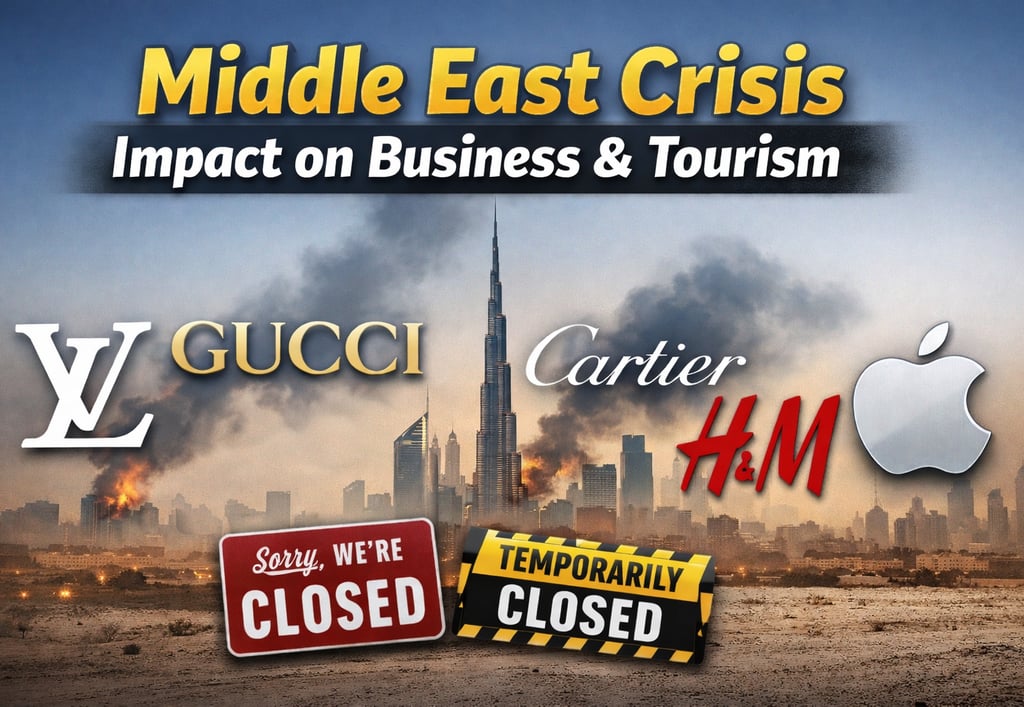
On 2 March 2026, the escalating conflict in the Middle East sent shockwaves through businesses, tourism, and global markets. The U.S. and Israel conducted airstrikes against Iran, prompting Tehran to retaliate with missiles and drones targeting Gulf countries. This has caused major disruptions across Dubai, Abu Dhabi, Bahrain, and other key commercial hubs, with many stores shutting down, staff attendance becoming voluntary, and travel heavily affected.
Luxury retailers and global brands have faced immediate operational challenges. Chalhoub Group, which operates 900 stores across brands such as Versace, Jimmy Choo, and Sephora, closed all stores in Bahrain while maintaining voluntary attendance in the UAE, Saudi Arabia, and Jordan. Lynn Al Khatib, Vice President of Communications at Chalhoub Group, confirmed that the leadership team personally visited Dubai Mall and Mall of the Emirates to check on staff. Similarly, Gucci’s parent company Kering temporarily closed its stores in the UAE, Kuwait, Bahrain, and Qatar while suspending all business travel to the region.
The conflict has also sent luxury stock prices tumbling. Shares of LVMH, Hermes, and Richemont fell between 4% and 6.5% as investors assessed the regional impact. Although the Middle East accounts for only 5–10% of global luxury spending, it had been the fastest-growing region last year. Analysts warn that prolonged conflict could jeopardize hundreds of millions of dollars in sales, particularly from travel-dependent retail and tourism sectors.
Air travel has been severely disrupted. Major airports, including Dubai International, Abu Dhabi, Doha, and Kuwait International, faced partial or full closures, resulting in thousands of canceled or delayed flights. Globally, approximately 19,000 flights were affected, including 156 flights from Pakistan to the Middle East. The cancellations have caused major challenges for travelers, business visitors, and tourism-dependent businesses.
Daily life in Gulf cities has also been affected. Many smaller businesses, grocery stores, and service outlets temporarily closed, while long queues formed at essential supply points. Major companies, including Apple, H&M, and Reckitt, issued work-from-home directives and temporarily closed stores to ensure employee safety, highlighting the widespread business disruption.
The political consequences are equally significant. Iran launched multiple missile and drone strikes on Gulf states, while Israel targeted Hezbollah positions in Lebanon. These attacks caused civilian casualties and intensified regional instability, affecting global diplomatic relations and efforts toward peace.
Economic and market impacts are substantial. Luxury and beauty sectors are directly affected, while global oil and energy markets reacted sharply. Oil prices surged as the Strait of Hormuz, through which nearly 15% of the world’s oil flows, faced increased risk. Stock markets, shipping, and energy sectors worldwide also experienced immediate volatility.
Major luxury and retail brands had been investing heavily in the region. Cartier had recently launched a high-jewelry exhibition in Dubai, and LVMH staged a Louis Vuitton exhibition at Jumeirah Marsa Al Arab. Primark had planned to open three stores in Dubai by May 2026, with additional stores in Bahrain and Qatar. The current conflict, however, threatens these plans and illustrates the vulnerability of even well-established retail operations in the Gulf.
This unfolding situation demonstrates that modern conflicts extend beyond human casualties, affecting international business, tourism, and economic stability. If the crisis continues, both Gulf countries and European markets, where Middle Eastern tourists significantly contribute to luxury spending, could feel the impact. The events of 2 March 2026 serve as a stark reminder of how regional conflicts can rapidly ripple across global commerce and markets.
Stay informed with the latest national and international news.
© 2026. All rights reserved.