
Marco Rubio Gulf Tour 2026: Why UAE, Bahrain and Kuwait Are Worried About the Iran Peace Deal and $300 Billion Reconstruction Fund
U.S. Secretary of State Marco Rubio begins a crucial Gulf tour to reassure UAE, Bahrain and Kuwait over the controversial Iran peace deal. Learn why the $300 billion reconstruction fund, Iran's nuclear program, ballistic missiles and Strait of Hormuz security are raising concerns across the Middle East.
Raja Awais Ali
6/24/20265 min read
Marco Rubio Gulf Tour 2026: Why UAE, Bahrain and Kuwait Are Worried About the Iran Peace Deal and $300 Billion Reconstruction Fund
The Middle East has entered a new phase of uncertainty following the signing of a preliminary peace agreement between the United States and Iran. While Washington describes the agreement as a major diplomatic breakthrough capable of ending months of conflict, several Gulf nations remain deeply skeptical about what the deal could mean for their long-term security.
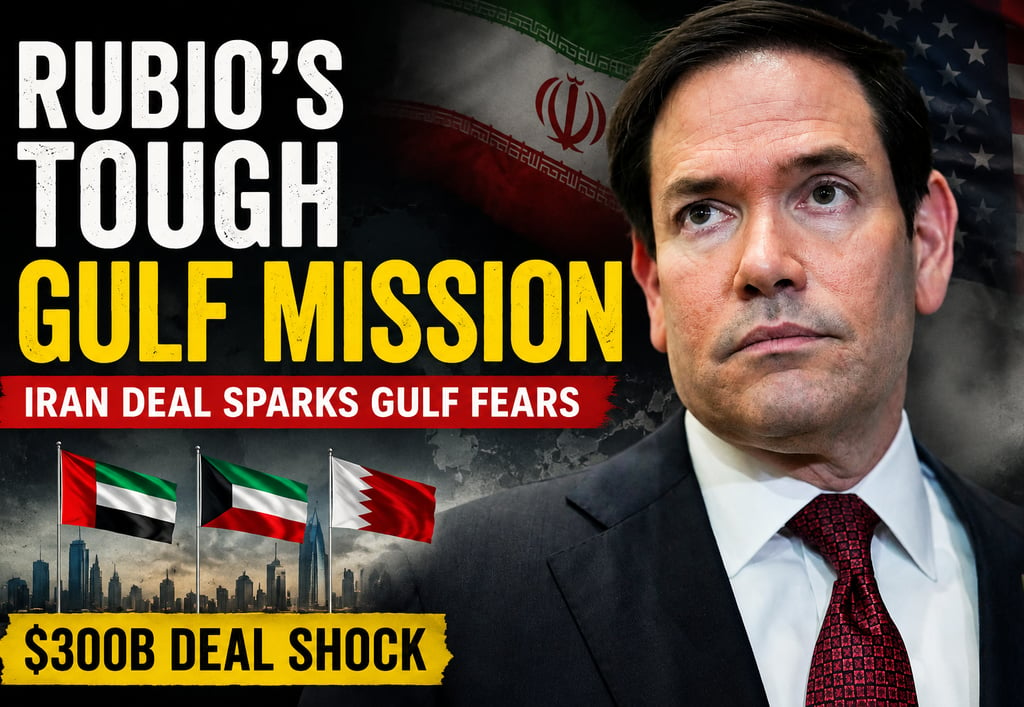
These concerns have placed U.S. Secretary of State Marco Rubio at the center of a delicate diplomatic mission. Rubio has begun a three-day tour of the Gulf region, visiting the United Arab Emirates, Kuwait and Bahrain in an effort to reassure key American allies that the new Iran agreement will not undermine regional stability.
The visit comes only days after the United States and Iran signed a 14-point memorandum of understanding, marking the first major agreement between an American president and an Iranian president since the 1979 Iranian Revolution. Although the memorandum is only an interim framework, it has already sparked intense debate across the Middle East, Washington and international financial markets.
For Gulf states that have directly experienced Iranian missile and drone attacks during the recent conflict, the agreement raises far more questions than answers.
Rubio arrived in Abu Dhabi and immediately held discussions with UAE President Sheikh Mohammed bin Zayed Al Nahyan, National Security Adviser Sheikh Tahnoun bin Zayed Al Nahyan and Foreign Minister Sheikh Abdullah bin Zayed Al Nahyan. According to officials, the talks focused on regional security, the future of U.S.-Iran negotiations and the concerns many Arab governments have regarding the concessions offered to Tehran.
One of the biggest sources of controversy is the proposed $300 billion reconstruction fund included in the broader peace framework. The fund is intended to help rebuild parts of Iran's economy and infrastructure damaged during the four-month war involving the United States, Israel and Iran.
However, Gulf leaders are concerned that such a massive financial package could indirectly strengthen Iran's military capabilities. Critics fear that money flowing into Iran's economy may eventually free up resources that could be redirected toward military modernization, missile development or support for regional proxy groups.
These concerns are particularly significant because the recent conflict demonstrated the extent of Iran's military reach. During the war, Iranian missiles and drones struck targets across the region, including countries hosting important U.S. military installations. Civilian casualties were reported in some areas, leaving governments eager to ensure that any future peace agreement contains strong security guarantees.
Another major concern involves Iran's ballistic missile program. While the preliminary agreement outlines broad principles for future negotiations, it does not contain specific restrictions on Iranian missile capabilities.
For Gulf nations, this omission is difficult to ignore.
Iran's missile arsenal has long been viewed as one of the primary security challenges facing the region. The recent conflict reinforced those fears as missiles and drones became central tools of military escalation. Many Gulf governments argue that a lasting peace agreement cannot be considered complete if it fails to address the weapons systems that have repeatedly threatened neighboring states.
The United States has attempted to calm these concerns by emphasizing that the current memorandum is only a starting point. Washington argues that the most difficult issues, including military restrictions and nuclear questions, will be negotiated during the next 60 days.
Nevertheless, Iranian officials have already signaled that some topics may remain off the table.
Tehran has consistently maintained that its missile program is a defensive necessity and not subject to negotiation. This position creates an immediate challenge for American diplomats attempting to convince Gulf allies that their security concerns will eventually be addressed.
Perhaps the most sensitive issue in upcoming negotiations is Iran's nuclear program.
Under the planned talks, American and Iranian negotiators are expected to focus heavily on the future of Iran's stockpile of highly enriched uranium. International experts estimate that Iran possesses uranium enriched up to 60 percent purity. While Iranian officials insist the program serves peaceful purposes, many Western governments note that 60 percent enrichment is only a short technical step away from weapons-grade material, which typically requires enrichment levels of around 90 percent.
The future handling of this material could become the defining issue of the entire negotiation process.
American officials want stronger monitoring mechanisms and safeguards designed to prevent any possible path toward nuclear weapons development. Iran, meanwhile, insists that its nuclear activities remain within its sovereign rights and are intended solely for civilian energy and scientific purposes.
The outcome of these discussions will likely determine whether the current memorandum evolves into a permanent peace agreement or collapses under the weight of unresolved disagreements.
The United Arab Emirates faces unique challenges arising from the conflict. Over the past two decades, the UAE has successfully positioned itself as one of the world's leading financial and business centers. Cities such as Dubai and Abu Dhabi built their international reputations on stability, investment opportunities and economic openness.
The recent war, however, exposed the vulnerability of even the region's most successful economies.
Reports indicate that some expatriates and international investors temporarily left the country during periods of heightened tension. Although economic activity has largely recovered, Emirati leaders remain determined to prevent future conflicts from disrupting business confidence and economic growth.
This explains why UAE officials are seeking detailed assurances regarding every aspect of the Iran peace process.
Beyond military and political concerns, the future of the Strait of Hormuz remains another critical issue.
The strategic waterway handles roughly 20 percent of global oil and liquefied natural gas shipments, making it one of the most important energy routes in the world. Since the outbreak of war on February 28, shipping activity in the area has faced significant disruption, increasing uncertainty in global energy markets and creating concerns among international traders.
Any instability in the Strait of Hormuz can quickly affect oil prices, shipping costs and global economic confidence.
As part of broader diplomatic efforts, Qatar and Oman are reportedly discussing new regional negotiations involving Iran, Iraq and Gulf Arab states. These discussions focus on maritime security and future arrangements governing navigation through the strategically important waterway.
Separate reports also suggest that Saudi Arabia may host wider regional reconciliation talks involving Iran and several Arab governments in the coming months. Such meetings could provide an opportunity to address issues that extend beyond the current U.S.-Iran framework.
Meanwhile, the political stakes inside the United States continue to rise.
Some Republican lawmakers argue that the agreement gives Iran too many benefits while securing too few guarantees in return. Others support the administration's approach, arguing that diplomacy offers a better path than prolonged military confrontation.
The debate has also drawn attention because both Marco Rubio and Vice President JD Vance are widely viewed as potential future leaders within the Republican Party. Their handling of the Iran negotiations could influence not only American foreign policy but also future political dynamics in Washington.
For Rubio personally, the Gulf tour represents an important test of leadership.
He must defend an agreement strongly backed by President Donald Trump while simultaneously addressing the fears of regional allies that have borne the direct consequences of conflict with Iran. Balancing those competing interests will require careful diplomacy and credible reassurances.
At present, the reality is that no final peace agreement exists.
The 14-point memorandum has opened the door to negotiations, but the most difficult questions remain unresolved. The future of Iran's enriched uranium stockpile, the fate of sanctions, the role of ballistic missiles, regional security arrangements, maritime stability in the Strait of Hormuz and oversight of the proposed $300 billion reconstruction fund are all issues that still require extensive negotiations.
The next 60 days could therefore prove decisive not only for U.S.-Iran relations but for the entire Middle East.
If negotiators can transform the current framework into a comprehensive and enforceable agreement, the region could move toward a period of greater stability. If negotiations fail, however, tensions could quickly return, reopening the possibility of renewed confrontation and economic disruption.
For now, Gulf leaders remain cautious, Washington remains optimistic and Tehran remains determined to protect its strategic interests. As Marco Rubio continues his Gulf tour, the world will be watching closely to see whether diplomacy can bridge the deep mistrust that still defines relations across one of the world's most volatile regions.
Stay informed with the latest national and international news.
© 2026. All rights reserved.