
Keir Starmer Resignation: UK Prime Minister Steps Down After Labour Crisis and Political Shift in Britain
Keir Starmer has resigned as UK Prime Minister after two years in power. Explore Labour Party’s crisis, his rise to victory in 2024, key achievements, political controversies, Reform UK’s rise, and the future of British politics.
Raja Awais Ali
6/22/20267 min read
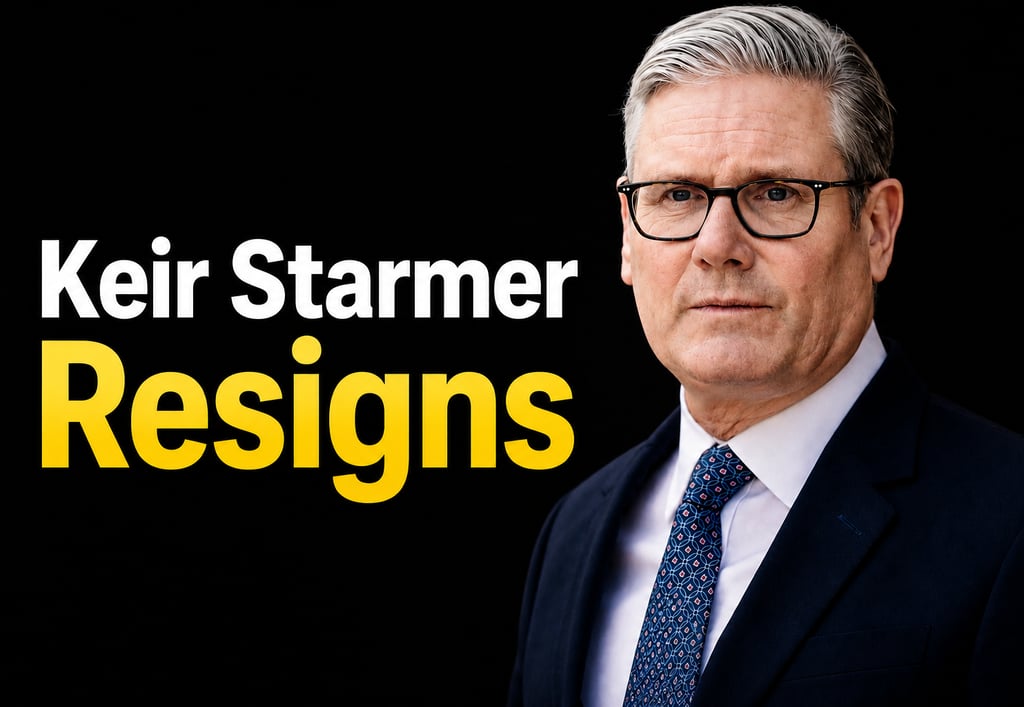
Keir Starmer's Resignation: From Historic Victory to Political Decline in Two Years, Labour's Crisis, Britain's Changing Politics and the Complete Story of a Prime Minister
British politics has once again entered a period of uncertainty. Prime Minister Keir Starmer, who came to power after securing one of the largest parliamentary majorities in modern British history during the 2024 general election, has announced his resignation just two years later. His departure is being viewed as a major blow not only to the Labour Party but also to the broader political landscape of the United Kingdom. A leader who was once regarded as a symbol of stability, seriousness and pragmatic politics has now been forced to step down amid growing pressure from within his own party and a steady decline in public support. Ironically, the same moderate and ideologically flexible approach that helped him reach power ultimately became one of the primary reasons behind his political downfall.
Speaking outside 10 Downing Street in London, the 63-year-old Starmer delivered an emotional address in which he acknowledged that his party was now asking whether he remained the best person to lead Labour into the next general election. He said the parliamentary party had already answered that question and that he accepted its verdict with good grace. Starmer pledged to do everything possible to ensure an orderly transfer of power. As he thanked his wife Victoria and his family for their unwavering support, his voice broke with emotion, marking the end of a significant chapter in his political journey.
Starmer's rise in British politics is considered one of the most remarkable political stories in recent British history. He was first elected to Parliament in 2015. Before entering frontline politics, he served as the Director of Public Prosecutions and was widely respected as one of Britain's most senior legal figures. In 2020, he became leader of the Labour Party at a time when the party was facing one of the deepest crises in its history. Under Jeremy Corbyn, Labour had suffered its worst electoral defeat since 1935. The party was battling allegations of antisemitism, facing criticism over its Brexit position and struggling with deep internal divisions.
Drawing upon his legal and administrative experience, Starmer set about rebuilding the party. He moved to address allegations of antisemitism, improved Labour's financial position, reduced factional infighting and repositioned the party as a credible alternative government. His political strategy focused on economic stability, responsible government and moderate politics. That approach ultimately paid off when Labour secured a historic victory in the 2024 general election, winning a commanding majority in the 650-seat House of Commons.
However, political analysts warned at the time that the victory was not as secure as it appeared. Labour's vote share was not exceptionally high, and much of the party's success reflected Conservative weaknesses, voter frustration and tactical voting. Renowned British pollster John Curtice famously observed that the election looked more like one that the Conservatives had lost than one that Labour had overwhelmingly won.
Once in office, Starmer inherited a country grappling with multiple challenges. Britain faced weak economic growth, a housing crisis, inflationary pressures, strained public services, healthcare challenges and continuing concerns over illegal migration. His government made economic recovery its top priority and promised to create growth through stability. Yet translating those promises into visible results proved far more difficult than expected.
Economic growth remained sluggish and many voters struggled to see meaningful improvements in their daily lives. Although the government worked to restore investor confidence, encourage investment and create conditions for lower interest rates, the benefits were slow to reach ordinary households. Inflation and the rising cost of living continued to fuel public frustration throughout much of his premiership.
Healthcare represented another major challenge. The Starmer government introduced several measures aimed at addressing the crisis within the National Health Service. Efforts were made to reduce patient waiting lists, increase hospital capacity and address workforce shortages. Government officials argued that waiting times had improved and progress had been made in several areas. Nevertheless, many members of the public remained dissatisfied with the healthcare system and felt that significant problems persisted.
Workers' rights became one of the defining themes of Starmer's domestic agenda. His government introduced reforms designed to strengthen workplace protections, improve employment conditions and enhance job security. Labour consistently highlighted these measures as one of its key achievements, arguing that millions of workers benefited from stronger legal protections and improved rights in the workplace.
In the fields of energy and environmental policy, Starmer's administration promoted investment in renewable energy and supported the transition towards cleaner sources of power. The government argued that greater investment in green energy was essential to securing Britain's long-term energy future. Critics, however, contended that the pace of change was too slow and that a more ambitious strategy was needed to meet future challenges.
Foreign policy is generally regarded as one of the stronger aspects of Starmer's time in office. During the Russia-Ukraine war, Britain continued its support for Ukraine under his leadership while maintaining close cooperation with European allies. Several European leaders praised his diplomatic efforts and commitment to collective security. Alongside French President Emmanuel Macron, Starmer also played a role in diplomatic discussions aimed at reducing tensions in the Middle East and addressing concerns surrounding the Strait of Hormuz.
Relations with the United States initially benefited from Starmer's pragmatic approach. Seeking to maintain strong ties with Washington, he undertook several diplomatic initiatives, including inviting President Donald Trump for a second state visit to Britain. Over time, however, differences emerged over Iran and other international issues, creating tensions between the two leaders. Just one day before Starmer's resignation announcement, Trump posted on social media that the British Prime Minister had failed on immigration and energy policy.
Despite the achievements highlighted by his supporters, critics argued that Starmer's greatest weakness was not policy but leadership and vision. Throughout his premiership, he faced accusations of lacking a compelling long-term vision for Britain's future. While he often focused on what was realistically achievable, many voters wanted a clearer understanding of where he intended to take the country. According to one former adviser, Starmer failed to provide a convincing destination that would allow voters to make sense of his decisions and priorities.
As time passed, the government became increasingly entangled in a series of controversies. Questions surrounding political donations, multiple policy reversals, high-profile resignations and dismissals repeatedly dominated headlines. Among the most damaging controversies was the appointment of senior Labour figure Peter Mandelson, whose links to the late American sex offender Jeffrey Epstein had already attracted criticism. When questions emerged, Starmer argued that he had not been fully aware of the extent of those connections. However, the explanation raised further concerns and damaged confidence in his leadership.
During the final months of his government, tensions within Downing Street became increasingly visible. Several close advisers left their positions, including former Chief of Staff Morgan McSweeney. Relations with the civil service also deteriorated following the dismissal of a senior Foreign Office official. Both inside and outside government, there was a growing perception that Starmer had become trapped in a defensive political position and was struggling to regain momentum.
The local elections of May 2026 proved to be a turning point. Labour suffered significant setbacks while Nigel Farage's Reform UK achieved notable gains across several parts of the country. The results intensified calls within Labour for a change in leadership. Many Members of Parliament concluded that the party's chances of winning the next general election would diminish if Starmer remained at the helm.
Throughout this difficult period, Starmer increasingly relied on advice from his wife Victoria. According to reports, after Labour's disappointing local election performance in May, he initially decided to continue fighting for his position following lengthy discussions with her. However, after spending a weekend at Chequers, the Prime Minister's official country residence, he ultimately concluded that resignation was the best course of action.
Attention has now shifted to Andy Burnham, who is widely viewed as the strongest contender to succeed Starmer. The former Mayor of Greater Manchester is regarded by many within Labour as a politician capable of challenging Nigel Farage and countering the growing influence of Reform UK. Some party figures have even described him as the individual best positioned to stop the rise of right-wing populism.
Perhaps Starmer's most enduring political legacy will be the weakening of Britain's traditional two-party system. Recent elections have demonstrated that the decades-long dominance of Labour and the Conservatives can no longer be taken for granted. Reform UK's membership has surpassed 270,000 while Labour has experienced declining membership numbers. In February 2026, Starmer himself warned his party that the battle against Reform UK represented "the fight of our lives." Ultimately, however, it was a battle he was unable to win.
Starmer's premiership ended with a striking contradiction. He was the leader who brought Labour back to power after one of the worst defeats in its modern history, yet he was unable to convince his own party that he remained the right person to lead it into the future. Supporters will remember him as a serious, responsible and pragmatic Prime Minister who sought to restore stability during a period of considerable economic and political uncertainty. Critics, meanwhile, will view him as a leader who struggled to maintain public support because he lacked a compelling vision, effective communication and a powerful political narrative capable of sustaining his historic electoral mandate.
With his resignation, an important chapter in British politics has come to an end. Yet the debate surrounding Keir Starmer's achievements, shortcomings, leadership style and long-term legacy is unlikely to disappear anytime soon. His rise from respected legal figure to Prime Minister, his success in rebuilding Labour from the ruins of electoral defeat, his efforts to govern during a period of immense challenges and his eventual resignation under mounting political pressure ensure that his story will remain a significant part of Britain's political history for many years to come. Whether history ultimately judges him as a reformer who stabilized Britain during difficult times or as a leader who failed to inspire the public despite holding enormous political power, his impact on British politics will continue to be discussed long after his departure from Downing Street.
Stay informed with the latest national and international news.
© 2026. All rights reserved.