
Israeli Settlers Torch West Bank Mosques After Deadly Clashes as Israeli Strike Kills Senior Hamas Security Official in Gaza
Israeli settlers set fire to West Bank mosques after deadly clashes near Nablus while an Israeli strike kills a senior Hamas security official in Gaza. Full analysis.
Raja Awais Ali
7/26/20265 min read
Israeli Settlers Torch West Bank Mosques After Deadly Clashes as Israeli Strike Kills Senior Hamas Security Official in Gaza
The conflict in the Middle East has entered another dangerous phase, with violence expanding beyond Gaza and increasingly engulfing the occupied West Bank. On July 26, 2026, two major developments highlighted the growing instability across the Palestinian territories. In the occupied West Bank, Palestinian officials said Israeli settlers attacked villages, set fire to two mosques, and painted revenge slogans on buildings following a deadly confrontation near Nablus. On the same day, an Israeli airstrike in central Gaza killed a senior Hamas internal security official and one of his associates, underscoring that military operations continue despite the ceasefire that halted full-scale fighting months earlier.
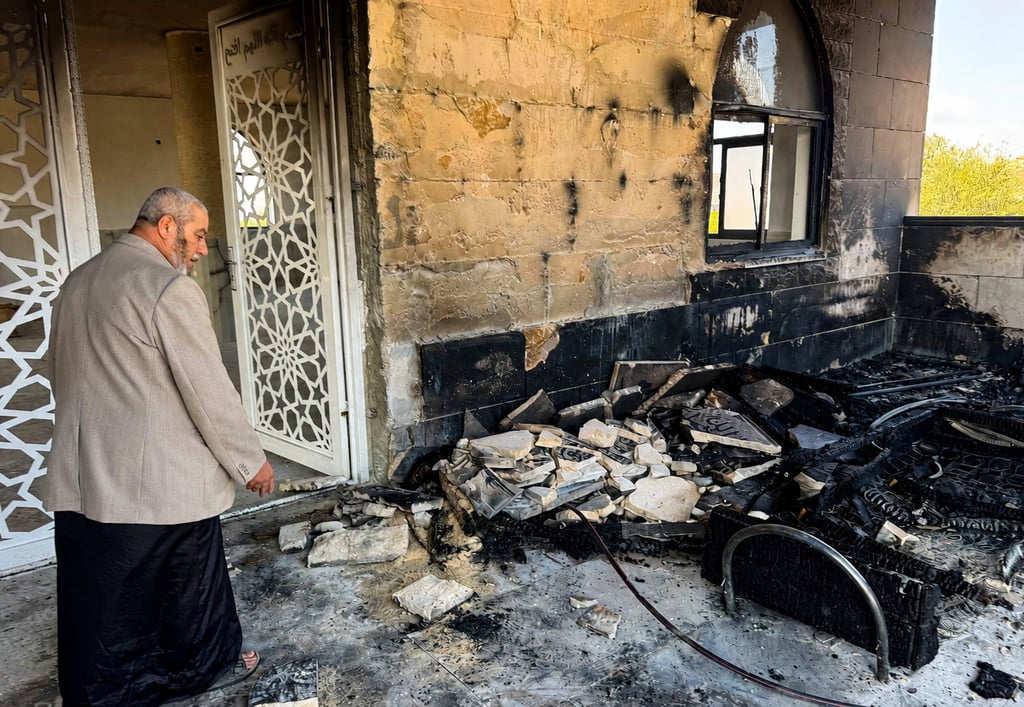
According to Palestinian officials, Israeli settlers entered the village of Qusra, southeast of Nablus, during the early hours of Sunday and set fire to a newly completed mosque. Residents said the attackers spray-painted Hebrew graffiti on the mosque's walls, including the phrases "Jewish Revenge" and "Revenge Benayahu," referring to 32-year-old Israeli reserve soldier Benayahu Mellet, who was killed during violent clashes near the Palestinian village of Tal two days earlier. Local residents reported that nearby buildings were also vandalized before the attackers fled the area.
Abdel Azim Wadi, head of the Qusra village council, said the village has experienced repeated attacks by Israeli settlers since 2011, but that such incidents have increased significantly since the Gaza war began in October 2023. He described the latest attack as an assault not only on property but also on religious freedom and the safety of Palestinian civilians living in the area.
Another attempted attack targeted a mosque in the village of Kour, southeast of Tulkarm. According to Farid Jiyousi, a member of the village council, three Israeli settlers attempted to set the mosque on fire before dawn. However, worshippers arriving for morning prayers quickly extinguished the flames before they spread into the main prayer hall. Graffiti written in Hebrew was also found on the mosque's walls. Local officials said this was the first such attack ever reported in their village, increasing fears that settler violence is spreading into new areas.
The attacks came just two days after one of the deadliest confrontations in the northern West Bank this year. Palestinian officials said a large group of Israeli settlers entered the area surrounding the Palestinian village of Tal, southwest of Nablus, on Friday. Villagers confronted the settlers, and the confrontation quickly escalated into a gun battle. The violence left four Palestinians dead along with two Israelis, including a local Israeli security coordinator and reserve soldier Benayahu Mellet. Palestinian officials believe Sunday's attacks on the mosques were acts of retaliation linked to those deaths.
Figures released by the United Nations and the Palestinian Authority indicate that confrontations involving Israeli settlers have risen sharply throughout 2026. Dozens of Palestinians have been killed and hundreds more injured in incidents involving settlers and Israeli security forces across the occupied West Bank. Human rights organizations have repeatedly warned that the increasing frequency of these attacks risks triggering a wider escalation throughout the territory.
The legal status of Israeli settlements in the occupied West Bank remains one of the central issues in the Israeli-Palestinian conflict. Most countries and United Nations bodies consider the settlements illegal under international law, a position Israel rejects. Meanwhile, the Palestinian leadership continues to seek an independent state comprising Gaza, the West Bank, and East Jerusalem. The continued expansion of settlements remains a major obstacle in diplomatic efforts aimed at reaching a lasting peace agreement.
Since the Gaza war began following Hamas' October 2023 attack on southern Israel, violence in the occupied West Bank has intensified considerably. Alongside Israeli military operations, attacks involving settlers have become more frequent, contributing to rising casualties, widespread displacement, and increasing tensions between Palestinian communities and nearby Israeli settlements.
The Israeli military confirmed that troops responding to the incident in Qusra found evidence of arson and Hebrew graffiti at the mosque. Military officials said security forces are searching for those responsible, while Israeli police have been assigned to collect forensic evidence. The military stated that it strongly condemns attacks on religious sites and emphasized that security forces will continue working to maintain public order and investigate those responsible.
Following Friday's deadly confrontation, Israeli Prime Minister Benjamin Netanyahu ordered additional Israeli troops to be deployed across the northern West Bank. He also announced that more Israeli settlements would be authorized, arguing that expanding settlements would strengthen security in the area. Members of his right-wing coalition, particularly Finance Minister Bezalel Smotrich, have repeatedly called for accelerating Israeli control over the occupied West Bank through additional settlement construction. Critics argue that such measures are likely to increase tensions and further complicate future peace negotiations.
While violence escalated in the West Bank, another significant development unfolded inside the Gaza Strip. An Israeli airstrike in the central Gaza city of Deir Al-Balah killed Colonel Wael El-Ledawi, head of Hamas' internal security service for central Gaza, along with Major Ramez Abu Zraiq. According to Gaza medical officials and the Hamas-run Interior Ministry, both men were traveling in a vehicle when it was struck on Sunday.
The Israeli military confirmed carrying out a strike against what it described as a Hamas militant but did not identify the individual or provide further operational details.
Israel has targeted dozens of members of Hamas-run police and internal security services over recent months, maintaining that many of those officials are also members of Hamas' military wing and therefore constitute legitimate military targets. Hamas, however, argues that attacks against its police and internal security agencies are intended to create lawlessness inside Gaza and violate the U.S.-brokered ceasefire that took effect in October.
According to Gaza health authorities, more than 1,190 Palestinians, the majority reported to be civilians, have been killed in Israeli strikes since the ceasefire began. During the same period, four Israeli soldiers have also been killed during military operations inside Gaza. Although the ceasefire brought an end to large-scale combat, limited Israeli airstrikes and military operations have continued almost daily, keeping the conflict active despite the reduction in overall fighting.
Israeli military estimates indicate that approximately 64% of the Gaza Strip is currently under Israeli control. Nearly two years of war have devastated much of the territory, leaving entire neighborhoods destroyed. Around two million Palestinians are now living in an extremely narrow coastal area, many in temporary tents or damaged buildings while facing severe shortages of food, clean water, electricity, medicine, and other essential humanitarian supplies.
The latest developments demonstrate that the conflict is no longer confined to Gaza alone. Violence in the occupied West Bank continues to intensify through settler attacks, deadly confrontations, military deployments, and political decisions regarding settlement expansion. At the same time, Israeli military operations inside Gaza remain ongoing despite the ceasefire, with senior Hamas officials continuing to be targeted.
Together, these parallel developments illustrate the increasingly complex nature of the conflict. The combination of expanding settlement activity, attacks on religious sites, continuing military operations, and the absence of meaningful diplomatic progress raises concerns that tensions could escalate even further in the coming weeks. Unless renewed political negotiations produce tangible results, both Gaza and the occupied West Bank are likely to remain at the center of one of the world's most volatile and closely watched conflicts.
Stay informed with the latest national and international news.
© 2026. All rights reserved.