
Israel Expands Lebanon War: Netanyahu Orders Beirut Strikes as Hezbollah Attacks Continue
Israel launches new strikes on Beirut’s southern suburbs as Hezbollah attacks continue. Explore casualties, diplomacy, and the latest Lebanon war updates.
Raja Awais Ali
6/1/20265 min read
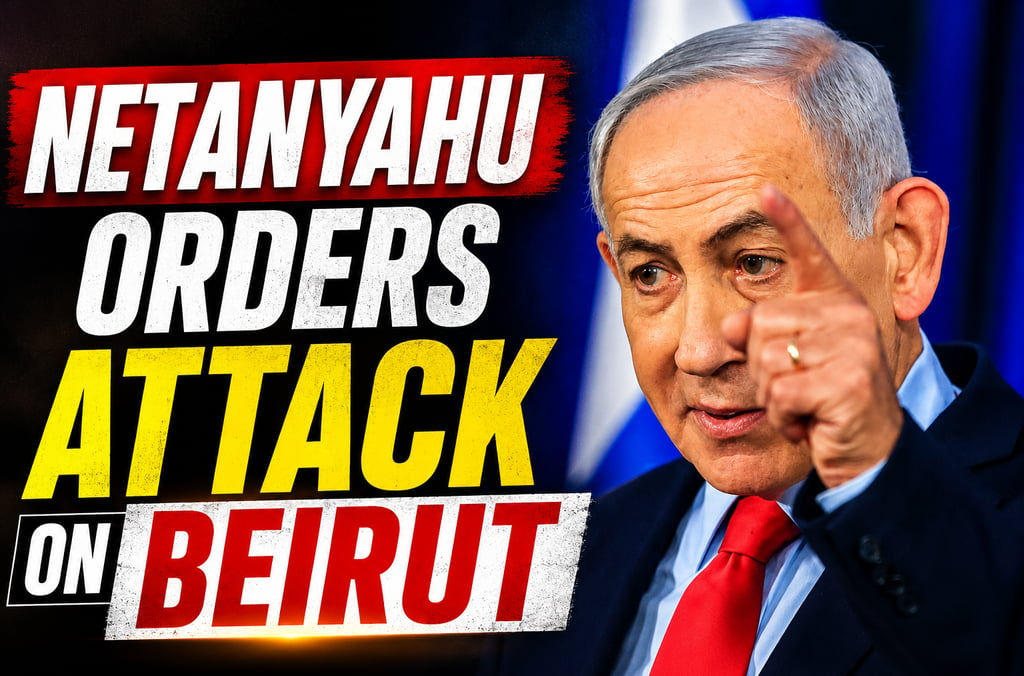
Israel Expands Lebanon War as Netanyahu Orders Strikes on Beirut’s Southern Suburbs Amid Rising Casualties and Failing Diplomacy
The conflict between Israel and Hezbollah entered a dangerous new phase on June 1, 2026, after Israeli Prime Minister Benjamin Netanyahu ordered military strikes on Beirut’s southern suburbs, a region widely known as Hezbollah’s main stronghold in Lebanon. The move signals a significant escalation in the ongoing Lebanon war, which has already caused thousands of deaths, displaced more than a million people, and complicated diplomatic efforts involving the United States, Iran, Israel, and Lebanon.
According to the Israeli Prime Minister’s Office, Netanyahu and Defense Minister Israel Katz instructed the Israeli military to strike what they described as “terrorist targets” in the southern suburbs of Beirut, commonly known as Dahiyeh. Israeli officials said the decision was made in response to what they called repeated ceasefire violations and attacks by Hezbollah against Israeli cities and civilians.
The latest development comes at a critical moment in the conflict. While fighting has continued in southern Lebanon for months, Israel had carried out only two strikes on Beirut’s southern suburbs since U.S. President Donald Trump announced a Lebanon ceasefire on April 16, 2026. The new order to target Dahiyeh suggests that tensions are once again rising despite ongoing international efforts to prevent a wider regional war.
The current Lebanon conflict began on March 2, 2026, when Hezbollah opened fire on Israel in support of Iran during the broader U.S.-Israeli military confrontation with Tehran. What initially appeared to be a regional spillover quickly developed into one of the most serious military confrontations between Israel and Hezbollah in recent years.
Since the fighting started, Lebanese authorities report that more than 3,370 people have been killed in Lebanon as a result of Israeli military operations. The death toll includes civilians, women, and children, while entire communities have been forced to abandon their homes. Lebanese officials estimate that more than one million people have been displaced by the conflict, creating one of the largest humanitarian crises the country has experienced in decades.
Israel, meanwhile, says that 24 Israeli soldiers and four civilians have been killed since the conflict began. Israeli officials argue that Hezbollah embeds military infrastructure and fighters within civilian areas, making military action necessary to protect northern Israeli communities from attacks.
The escalation follows an intense weekend of military activity in southern Lebanon. Israeli forces captured the historic Beaufort Castle, a fortress dating back approximately 900 years. The site holds both military and symbolic importance due to its strategic location overlooking large parts of southern Lebanon. Following the capture of the castle, Netanyahu ordered the Israeli military to expand its ground operations further into Lebanese territory.
In a statement released on Sunday, Netanyahu said Israel intends to deepen and expand its control over areas that were previously under Hezbollah influence. Israeli officials describe these operations as part of a broader effort to establish a security zone in southern Lebanon. The Israeli military has already created what it calls a protective buffer area, where numerous villages have reportedly been destroyed or evacuated.
Israel says the goal is to prevent Hezbollah fighters from operating near the border and to increase security for residents of northern Israel. Critics, however, argue that the expansion of military operations risks worsening the humanitarian situation and increasing regional instability.
Hezbollah has strongly rejected Israeli accusations and insists it has the right to resist what it describes as Israeli occupation and aggression. The group reported carrying out 21 military operations on Sunday alone. Among those operations was a rocket barrage targeting military infrastructure in the Israeli city of Nahariya.
The exchange of attacks highlights the continuing cycle of retaliation that has made achieving a ceasefire increasingly difficult. While international mediators have attempted to reduce tensions, military developments on the ground have repeatedly undermined diplomatic progress.
The conflict is also affecting broader negotiations involving Iran and the United States. Iranian Foreign Ministry spokesperson Esmaeil Baghaei said Israeli military actions in Lebanon are among the factors delaying diplomatic efforts aimed at ending the wider U.S.-Iran conflict. He emphasized that a ceasefire in Lebanon remains an essential component of any future agreement involving Tehran and Washington.
As violence continues to spread, international concern is growing. France has called for an emergency meeting of the United Nations Security Council, citing the escalating situation in Lebanon and the risk of a wider regional confrontation. French officials believe immediate diplomatic engagement is necessary to prevent further deterioration of security conditions across the Middle East.
The United States has been actively involved in mediation efforts since the conflict intensified. American officials have hosted several rare discussions involving representatives from both Israel and Lebanon, despite strong objections from Hezbollah. These talks have focused on finding practical steps toward reducing violence and eventually restoring stability along the border.
U.S. Secretary of State Marco Rubio recently spoke with Lebanese President Joseph Aoun and Israeli Prime Minister Benjamin Netanyahu regarding possible diplomatic solutions. According to a U.S. official, Washington proposed a gradual de-escalation plan under which Hezbollah would halt attacks against Israel while Israel would avoid further escalation in Beirut.
American officials hoped that such a step-by-step approach could create space for a broader cessation of hostilities. However, recent developments suggest the diplomatic track has become increasingly fragile.
A Lebanese source familiar with negotiations between Beirut and Washington indicated that Netanyahu’s latest decision reflects a deterioration in diplomatic momentum over recent days. The source suggested that progress achieved through mediation efforts is now under significant pressure as military operations continue to expand.
Lebanese Parliament Speaker Nabih Berri, a close ally of Hezbollah, stated that he could guarantee the group’s immediate commitment to a ceasefire if an agreement were reached. However, he questioned who would ensure that Israel stopped its military operations first. His comments reflect one of the central challenges facing mediators: both sides continue to demand security guarantees before agreeing to halt attacks.
Meanwhile, residents of Beirut’s southern suburbs have once again been forced to prepare for possible large-scale airstrikes. Images from the area show families, including women and children, leaving their homes and moving toward safer locations amid fears of renewed bombardment. Many residents remember the intense destruction that affected the area during earlier stages of the conflict and are concerned that another major military campaign could be approaching.
The Lebanon war has become the deadliest regional spillover from the wider confrontation involving Israel, Iran, and the United States. What began as support operations by Hezbollah has evolved into a major conflict affecting millions of civilians, destabilizing regional diplomacy, and increasing concerns about a broader Middle East war.
With casualties continuing to rise, military operations expanding, and diplomatic efforts struggling to gain traction, the coming weeks could prove critical. The decisions made in Beirut, Jerusalem, Washington, and Tehran may determine whether the region moves toward de-escalation and negotiations or faces an even more dangerous period of conflict.
For now, the situation remains highly volatile. Israel is expanding both its air and ground operations, Hezbollah continues its attacks, international mediators are racing to prevent further escalation, and civilians on both sides remain caught in the middle of a conflict with no clear end in sight.
Stay informed with the latest national and international news.
© 2026. All rights reserved.