
Israel’s Air Superiority Plan 2026: F-35 & F-15IA Deal, $119B Defense Strategy and Middle East Power Shift
Israel approves F-35 and F-15IA fighter jet deal with Lockheed Martin and Boeing as part of a $119B defense plan. Full analysis of air power, drones, missile defense, and regional impact.
Raja Awais Ali
5/3/20264 min read
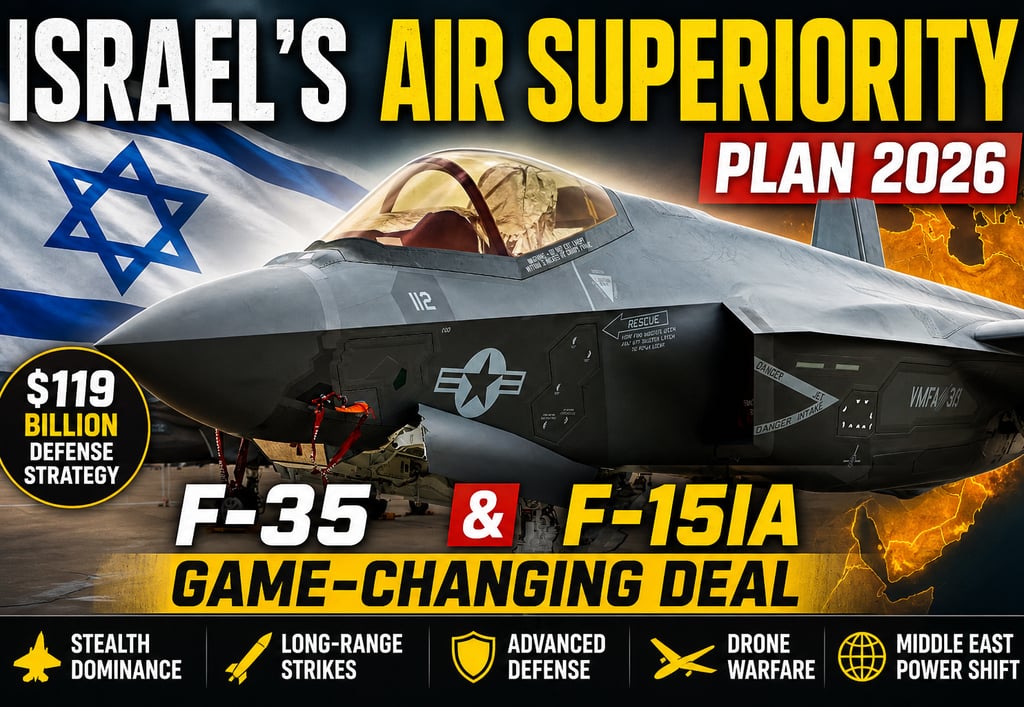
Israel’s Air Superiority Plan 2026: F-35 and F-15IA Acquisition and the Future of Middle East Military Power
Amid a rapidly evolving and volatile security environment in the Middle East, Israel has taken a major strategic step by approving a large-scale acquisition of advanced fighter aircraft. On May 3, 2026, Israel confirmed plans to purchase two new squadrons of F-35 and F-15IA fighter jets from leading U.S. defense companies Lockheed Martin and Boeing. The deal, valued at tens of billions of dollars, marks a critical phase in Israel’s long-term military modernization strategy and reflects its preparation for future high-intensity conflicts.
This procurement is part of a broader defense framework estimated at 350 billion shekels (approximately $119 billion). Israeli Prime Minister Benjamin Netanyahu emphasized that a significant portion of this budget will be allocated to domestic weapons production, aiming to reduce reliance on foreign suppliers during wartime. He also highlighted plans to develop next-generation indigenous aircraft, signaling a clear shift toward defense self-reliance and technological independence.
Under this plan, Israel will expand its fleet with a fourth squadron of F-35 Lightning II and a second squadron of F-15IA. The F-35, known for its stealth capabilities, sensor fusion, and network-centric warfare systems, serves as a “first-strike platform” capable of penetrating heavily defended airspace. In contrast, the F-15IA is designed for heavy payload delivery and long-range strike missions. Together, these aircraft form what defense analysts describe as a “dual-strike doctrine,” where the F-35 disables enemy defenses and the F-15IA executes large-scale precision attacks.
This strategy reflects an upgraded version of Israel’s long-standing air superiority doctrine, under which the Israel Defense Forces prioritizes achieving control of the air before engaging in ground or naval operations. This doctrine has consistently shaped Israel’s military planning and continues to define its operational approach in modern warfare.
The timing of this decision is closely linked to the recent U.S.–Iran conflict. On February 28, 2026, the United States and Israel launched coordinated airstrikes on Iran, significantly escalating regional tensions. Although a ceasefire has been in place since April 8, the situation remains fragile. During the conflict, the United States Navy maintained a blockade of Iranian ports, increasing economic and strategic pressure on Tehran. These developments reinforced Israel’s assessment that advanced air power and long-range strike capabilities are essential for future conflicts.
From a strategic perspective, Iran remains a central factor in Israel’s defense calculations. The geographical distance between the two countries—over 1,500 kilometers—requires aircraft capable of deep penetration and extended operational range. This makes aerial refueling and long-range strike platforms critical. The combination of the F-35’s stealth capabilities and the F-15IA’s payload capacity provides Israel with a credible “deep strike capability,” particularly relevant for targeting high-value military or nuclear infrastructure.
Israel’s defense expansion is not limited to fighter jets. The country is simultaneously strengthening a comprehensive, multi-layered defense ecosystem. Unmanned aerial systems play a central role in this framework. Israel is among the world’s leading producers of military drones, including surveillance UAVs, armed drones, and loitering munitions. These systems provide real-time intelligence, precision targeting, and rapid strike capabilities, making them indispensable in modern warfare.
Equally significant is Israel’s advanced missile defense architecture. Systems such as Iron Dome intercept short-range rockets, while David's Sling addresses medium-range threats. For long-range ballistic missiles, the Arrow Missile Defense System provides high-altitude interception capabilities. Together, these systems create a layered defensive shield capable of responding to diverse aerial threats.
In addition to kinetic capabilities, Israel continues to invest heavily in cyber warfare and electronic warfare systems. The Israel Defense Forces has developed advanced capabilities to disrupt enemy communications, disable radar systems, and conduct cyber operations targeting critical infrastructure. In modern conflicts, these non-kinetic tools are as decisive as traditional weapons systems.
Space-based capabilities are also becoming increasingly important. Israel is enhancing its satellite surveillance, missile tracking, and secure communication networks to ensure real-time situational awareness. These assets enable faster decision-making and improve operational coordination across multiple domains, including air, land, sea, cyber, and space.
Historically, Israel has relied heavily on air power to maintain its military advantage. From the 1967 war to recent operations against Hamas in Gaza and Hezbollah in Lebanon following the October 7, 2023 attacks, the Israeli Air Force has consistently played a decisive role. The current modernization effort represents a continuation of this strategy, adapted to the demands of next-generation warfare.
Regionally, this development is likely to accelerate an arms race. Iran may expand its missile and drone programs in response, while countries such as Saudi Arabia and others in the Gulf could increase defense spending to maintain strategic balance. This dynamic raises concerns about long-term stability in the Middle East.
From an economic standpoint, the 350 billion shekel defense plan represents a significant investment. While it may place pressure on public finances, it is also expected to boost Israel’s domestic defense industry, create jobs, and drive technological innovation. Increased local production will reduce supply chain vulnerabilities, a key lesson from recent conflicts.
In conclusion, Israel’s acquisition of F-35 and F-15IA fighter jets is not merely a procurement decision but part of a broader transformation toward an integrated, multi-domain military system. By combining air superiority, drone warfare, missile defense, cyber capabilities, and space assets, Israel is positioning itself for the future of warfare. This is not just about strengthening defense—it is about shaping the battlefield of tomorrow and redefining the balance of power in the Middle East.
Stay informed with the latest national and international news.
© 2026. All rights reserved.