
Iran War Costs U.S. $11.3 Billion in Just Six Days as Middle East Conflict Shakes Global Markets
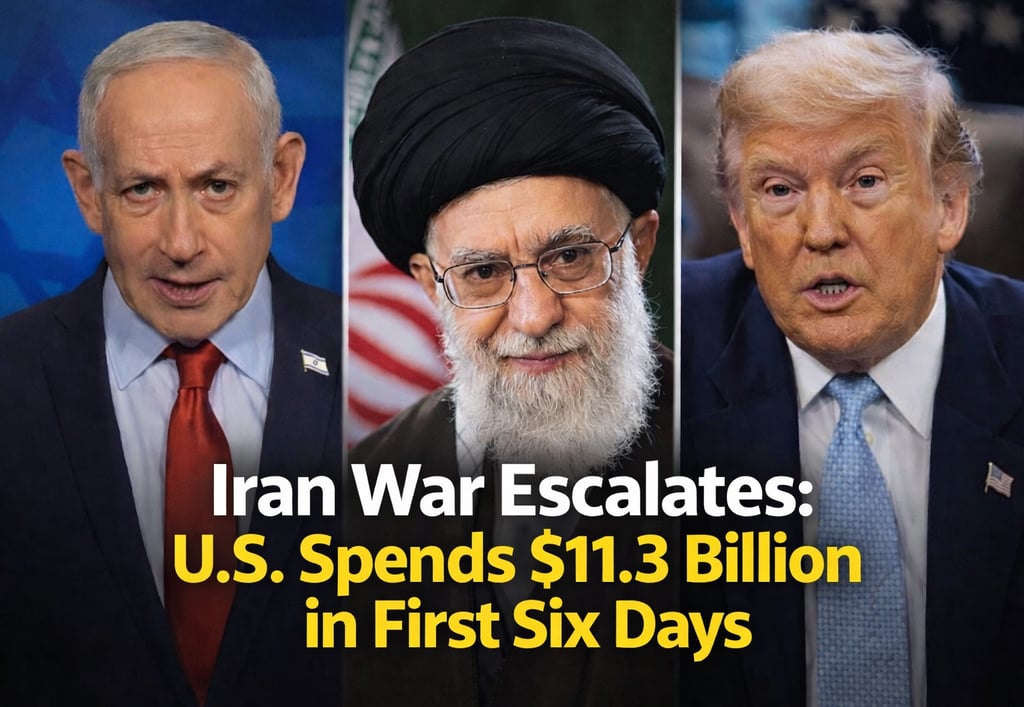
The U.S. war against Iran has already cost $11.3 billion in six days, raising fears of a wider Middle East conflict, rising oil prices, and new global economic risks.
Raja Awais Ali
3/12/20264 min read
Iran War Costs U.S. $11.3 Billion in Just Six Days as Middle East Conflict Escalates
The rapidly escalating conflict in the Middle East has once again placed the region at the center of global geopolitical tensions. Military operations launched by the United States and Israel against Iran have triggered widespread concern among governments, economists, and security analysts around the world. Within days, the conflict has not only intensified regional instability but also disrupted energy markets and raised fears of a prolonged and costly war.
According to officials from the administration of Donald Trump, the United States has already spent at least $11.3 billion during the first six days of the war against Iran. The estimate was shared with U.S. senators during a closed-door congressional briefing as lawmakers demanded greater transparency about the financial and strategic implications of the conflict.
The figure represents only a preliminary estimate of the war’s early costs and does not include several major military expenditures such as long-term deployments, logistics, and extended naval operations in the region. Defense officials suggested that the total cost could rise significantly if the conflict continues or expands into a wider regional confrontation.
Pentagon officials also told lawmakers that approximately $5.6 billion worth of munitions were used in the first two days of the air campaign alone. These weapons include precision-guided bombs, cruise missiles, and advanced strike systems deployed from aircraft carriers and long-range bombers. Modern warfare relies heavily on high-tech weaponry, and each missile or guided bomb can cost hundreds of thousands, and in some cases millions, of dollars.
The military campaign officially began on February 28, 2026, when U.S. and Israeli forces launched coordinated airstrikes targeting Iranian military installations and strategic infrastructure. The strikes were described by officials as an attempt to weaken Iran’s missile capabilities and its regional military network. However, the operation quickly escalated beyond its initial scope.
Within days, the conflict expanded across the region, with fighting spreading into neighboring Lebanon. Iran-aligned groups reportedly became involved in the confrontation, further complicating the security situation. Analysts warn that the growing number of actors involved increases the risk of a broader regional war.
The humanitarian impact of the conflict has also been severe. International media reports indicate that nearly 2,000 people have been killed since the beginning of the fighting. Most of the casualties are reported to be Iranian and Lebanese civilians, though military personnel have also been among the dead. Human rights observers warn that the death toll could rise sharply if the conflict intensifies.
Beyond the battlefield, the war is already sending shockwaves through the global economy. Rising tensions in the Persian Gulf have disrupted shipping routes and increased fears about the security of vital energy corridors. Oil traders and market analysts are particularly concerned about instability around the Strait of Hormuz, one of the world’s most important maritime chokepoints for crude oil transport.
As uncertainty spreads across energy markets, global oil prices have surged, with some benchmarks climbing above $100 per barrel. Because nearly one-third of the world’s seaborne oil supply passes through the Strait of Hormuz, any disruption to the route could trigger a major energy shock affecting economies worldwide.
President Trump has publicly stated that the United States has achieved significant early success in the military campaign. Speaking during a visit to Kentucky, he said that the U.S. had “won” the initial phase of the conflict but emphasized that American forces would remain engaged until the mission was fully completed. The statement has raised questions among analysts about how long the conflict may continue.
Inside Washington, the war is also fueling intense political debate. Members of Congress are demanding more detailed information about the administration’s long-term strategy and the potential financial burden of the operation. Several congressional aides say the White House may soon request additional war funding from lawmakers.
Early estimates suggest the administration could seek up to $50 billion in additional funding to sustain military operations and replenish depleted weapons stockpiles. U.S. defense inventories were already under strain due to increased global demand and previous military commitments, making resupply a major concern for Pentagon planners.
In response to these challenges, President Trump recently held meetings with executives from several major defense contractors. The discussions reportedly focused on accelerating weapons production and ensuring that the U.S. military can maintain operational readiness if the conflict expands.
Democratic lawmakers have also called for public testimony from administration officials under oath, seeking clearer explanations about the goals of the war, its expected duration, and Washington’s long-term plans for Iran after hostilities eventually end.
Meanwhile, Iranian officials have vowed to continue resisting the attacks and defending their sovereignty. Tehran claims it has already launched missile and drone strikes targeting American and Israeli interests across the region, raising fears that the confrontation could spiral into a much larger regional war.
Security analysts note that modern conflicts rarely remain confined to military battlefields. Instead, their consequences ripple across global economies, political alliances, and international diplomacy. The rapidly escalating Iran war appears to be following that pattern, with financial costs mounting and geopolitical tensions intensifying.
For now, the world is watching closely as the conflict unfolds. If diplomatic solutions fail to emerge and military escalation continues, the war could reshape the strategic landscape of the Middle East while imposing enormous economic costs on the global community.
Stay informed with the latest national and international news.
© 2026. All rights reserved.