
Iran War 2026: US Special Forces Rescue Airman After F-15 Crash in Iran | Full Analysis April 5
A high-risk US special forces mission rescues a downed F-15 airman deep inside Iran. Full detailed analysis of the Iran War 2026, aircraft involved, casualties, and global impact.
Raja Awais Ali
4/5/20265 min read
Iran War 2026: F-15 Crash, High-Risk US Special Forces Rescue Mission, and the Full War Picture (April 5, 2026)
The ongoing war between Iran, the United States, and Israel has now entered its sixth week, and as of April 5, 2026, the situation has become extremely critical. The conflict began on February 28, 2026, when the United States and Israel launched large-scale strikes on Iran’s nuclear and military infrastructure. The objective was to weaken Iran’s missile and nuclear capabilities, but Iran responded swiftly and aggressively using ballistic missiles, cruise missiles, drones, and advanced air defense systems to target US and allied assets. Within days, the conflict expanded across the Middle East, affecting Gulf countries, Iraq, Syria, and key maritime routes in the Persian Gulf, while also putting significant pressure on the global economy, oil supply, and financial markets.
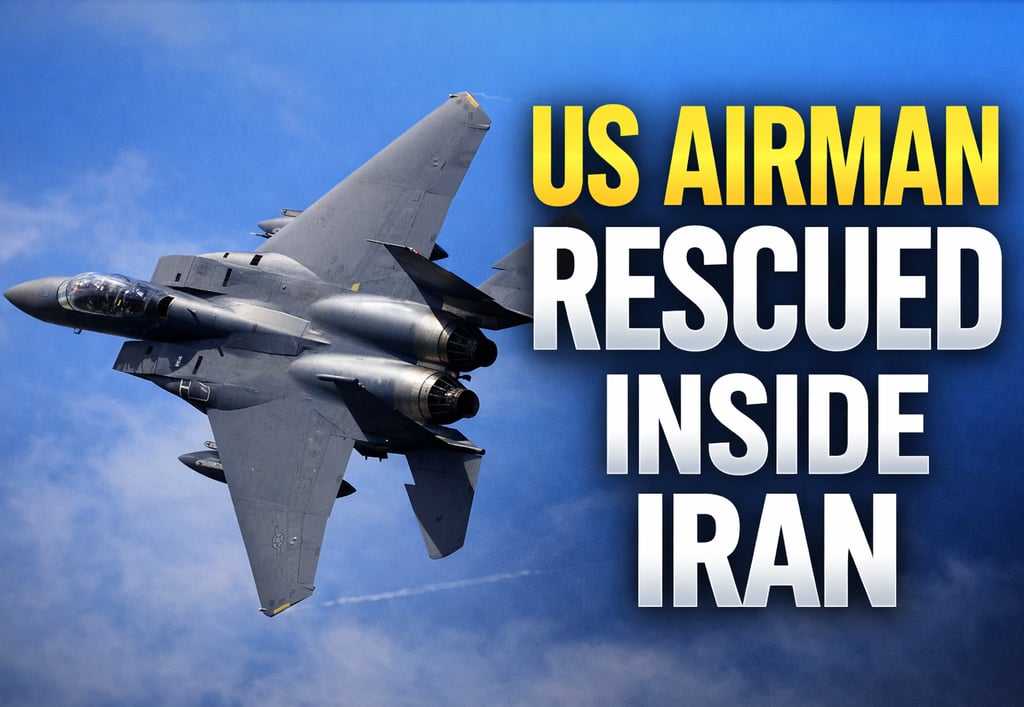
During this escalating conflict, a major turning point occurred on April 4, 2026, when Iranian air defense systems shot down a US F-15E Strike Eagle fighter jet inside Iranian territory. This marked a significant moment in the war, as it was one of the most advanced US aircraft to be downed in hostile territory. The aircraft carried two crew members: a pilot and a weapons systems officer, reportedly a colonel. Both managed to eject safely but landed in a mountainous and highly dangerous region deep inside Iran, surrounded by Iranian forces and local networks. Shortly after the incident, Iranian authorities urged civilians to help locate the American airman, aiming to capture him alive and use him as political leverage against Washington. Had Iran succeeded, it could have triggered a major hostage crisis, potentially shifting public opinion in the United States against the war.
In response, the United States immediately launched a large-scale Search and Rescue operation involving dozens of aircraft, special forces units, drones, satellite intelligence, and helicopters. The first crew member was rescued relatively quickly, but the second officer remained hidden behind enemy lines for several hours, possibly more than a day. Despite being injured, he managed to survive while evading Iranian forces and local civilians. US airmen are trained under Survival, Evasion, Resistance, and Escape (SERE) protocols, but operating in Iran presents unique challenges due to language barriers, unfamiliar terrain, and a hostile environment where most personnel are not fluent in Persian.
The rescue mission faced intense resistance from Iranian forces. Reports indicate that at least two UH-60 Black Hawk helicopters were hit by Iranian fire but managed to escape. Additionally, an A-10 Thunderbolt II aircraft was struck during operations, forcing its pilot to eject. Iranian sources also claimed that several US aerial assets were destroyed during the mission. The operation involved dozens of aircraft and helicopters, highlighting its scale and complexity. At one point, US forces were forced to destroy one of their own malfunctioning aircraft to prevent it from falling into enemy hands, underscoring the high-risk nature of the mission.
Eventually, US special forces successfully reached the injured officer, extracted him from a remote location, and transported him to a secure landing zone within Iran before evacuating him by helicopter. US President Donald Trump described the mission as one of the most daring rescue operations in US military history and claimed that no American personnel were killed or wounded, although field reports suggest a more complex reality. This operation is particularly notable as it marks a rare instance where two US aircrew members were rescued separately from deep within enemy territory.
Israel is also believed to have played a significant role in the operation by providing intelligence, satellite data, and possibly operational coordination. Reports suggest that the CIA conducted a deception campaign to mislead Iranian forces and conceal the actual rescue location. These combined efforts were critical to the success of the mission, but they also highlight that Iran’s defensive capabilities remain strong and effective.
In terms of casualties, the war has already taken a heavy toll. Across Iran, Iraq, Syria, and the Gulf region, approximately 2,000 to 3,500 people have been killed, while injuries range between 8,000 and 12,000. The United States has confirmed 13 military fatalities and over 300 wounded personnel. Iranian losses are believed to be significantly higher, although exact figures remain difficult to verify. Military equipment losses have also been substantial, including dozens of drones, multiple fighter aircraft, and several missile systems. According to US intelligence, only about one-third of Iran’s missile arsenal has been definitively destroyed, while another third remains uncertain, and the rest could still be operational, posing ongoing threats.
Economically, the war has had a profound global impact. Oil prices have surged significantly, with Brent crude trading between $95 and $110 per barrel, and in some cases even higher. Global stock markets have become increasingly volatile, inflation concerns are rising, and supply chains are being disrupted, particularly due to risks to key shipping routes in the Persian Gulf. Gulf economies, aviation, insurance, and the energy sector are all experiencing serious pressure.
Looking at the aircraft involved in this operation provides insight into the level of advanced and costly military power deployed. The F-15E Strike Eagle is a twin-seat, all-weather, multi-role strike fighter designed for deep strike missions, ground attacks, and air superiority. It can reach speeds of up to Mach 2.5 (around 2,650 km/h) and has a range of approximately 3,900 kilometers. The aircraft is equipped with advanced radar systems, night vision capabilities, precision-guided munitions, and a wide array of missiles. Its unit cost is estimated between $80 million and $100 million, with overall operational costs significantly higher depending on mission configuration.
Similarly, the A-10 Thunderbolt II, commonly known as the “Warthog,” is specifically designed for close air support missions. Its most distinctive feature is the powerful 30mm GAU-8 Avenger cannon, capable of destroying heavily armored vehicles and tanks. The aircraft has a top speed of around 706 km/h and is highly effective at low altitudes. Its unit cost ranges from $18 million to $25 million, though upgraded versions can be more expensive.
The UH-60 Black Hawk is a versatile multi-role helicopter widely used by the US military for troop transport, medical evacuation, rescue missions, and special operations. It can carry up to 11 soldiers and has a top speed of approximately 280 km/h, with a range of about 500 to 600 kilometers. It is equipped with advanced navigation, defense, and communication systems. The cost of a Black Hawk helicopter typically falls between $20 million and $25 million, depending on configuration.
The presence of these high-value assets highlights not only the operational complexity of the rescue mission but also its immense financial scale. A single operation involving such aircraft, combined with fuel, logistics, intelligence, and support systems, can cost hundreds of millions, if not billions, of dollars.
Overall, this incident is not just a rescue mission—it reflects the broader complexity, intensity, and unpredictability of the Iran War 2026. On one side, the United States is leveraging advanced technology, special forces, and global alliances to assert dominance, while on the other, Iran continues to demonstrate resilience through its missile capabilities, air defense systems, and strategic geography. The coming days will be critical in determining whether the conflict escalates further, particularly if the United States targets Iran’s energy infrastructure, or if diplomatic efforts emerge. For now, all indications suggest that the war may become longer and more dangerous, with far-reaching consequences not only for the Middle East but for the entire world.
Stay informed with the latest national and international news.
© 2026. All rights reserved.