
Iran War 2026: Trump Warns of Major Strike as Strait of Hormuz Crisis Sends Oil Prices Surging
Iran war 2026 escalates as Donald Trump warns of major strikes on Iran while tensions in the Strait of Hormuz push global oil prices above $100. Global energy markets face rising uncertainty.
Raja Awais Ali
3/13/20263 min read
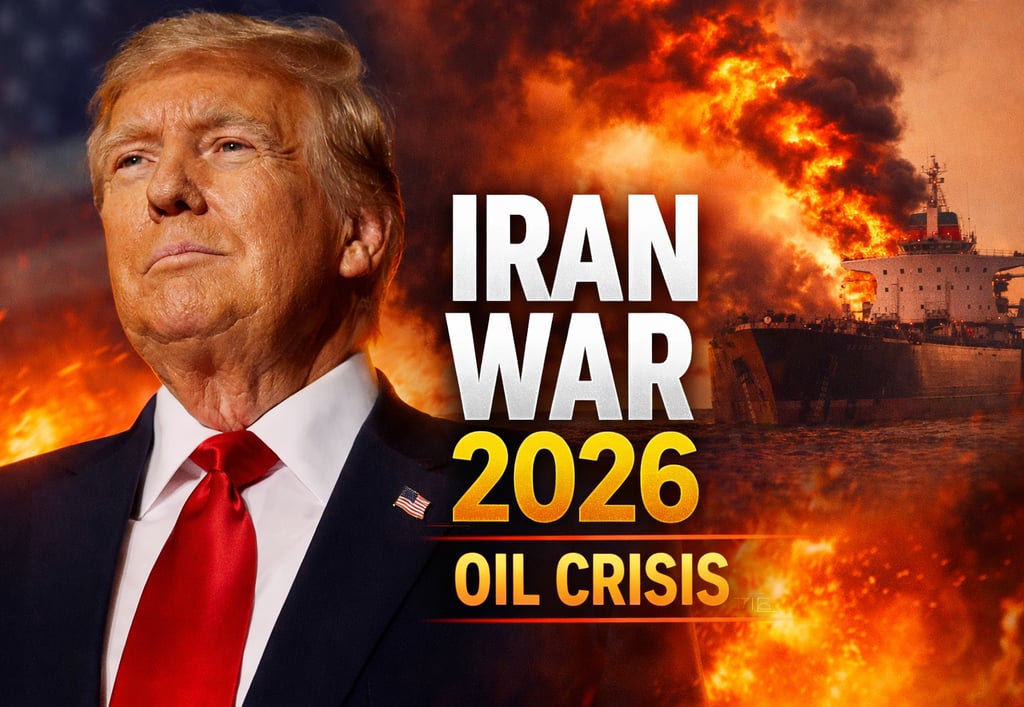
Iran War 2026: Trump Threatens Strong Action as Russian Oil Waiver and Strait of Hormuz Tensions Shake Global Energy Markets
The Middle East has once again become the center of global political and economic attention. On March 13, 2026, escalating tensions between the United States, Israel, and Iran intensified the ongoing regional conflict, raising serious concerns about global energy security and economic stability.
U.S. President Donald Trump warned that the United States could strike Iran “very hard” in the coming days if hostilities continue to escalate. The statement comes at a moment when Washington has simultaneously taken an unexpected step by issuing a temporary waiver allowing limited purchases of Russian oil already at sea, an attempt to calm global markets shaken by the war.
These developments suggest that the current conflict is no longer just a regional military confrontation. Instead, it is rapidly evolving into a broader geopolitical and economic crisis with direct consequences for global energy supply, financial markets, and international security.
The war, which began in late February 2026, has now entered its second week with both sides carrying out extensive military operations. Israeli forces say they have conducted widespread airstrikes across Iranian territory, targeting key military infrastructure including ballistic missile launchers, air defense systems, and weapons manufacturing facilities. Reports indicate that more than 200 military targets were struck in a single day during one of the most intense waves of attacks.
Iran, in response, has launched multiple missile and drone strikes toward Israel, triggering air defense systems and emergency responses in several Israeli regions. The continuing cycle of attacks has significantly raised fears of a broader regional war.
According to early estimates from regional sources, the conflict has already resulted in more than 2,000 deaths, with the majority reported inside Iran. Casualties have also been recorded in Lebanon and parts of the Gulf region, highlighting how the conflict is increasingly spreading beyond its original front lines.
One of the most critical aspects of the crisis involves the strategic waterway known as the Strait of Hormuz. This narrow shipping corridor is considered one of the most vital energy routes in the world. Approximately 20 percent of global oil shipments pass through this passage every day.
Recent tensions in the strait, including threats to commercial shipping and attacks on vessels, have raised alarm among energy analysts and global shipping companies. Any serious disruption in this corridor could have immediate and far-reaching consequences for the world economy.
President Trump has suggested that the United States could deploy naval forces to escort oil tankers if the security situation deteriorates further. Such a move would dramatically increase the military presence in the Gulf and could potentially heighten the risk of direct confrontation between U.S. and Iranian forces.
Energy markets have already begun reacting to the crisis. Global benchmark Brent crude oil prices have surged to around $99.50 per barrel, representing an increase of nearly 40 percent since the war began. At certain points earlier in the week, prices briefly crossed the $110 per barrel mark, reflecting growing fears of supply disruptions.
Energy experts warn that if the conflict continues to escalate or if shipping routes in the Gulf become severely restricted, oil prices could rise significantly further. Some analysts believe prices could reach $120 to $150 per barrel, levels that would likely trigger widespread economic consequences across multiple sectors.
The impact of rising energy prices is already being felt in several countries. Fuel costs are increasing, transportation expenses are rising, and concerns about inflation are spreading through global markets.
At the same time, the United States has introduced a temporary 30-day waiver allowing the purchase of certain Russian oil cargoes already at sea. The decision is widely seen as an attempt to stabilize supply and prevent a sharp energy shortage while the Middle East conflict continues to disrupt markets.
Energy analysts note that the move reflects the complex geopolitical balancing act currently unfolding. While Washington remains heavily involved in the conflict with Iran, it is also trying to prevent global oil prices from rising to levels that could harm the world economy.
Beyond energy markets, the conflict is also affecting financial markets and investor confidence. Stock markets across Europe and Asia have experienced volatility as investors respond to the growing uncertainty surrounding the war.
Energy specialists warn that the present crisis could become one of the largest disruptions to global oil supply in recent history if tensions continue to escalate.
In the United States, diesel prices have climbed to around $4.89 per gallon, the highest level since late 2022. Rising fuel prices could eventually impact food costs, logistics networks, and international trade.
Overall, the 2026 Iran conflict is no longer limited to a regional power struggle. It has become a global geopolitical challenge involving military escalation, economic uncertainty, and energy security risks.
The coming days may prove decisive. If diplomatic efforts fail and military operations intensify, the conflict could expand further across the Middle East, potentially drawing in additional regional actors and placing even greater pressure on global markets.
For now, governments, energy companies, and financial institutions around the world are closely watching developments, aware that the next phase of this crisis could shape global politics and economic stability for months to come.
Stay informed with the latest national and international news.
© 2026. All rights reserved.