
Iran War 2026: Gulf Luxury Car Market Crashes 30%, Supply Chain Disruptions Trigger Billion-Dollar Industry Losses
The Iran War 2026 has triggered a 30% drop in Gulf luxury car sales, disrupted global supply chains, and caused billion-dollar losses for brands like Ferrari, Bentley, and Rolls-Royce. Full latest analysis.
Raja Awais Ali
3/30/20265 min read
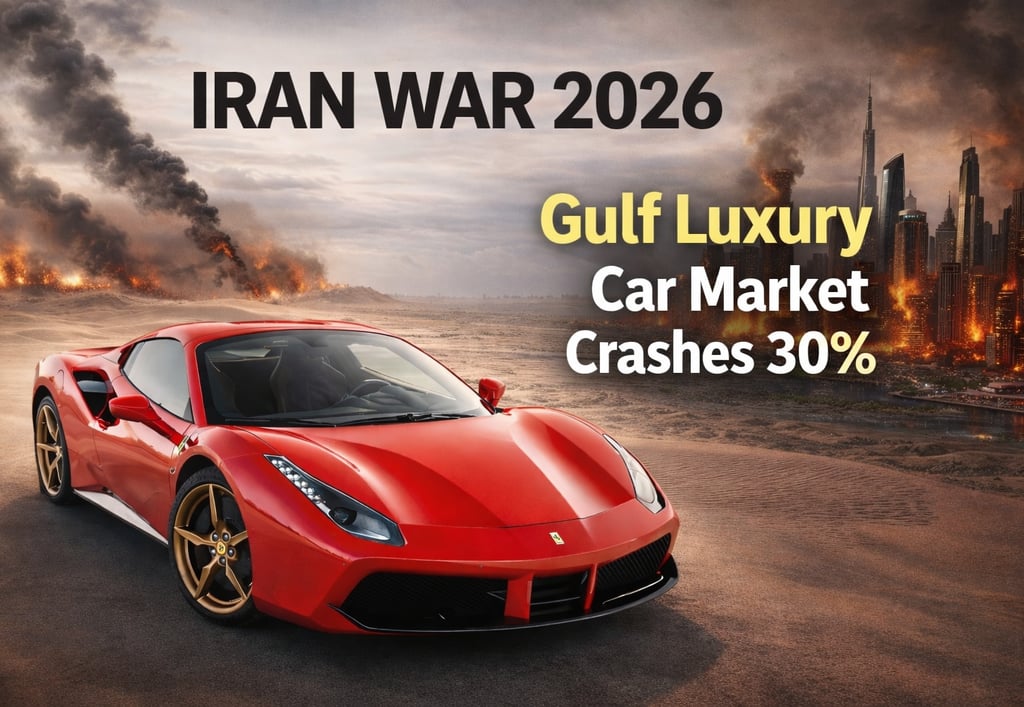
Iran War 2026: Gulf Luxury Car Market Crashes 30% as Supply Chain Disruptions Trigger Billion-Dollar Industry Losses
The Iran War that began on February 28, 2026, in the Middle East has delivered a significant shock not only to the global economy but also to the luxury car industry. The Gulf region, long considered one of the most profitable markets in the world despite its relatively low sales volume, is now facing uncertainty and a sharp slowdown in business activity. Global automotive giants such as Rolls-Royce Motor Cars, Ferrari, Bentley, Lamborghini, Porsche, Maserati, and Jaguar Land Rover are closely monitoring the situation, as this region contributes disproportionately high profit margins to their overall business.
Luxury car demand in Gulf countries such as the United Arab Emirates, Saudi Arabia, and Qatar has historically remained strong. Buyers in these markets are not only known for purchasing high-end vehicles but also for favoring bespoke, custom-built models featuring gold plating, rare wood trims, handcrafted interiors, and limited-edition designs. These customizations can multiply the value of a vehicle several times over, sometimes exceeding $10 million per unit, making the Gulf a high-margin market for luxury automakers.
Following the outbreak of the war, several luxury car showrooms across the Gulf temporarily shut down, particularly in Dubai, one of the world’s most prominent hubs for high-end automobile sales. A notable example is the well-known dealership F1rst Motors, which closed briefly and later reported approximately a 30% decline in business upon reopening. This indicates a sharp drop in buyer activity and rising uncertainty within the market.
Although some showrooms have resumed operations, there has been a clear decline in walk-in customers. Dealers report that most transactions are now taking place through online channels or private appointments, while general showroom traffic has dropped significantly. This shift reflects a broader transformation in consumer behavior under uncertain economic and geopolitical conditions.
At the same time, Ferrari and Maserati temporarily halted vehicle shipments to Gulf countries due to security concerns affecting shipping routes. Other manufacturers also limited new deliveries, severely disrupting supply chains. The conflict has put the Strait of Hormuz—a critical global trade route—at risk, impacting not only oil transportation but also vehicle shipments. As a result, companies have been forced to explore alternative logistics solutions, including air freight, which is significantly more expensive. This has increased operational costs and raised the likelihood of further price hikes for luxury vehicles.
Interestingly, ultra-wealthy buyers continue to make purchases, particularly in the segment above $1 million. However, overall market activity has slowed. Some customers are even spending up to €30,000 to relocate their vehicles abroad for safety, highlighting the growing sense of uncertainty in the region.
Looking at sales performance over the past six years, Ferrari’s deliveries increased from 9,119 units in 2020 to 11,155 in 2021, 13,221 in 2022, 13,663 in 2023, 13,752 in 2024, and approximately 13,900 units in 2025, reflecting steady but slowing growth. Rolls-Royce Motor Cars saw sales rise from 3,756 units in 2020 to 5,586 in 2021, 6,021 in 2022, and a record 6,032 in 2023, before declining to 5,712 in 2024 and approximately 5,500 in 2025, indicating a clear slowdown.
Bentley’s sales grew from 11,206 units in 2020 to 14,659 in 2021 and peaked at 15,174 in 2022, before falling to 13,560 in 2023, around 13,000 in 2024, and approximately 12,500 in 2025. Lamborghini recorded growth from 7,430 units in 2020 to 10,112 in 2023, followed by stabilization at around 10,000 in 2024 and a slight decline to approximately 9,800 in 2025. Meanwhile, Porsche deliveries increased from 272,162 units in 2020 to 320,221 in 2023, remained stable at around 320,000 in 2024, and slightly declined to approximately 315,000 in 2025, reflecting global demand pressures.
According to Ferrari, the Middle East accounted for approximately 4.6% of its total global sales, underscoring the strategic importance of the region, particularly due to high-margin bespoke and limited-edition models.
The global luxury car industry was already under pressure before the conflict. Demand in China had weakened, Europe was experiencing an economic slowdown, and the United States was facing policy and tariff-related challenges. Meanwhile, the Russia market had effectively disappeared after 2022 due to sanctions following the Russia-Ukraine War. The disruption of the Gulf market has now added further pressure on global automakers.
International reports indicate that the crisis has also heavily impacted the shipping sector. Following attacks on vessels near the Strait of Hormuz, several global shipping companies scaled back operations, leading to sharp increases in freight and insurance costs. Additionally, the supply of used luxury vehicles from Japan and South Korea has been disrupted, with shipments facing delays or being rerouted.
Analysts now suggest that the situation has evolved beyond a simple demand slowdown or regional instability. It has become a full-scale economic chain disruption affecting logistics, production, and pricing simultaneously. The situation in the Strait of Hormuz has particularly shaken the global shipping industry, with insurance costs rising multiple times and companies either rerouting or suspending maritime operations.
In response, Ferrari has resorted to air freight for its ultra-wealthy clients, using cargo aircraft such as the Boeing 747. While this approach is three to four times more expensive than sea transport, it highlights the lengths to which companies are going to maintain their high-end customer base. However, even these measures are placing additional pressure on profit margins, despite some limited resumption of shipments.
The luxury market is now clearly divided into two segments: ultra-rich buyers who remain active, and mid-level luxury consumers who are gradually exiting the market. This shift has led to a noticeable decline in showroom traffic and demonstrates that economic uncertainty tends to impact middle-tier consumers first. Despite its relatively low volume, the Middle East remains a disproportionately high-profit market for luxury brands.
The war has also disrupted industrial supply chains, particularly affecting the availability of key raw materials such as aluminum, which is essential for vehicle manufacturing. This is expected to increase production costs and drive further price increases in the future. At the same time, investor concerns have placed additional pressure on the stock performance of several luxury automakers.
Executives from Bentley and Volkswagen have also signaled that luxury purchases are no longer a top priority for consumers under current conditions, warning that the situation could worsen if instability persists.
Furthermore, the bespoke segment—traditionally the most profitable area of the luxury car industry—has nearly come to a halt. New orders have declined significantly, as buyers shift their focus from luxury spending to asset protection. This has directly impacted high-margin revenue streams.
Overall, the Iran War 2026 has inflicted significant damage on the Gulf luxury car market, with an immediate decline of approximately 30% in sales, major supply chain disruptions, rising costs, and shifting consumer behavior. If the situation continues, this crisis may not remain temporary but could fundamentally reshape the business model of the global luxury automotive industry. Heavy reliance on the Gulf market may emerge as a major strategic risk, forcing companies to rethink their market strategies, cost structures, and future growth plans.
Dubai has recently come under global environmental scrutiny after being ranked among the world’s top 10 most polluted cities in a major air quality report released on September 10, 2025. With an Air Quality Index (AQI) of 142, the city falls into the “unhealthy for sensitive groups” category, raising serious concerns about public health and sustainable urban development. According to the report, heavily polluted cities such as Delhi, Lahore, Dhaka, and Karachi continue to dominate global rankings, but Dubai’s entry highlights that even fast-growing modern cities are not immune to air quality challenges.
The major causes behind Dubai’s rising pollution include large-scale construction dust, increasing vehicle emissions, industrial activity, and natural desert conditions that trap pollutants in the air. Experts warn that this trend could lead to higher cases of asthma, bronchitis, cardiovascular diseases, and long-term respiratory issues, especially among children and the elderly. In response, UAE authorities are planning stricter emission controls, expansion of green transportation, and investment in renewable energy projects to improve air quality.
To understand the full breakdown of causes, rankings, and government response, read our detailed analysis here:
👉 https://blinknews.blog/dubai-top-10-most-polluted-cities-september-2025
Stay informed with the latest national and international news.
© 2026. All rights reserved.