
Iran War 2026 Pushes China Toward Electric Trucks as Diesel Costs Surge
Rising diesel prices after the Iran War 2026 are accelerating China’s shift to electric heavy trucks. Discover how EV trucks are reshaping China’s transport industry, oil demand, and global energy markets.
Raja Awais Ali
5/7/20264 min read
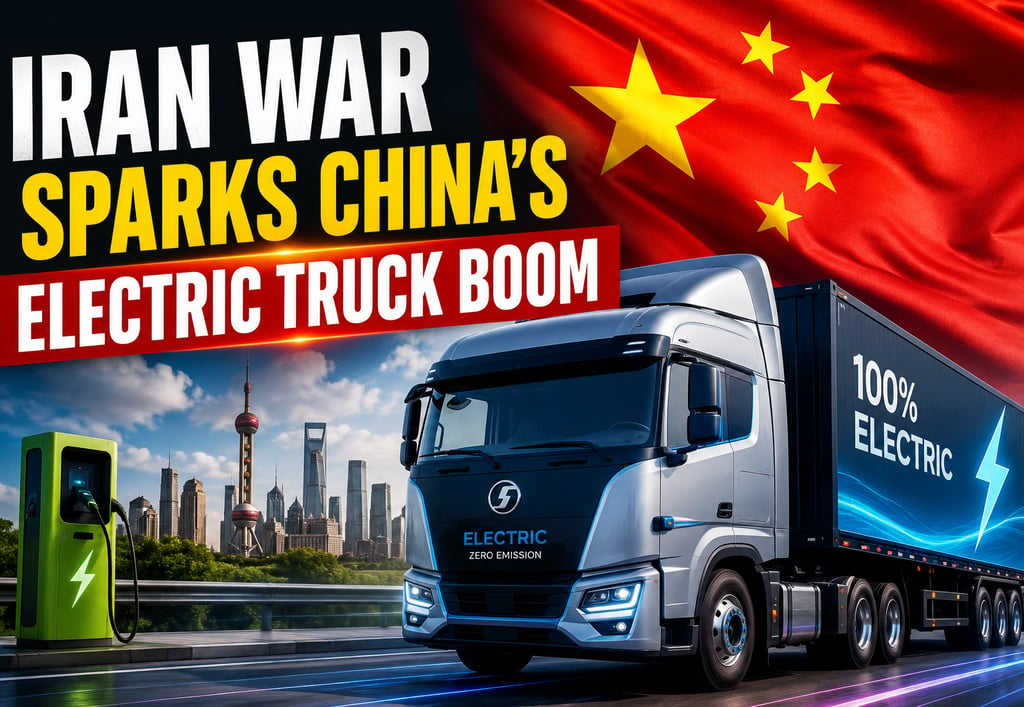
Iran War 2026 Pushes China Into an Electric Truck Revolution as Diesel Prices Surge
The economic shockwaves created by the Iran War 2026 are now reshaping industries far beyond the Middle East. While global attention has largely focused on military tensions, oil supply risks, and rising energy prices, another major transformation is quietly unfolding inside China. The world’s largest oil importer is rapidly accelerating its transition from diesel-powered heavy trucks to electric transport, a shift that could permanently alter global fuel demand and the future of commercial logistics.
China’s electric vehicle industry has already become a global leader over the past decade, but heavy-duty trucking remained heavily dependent on diesel fuel. That situation is now changing faster than expected. Since the Iran conflict escalated on February 28, 2026, diesel prices in China have jumped by nearly 27 percent, reaching their highest levels in almost four years. The sharp rise in fuel costs is forcing logistics companies, industrial operators, and fleet owners to rethink the economics of traditional transport.
As operating expenses climb, electric heavy trucks are becoming financially attractive at an unprecedented speed. New-energy heavy truck sales in China, most of which are electric, rose 45 percent during the first quarter of 2026, reaching around 44,000 units. Electric models now account for more than a quarter of all new heavy truck sales in the country, compared with less than 20 percent during the same period last year.
Industry analysts believe the momentum is only beginning. Market researchers expect electric heavy truck sales to continue rising strongly throughout 2026 due to higher fuel prices, government support programs, and the rapid expansion of charging infrastructure across industrial regions. What once appeared to be a slow transition is now turning into a full-scale industrial shift.
One of the most important reasons behind this rapid growth is the changing cost structure of freight transport. Although electric heavy trucks still cost significantly more upfront than diesel models, long-term operating costs are dramatically lower. In China, a typical electric heavy truck can cost more than 500,000 yuan, while diesel versions are often priced near 300,000 yuan. However, government trade-in subsidies have reduced much of that difference, especially after authorities extended incentive programs through the end of 2026.
The real advantage appears after years of operation. Energy research firms estimate that the total lifecycle cost of an electric heavy truck over one million kilometers is nearly half that of a diesel equivalent when fuel, maintenance, and operating expenses are included. For transport companies operating large fleets, those savings are becoming too large to ignore.
The Iran War has therefore created a powerful economic trigger. Higher oil prices are no longer just increasing transportation costs; they are accelerating structural change inside the world’s largest manufacturing economy. Analysts now expect China’s transition away from diesel to move faster than previously forecast, especially in industries linked to steel, mining, ports, and industrial logistics.
Electric heavy trucks are also becoming more practical than before. Earlier models were mostly limited to short industrial routes, but Chinese manufacturers are now developing vehicles capable of traveling much longer distances. Many current electric trucks already offer driving ranges of around 300 kilometers per charge, while newer models entering the market are approaching 600 kilometers. That improvement is expanding their role beyond local industrial transport and into wider freight networks.
Chinese truck manufacturers are also preparing to expand aggressively into international markets. Europe, currently the world’s second-largest electric truck market, is expected to become a major target for Chinese exports. Chinese electric truck makers are planning to launch sales across Europe with prices significantly lower than many existing European competitors. This growing export push could create serious pressure on Western truck manufacturers already struggling with high production costs and the expensive transition toward green transport technology.
The wider implications extend far beyond the trucking sector itself. China’s rapid adoption of electric vehicles, combined with increased use of liquefied natural gas trucks and renewable energy infrastructure, is already reducing long-term growth in diesel and gasoline consumption. Many energy analysts previously expected China’s oil demand to peak around 2030, but current developments suggest that decline could begin earlier and move faster than expected.
Several energy consultancies now forecast a steeper drop in China’s diesel consumption during 2026 than they predicted before the Iran conflict began. Some estimates suggest diesel demand could decline by as much as 5 percent this year alone. That reduction represents tens of thousands of barrels per day disappearing from global fuel demand forecasts, potentially reshaping future oil market expectations.
What makes this development especially important is that it reflects more than a temporary market reaction. The Iran War has exposed how vulnerable global economies remain to oil supply disruptions and fuel price shocks. China’s response appears increasingly focused on reducing that vulnerability through electrification and energy diversification.
For years, electric trucks were viewed as a niche experiment with limited commercial viability. In 2026, they are quickly becoming a central part of China’s industrial strategy. Rising diesel prices, government incentives, lower operating costs, and rapid technological improvements are now combining to push the industry into a new phase of growth.
If current trends continue, China may soon lead not only the global electric car market but also the future of heavy commercial transportation. The consequences could reach far beyond China itself, affecting global oil demand, energy security strategies, international trucking markets, and the broader balance of industrial power in the years ahead.
Stay informed with the latest national and international news.
© 2026. All rights reserved.