
US Israel War 2026: Oil Prices Crash, Strait of Hormuz Crisis & Global Energy Shock Explained
March 23, 2026 crisis explained: Iran-US-Israel tensions, oil price crash, Strait of Hormuz disruption, global energy and economic impact.
Raja Awais Ali
3/23/20265 min read
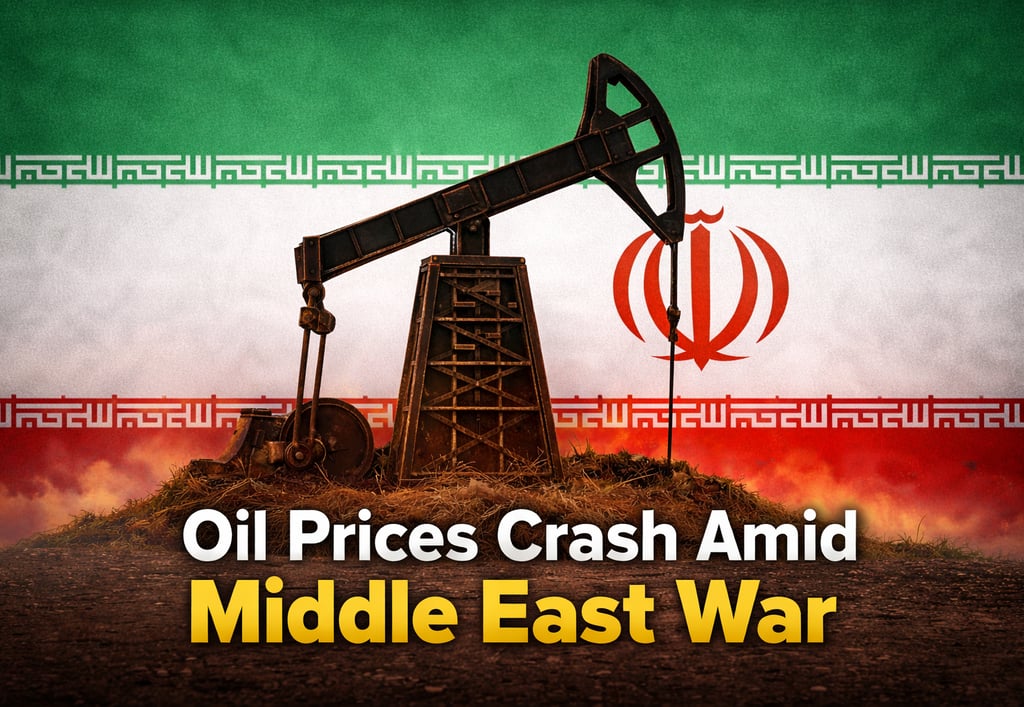
Iran–US–Israel Tensions Trigger Historic Oil Price Drop, Global Energy Crisis and an Uncertain Future
On March 23, 2026, escalating tensions in the Middle East between Iran, United States, and Israel reached a critical turning point when Donald Trump suddenly announced a five-day delay in the planned U.S. strikes on Iran’s power plants. This unexpected decision triggered massive volatility in the global oil market, leading to a sharp and unusual decline in prices. The development came at a moment when, just hours earlier, the region was on the brink of a major military confrontation. The United States had already issued a clear ultimatum to Iran, warning that if the Strait of Hormuz was not fully reopened, Iran’s energy infrastructure would be targeted.
In response, Iran’s Islamic Revolutionary Guard Corps issued a strong warning, stating that any U.S. attack would result in retaliation against Israel and American interests across Gulf countries, including critical energy installations. This significantly increased the risk of a wider regional war. Against this highly tense backdrop, Trump’s reference to “constructive dialogue” and the postponement of military action provided temporary relief to global markets.
The oil market reacted immediately. Brent crude oil prices dropped by approximately 14 to 15 percent, briefly falling to around $96 per barrel before stabilizing near $101. Similarly, West Texas Intermediate (WTI) crude declined by about 13 to 14 percent, reaching a low of $84 before recovering to around $89. However, when viewed in a broader context, oil prices had surged beyond $110 per barrel during the earlier phase of the escalation. This clearly demonstrates that global oil markets are currently experiencing extreme volatility and uncertainty, with significant price swings occurring within hours, reflecting both investor fear and cautious optimism.
At the center of this crisis lies the Strait of Hormuz, widely regarded as the lifeline of global energy supply. Approximately 20 percent of the world’s oil and gas passes through this narrow waterway. Due to the ongoing conflict, maritime traffic has been severely disrupted, and commercial shipping activity in several areas has nearly come to a halt. Recent reports suggest that the strait is effectively partially closed, resulting in a significant reduction in oil tanker movement. According to experts, this disruption is affecting between 7 to 10 million barrels of oil per day from the Middle East, representing a major shock to the global economy.
This is why energy analysts and global agencies have described the current situation as potentially more dangerous than the oil shocks of the 1970s. Unlike past crises, this situation is not only about supply disruption but also involves geopolitical tensions, war risks, and an already fragile global economic environment.
Looking deeper, the crisis is no longer limited to oil; it is now affecting global gas supplies as well. The UAE-based energy company ADNOC Gas has adjusted its LNG export operations due to shipping disruptions in the Strait of Hormuz. Additionally, there have been reports of missile debris falling near key energy infrastructure, highlighting the growing risk to facilities across the region. This indicates that the scope of the crisis is rapidly expanding and now directly threatens critical energy systems.
Furthermore, the crisis has severely impacted other oil-producing countries in the region. Iraq has declared force majeure on several oil fields operated by foreign companies, while production from the Basra Oil Company has dropped drastically from 3.3 million barrels per day to nearly 900,000 barrels per day. This represents a massive decline. Similarly, in Libya, the El Feel oil field has been shut down, halting production entirely. In Russia, certain port operations have also been disrupted due to attacks and security concerns, affecting oil loading activities.
All these factors combined have placed immense pressure on global supply chains, making oil availability increasingly uncertain. In an interesting development, the United States has temporarily eased some sanctions on Russian and Iranian oil to maintain market stability. At the same time, Asian countries, including India, are considering resuming purchases of Iranian oil. This clearly shows that the global economy is currently under severe energy pressure, forcing countries to take immediate and strategic decisions based on their national interests. As a result, global markets have become heavily dependent on geopolitical developments.
When analyzing financial markets, the decline in oil prices initially led to a temporary recovery in global stock markets, as investors interpreted the delay in military action as a reduction in immediate risk. However, experts believe that this reaction may be short-lived. Gold prices have also shown unusual volatility, indicating that investors remain cautious and are closely monitoring developments. Moreover, rising fuel prices and renewed inflation concerns in the United States and Europe are beginning to emerge again, turning this crisis into a broader economic challenge.
In addition, high-level emergency meetings have been held in the United States involving top energy officials and major industry players. These discussions have focused on increasing domestic oil production, utilizing strategic reserves, and exploring alternative supply sources such as Venezuela. According to experts, these measures clearly indicate that the United States is treating this crisis as a long-term strategic issue rather than a temporary disruption.
From a broader perspective, this crisis has exposed the vulnerabilities of the global energy system. A conflict in one region has the potential to disrupt economies across the entire world. This is particularly concerning at a time when global energy demand is continuously rising due to the expansion of digital economies, data centers, and industrial activities. The situation has highlighted the urgent need for energy diversification, resilient supply chains, and reduced dependence on geopolitically sensitive regions.
Meanwhile, military activities continued across the region on March 23. Israel carried out airstrikes in southern Lebanon, reportedly targeting locations linked to Iran. On the other hand, Iran increased its naval presence in the Gulf and issued warnings to commercial vessels, further escalating tensions in the Strait of Hormuz. At the same time, United States placed its naval and air forces in the region on high alert. These developments suggest that despite temporary diplomatic signals, the situation on the ground still points toward the possibility of a larger military confrontation.
Furthermore, the crisis has significantly impacted global shipping and insurance sectors. Insurance premiums for oil tankers passing through the Strait of Hormuz have increased dramatically, while several international shipping companies have started avoiding the route altogether. This means that the crisis is no longer limited to production alone; transportation and logistics have also become major challenges.
At the same time, China, the world’s largest oil importer, has begun considering the use of its strategic oil reserves and has called for de-escalation in the region. However, OPEC has not yet made any clear announcement regarding an increase in production, mainly due to security concerns and threats to infrastructure. Additionally, reports suggest that Iran and Russia are attempting to continue oil exports through alternative “shadow fleet” methods, reducing transparency in global markets.
The impact of these developments is not limited to major economies. Countries like Pakistan are also likely to face serious consequences, including rising fuel prices, pressure on the currency, and increasing inflation. This could further strain already fragile economic conditions in developing nations.
Looking ahead, the situation remains highly uncertain. If negotiations between the United States and Iran progress and the Strait of Hormuz is fully reopened, oil prices may decline further, providing some relief to the global economy. However, if tensions escalate again or the delayed U.S. strikes are eventually carried out, oil prices could rise sharply once more and may even exceed $120 per barrel, potentially triggering a new global economic crisis.
In conclusion, it would not be wrong to say that the developments of March 23, 2026, provide only a temporary sign of relief. There is still no clear or permanent solution in sight. Contradictions between political statements and ground realities continue to create uncertainty, making this one of the biggest challenges for global energy markets and the world economy. The coming days will be extremely important—not just for the Middle East, but for the entire world—as they will determine whether the global system moves toward stability or enters a prolonged and deeper economic crisis.
Stay informed with the latest national and international news.
© 2026. All rights reserved.