
Iran–US–Israel War 2026: Global Crisis, Lebanon Front, Economic Impact & Peace Efforts Explained
Full analysis of Iran–US–Israel war (March 26, 2026): Lebanon front, global economic crisis, oil shock, and rising geopolitical tensions.
Raja Awais Ali
3/26/20268 min read
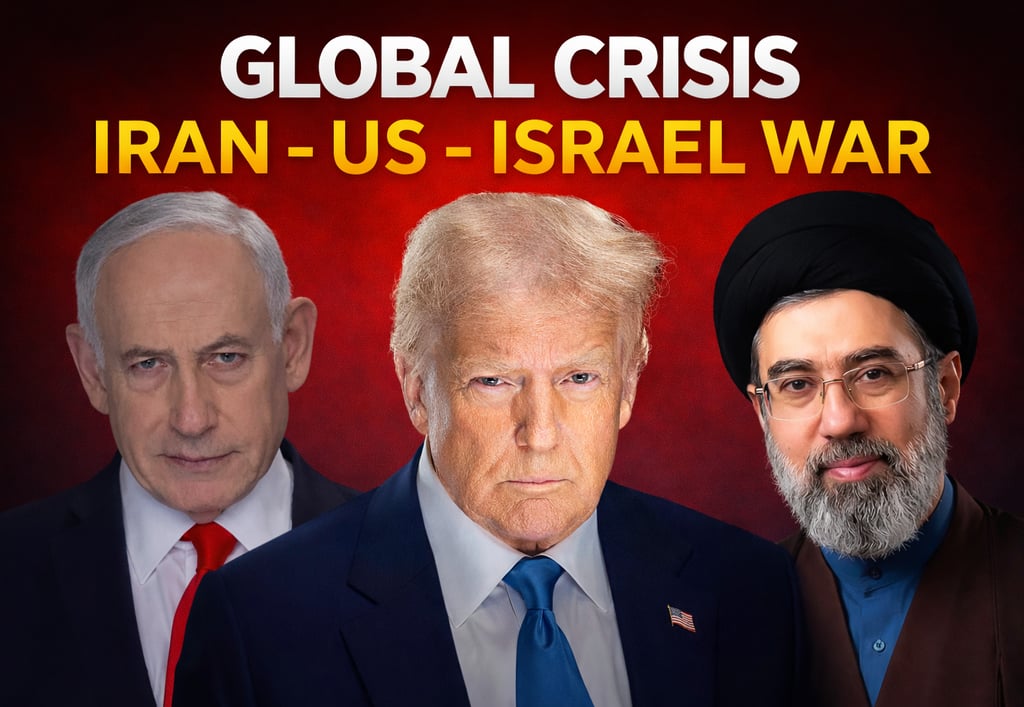
Iran–US–Israel War: Complete Analysis of the Global Crisis, Lebanon Front, Rising Political Tensions, and Expanding Worldwide Impact
The ongoing war between Iran, the United States, and Israel in the Middle East has now entered a highly critical and increasingly dangerous phase. What initially began as a regional confrontation has rapidly escalated into a complex and multi-layered conflict, where not only military engagements are intensifying but diplomatic, economic, and humanitarian crises are also deepening at an alarming pace.
Over the past four weeks, this conflict has continued to expand, drawing global powers directly and indirectly into its sphere. The consequences are no longer confined to the Middle East; instead, they are being felt across the globe. International economies, energy systems, and food supply chains are experiencing significant disruptions. Among the most important recent developments is the increasingly firm and uncompromising message delivered by the United States to Iran, emphasizing the urgent need for an immediate ceasefire and a binding agreement.
U.S. President Donald Trump addressed Iran in extremely strong terms, stating that the country must now demonstrate seriousness in its approach. According to him, Iran’s military capabilities have already suffered severe damage, leaving it with limited viable options other than entering into an agreement. Trump further warned that if Iran fails to act promptly, the situation could reach a point from which recovery may no longer be possible. He cautioned the Iranian leadership that time is running out rapidly, and any delay could result in further devastation.
The United States has reportedly presented Iran with a comprehensive 15-point plan aimed at ending the war. However, the conditions outlined in this plan are widely considered to be highly stringent and largely one-sided. These demands include the complete dismantling of Iran’s nuclear program, a total halt to uranium enrichment, strict limitations on its ballistic missile development, and the termination of financial support to allied groups operating across the region.
In addition to these demands, one of the most sensitive and strategically significant conditions involves the Strait of Hormuz. This narrow waterway is one of the world’s most crucial oil transit routes. The United States has called for Iran to relinquish its control or influence over this area. Iran, however, views control of the Strait as essential for its economic survival and regional strategic leverage, making this demand particularly contentious and difficult to accept.
Iran has not only rejected these conditions but has also adopted an even more hardened stance. Iranian Foreign Minister Abbas Araghchi clearly stated that there are no formal negotiations currently taking place between Iran and the United States. Instead, he described the situation as merely an exchange of indirect messages, which cannot be classified as official talks. He emphasized that Iran is focused on continuing resistance and defending its sovereignty rather than engaging in negotiations under pressure. According to him, Iran will not compromise on its principles under any circumstances and will not sacrifice its sovereignty or regional influence.
At the same time, Iran has outlined its own conditions for any potential agreement. These include firm guarantees against future military aggression, full compensation for war-related damages, and complete control over the Strait of Hormuz. Furthermore, Iran has insisted that Lebanon must be included in any ceasefire agreement. This condition significantly complicates diplomatic efforts, as it expands the scope of the conflict beyond Iran itself. Iran maintains that the war is not solely directed against it but is part of a broader confrontation involving its allied networks across the region. Therefore, any meaningful resolution must address all active fronts.
In this evolving situation, Pakistan has emerged as an important diplomatic mediator. Due to the absence of direct communication between the United States and Iran, messages are being conveyed through intermediary countries. While Turkey and Egypt are also involved in this process, Pakistan holds a particularly significant position because it maintains active and functional relations with both sides. Reports indicate that Iran has even identified Islamabad as a preferred venue for potential negotiations, highlighting Pakistan’s growing diplomatic relevance in the region.
A highly sensitive development has also come to light involving Israeli targeting decisions. According to various sources, Israel had planned to target Iranian Foreign Minister Abbas Araghchi and Parliamentary Speaker Mohammad Bagher Ghalibaf. However, following a request from Pakistan, these individuals were temporarily removed from Israel’s target list. Pakistan reportedly conveyed a message through the United States that the elimination of these key figures would completely shut down any possibility of negotiations. In response, the United States exerted pressure on Israel, leading to a temporary halt in plans to target them.
On the battlefield, the situation continues to deteriorate rapidly. Iran has launched multiple missile attacks targeting Israel, causing sirens to sound across major cities, including Tel Aviv. These attacks have created widespread panic among civilians and resulted in several injuries, demonstrating that Iran retains significant retaliatory capabilities despite ongoing strikes against it.
In response, Israel has conducted extensive strikes within Iranian territory, targeting key locations such as Bandar Abbas, Shiraz, and Isfahan. These operations have not been limited to military installations alone; civilian areas have also been affected. A particularly tragic incident occurred near Shiraz, where two young brothers were killed in a strike, underscoring the growing human cost of the conflict.
Israeli officials have claimed that they successfully eliminated a senior naval commander of Iran’s Islamic Revolutionary Guard Corps. They also indicated that several high-value targets remain on their list, suggesting that military operations are far from over.
Israel maintains that it will continue its operations until Iran’s military capabilities are significantly degraded or completely neutralized. However, there is concern within Israel’s defense establishment regarding the diplomatic trajectory of the conflict. Officials are skeptical that Iran will accept the current U.S. conditions and fear that the United States may eventually offer concessions during negotiations. Such concessions could potentially conflict with Israel’s strategic objectives.
At the global level, the economic impact of the war has become increasingly evident. Initially, when there were signs of a possible ceasefire, global stock markets showed signs of recovery. However, as those hopes diminished, markets once again came under pressure. Oil prices have started rising again, reflecting uncertainty and instability in global energy markets.
The situation has been further exacerbated by disruptions in the Strait of Hormuz, which accounts for approximately 20 percent of global oil and gas shipments. Any instability in this region has immediate and far-reaching consequences for the global economy. Industries such as aviation, retail, and automobile manufacturing are facing rising costs and significant supply chain disruptions.
Farmers in various parts of the world are experiencing shortages of diesel fuel, which is affecting agricultural productivity. If the situation continues, global food production could decline, leading to widespread food shortages. According to international food agencies, if the conflict persists until June, millions of people could face severe hunger.
These developments clearly indicate that the conflict has evolved beyond a regional dispute and has transformed into a full-scale global crisis with widespread implications.
One of the most sensitive and dangerous aspects of the conflict is the Lebanon front. Here, Hezbollah, an Iran-backed group, is directly engaged in confrontation with Israel, opening a new and highly volatile dimension to the war. This front not only expands the geographical scope of the conflict but also complicates any potential ceasefire agreement.
Tensions in Lebanon escalated when Hezbollah launched attacks against Israel on March 2. Israel responded with extensive air and ground operations across southern Lebanon. These operations have resulted in more than 1,000 deaths and displaced over one million people, creating a severe humanitarian crisis in a country that was already facing economic and political instability.
Infrastructure across Lebanon has been heavily damaged, and scenes of destruction are becoming increasingly common. Iran has made it clear through diplomatic channels that it will not accept any agreement that excludes Hezbollah. Reports suggest that Iran adopted this stance as early as mid-March, emphasizing that the conflict cannot be resolved unless Israeli operations in Lebanon come to an end.
Hezbollah continues to receive full support from Iran. Some sources indicate that assurances have been given to the group that its interests will be protected in any future agreement. Additionally, Hezbollah may also be using the conflict to strengthen its political position within Lebanon, particularly at a time when its influence had weakened following internal political developments after the 2024 conflict.
Israel has intensified its strategy in Lebanon by announcing plans to establish a “buffer zone” in southern Lebanon. Under this plan, Israel aims to extend its control up to the Litani River, approximately 30 kilometers north of its border. This area constitutes around 8 percent of Lebanon’s total territory.
Israeli forces have already begun implementing measures to establish this zone, including destroying bridges, constructing military positions, and demolishing homes in evacuated villages. Thousands of Israeli troops have been deployed to the region, and limited ground operations are currently underway.
Israel argues that these actions are necessary to ensure the safety of its citizens. However, many in Lebanon view this as the beginning of a potential long-term military occupation. There are growing fears that Israeli forces could advance further north, potentially threatening the capital, Beirut.
These concerns are rooted in historical precedent. Israel has previously carried out military operations in Lebanon in 1978 and launched a full-scale invasion in 1982, reaching Beirut. It maintained a presence in southern Lebanon until 2000. The 2006 war also serves as a significant reminder of the destructive potential of such conflicts.
Within Israel, the war is also having political consequences. Prime Minister Benjamin Netanyahu had hoped to use the conflict to strengthen his political position. However, so far, this has not translated into increased public support. Opinion polls suggest that if elections were held today, his government could face serious challenges.
Netanyahu is currently under pressure to secure approval for the national budget before the March 31 deadline. Failure to do so could automatically trigger early elections. As a result, he is taking urgent steps to maintain his coalition and keep his allies satisfied.
The economic cost of the war for Israel is also substantial. Estimates suggest that the conflict is costing approximately 5 billion shekels per week, equivalent to around 1.6 billion dollars. Additionally, defense spending has increased by 32 billion shekels, placing significant strain on the national budget.
To maintain political stability, Netanyahu has allocated additional funds to key coalition partners, particularly religious parties. This has further increased internal political tensions, with opposition groups criticizing the government for mismanagement of national resources.
Globally, the impact of the war continues to intensify. The energy crisis is worsening, and global supply chains are under severe pressure. Governments around the world are considering emergency measures similar to those implemented during the COVID-19 pandemic, including subsidies and financial relief packages.
A recent incident in Abu Dhabi, where debris from a ballistic missile killed two individuals, highlights the expanding geographical scope of the conflict. This demonstrates that the war is no longer limited to Iran and Israel but is increasingly affecting the broader Gulf region.
Major energy companies have also expressed concern over the situation. A leading oil executive accused Iran of destabilizing the global economy, stating that such actions are unacceptable and cannot be allowed to disrupt the international economic system.
Overall, the conflict has reached a stage where its consequences are expanding rapidly with each passing day. Diplomatic efforts are ongoing, but the rigid positions of both sides make a near-term resolution unlikely.
In conclusion, the world stands at a critical and fragile turning point. On one hand, the war continues to escalate; on the other, efforts for peace are still underway. However, the gap between these two realities remains wide. If global powers fail to act in a timely and effective manner, this crisis could deepen further, with long-lasting and potentially devastating consequences not only for the Middle East but for the entire world.
Stay informed with the latest national and international news.
© 2026. All rights reserved.