
Iran’s Supreme Leader Mojtaba Khamenei Vows to Keep Strait of Hormuz Closed — Global Oil Crisis Deepens
Iran’s Supreme Leader Mojtaba Khamenei warns the Strait of Hormuz will remain closed, raising fears of a global oil crisis and escalating tensions in the Middle East.
Raja Awais Ali
3/12/20262 min read
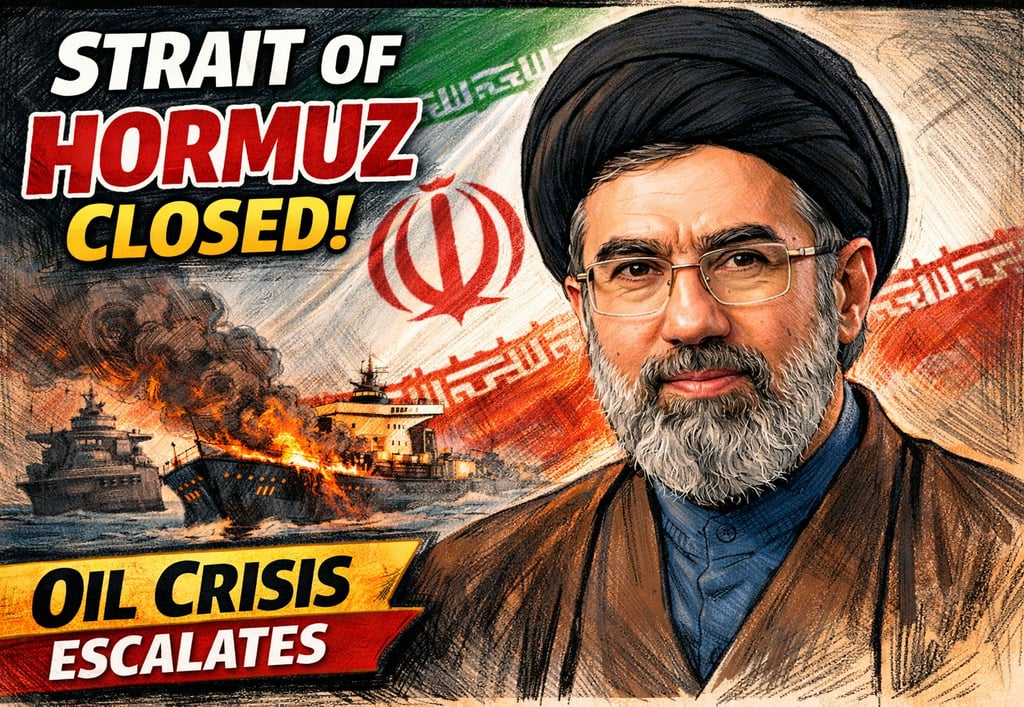
Iran’s New Supreme Leader Vows to Keep Strait of Hormuz Closed, Escalating Global Energy Crisis
On March 12, 2026, Iran’s newly appointed Supreme Leader, Ayatollah Mojtaba Khamenei, made his first official statement since succeeding his assassinated father, Ayatollah Ali Khamenei, vowing to keep the strategic Strait of Hormuz closed and intensifying tensions in the Middle East. His remarks, broadcast on Iranian state television, emphasized Iran’s determination to retaliate against adversaries and maintain the blockade of one of the world’s most important energy corridors. Khamenei declared that the closure of the Strait of Hormuz must remain a “lever to pressure the enemy” and urged neighboring countries to shut down all U.S. military bases on their soil. He pledged to avenge the blood of Iranian martyrs and warned that foreign forces in the region would continue to face attacks. The statement also revealed that Khamenei and members of his family suffered casualties in recent strikes, underlining the personal and national stakes in the conflict.
The Strait of Hormuz is a vital passageway for global energy supplies, with nearly 20% of the world’s oil and LNG passing through it. The ongoing blockade has already caused severe disruptions, sending oil prices past $100 per barrel and raising concerns that prices could reach $200 per barrel if the strait remains closed. The International Energy Agency (IEA) authorized an unprecedented release of 400 million barrels from strategic reserves, including nearly half from the United States, but analysts warn that this intervention covers only about three weeks of supply. Iran’s Revolutionary Guards have intensified operations in the Gulf, targeting vessels that ignore warnings, further complicating global shipping and trade. Tankers in Iraqi ports have been set ablaze in recent attacks, demonstrating Iran’s willingness to escalate militarily and defy U.S. claims that the conflict has been contained.
The crisis traces back to late February, when a U.S.-Israeli airstrike killed Iran’s former Supreme Leader and senior military commanders, igniting a broader regional war that has claimed roughly 2,000 lives. In response, Iran has deployed drones and missiles across Kuwait, Iraq, UAE, Bahrain, and Oman, while Lebanese militia Hezbollah launched its largest rocket attack into Israel since the start of the war, prompting retaliatory strikes on Beirut. U.S. President Donald Trump has repeatedly claimed that the U.S. has already “won” the conflict, yet Iran’s ongoing military operations and hardline statements indicate that the standoff is far from over. Both sides show little willingness to compromise, and the risk of a broader multi-front conflict remains high.
Inside Iran, security forces have strengthened their presence, particularly in Tehran, while citizens report heightened fear and limited public movement. Despite some public desire for change, there has been no organized anti-government protest since the conflict escalated. Iran’s leadership continues to reinforce national unity and portray the blockade and military response as essential measures to protect sovereignty and avenge martyrs.
Iran’s pledge to keep the Strait of Hormuz closed represents a severe disruption to global energy supplies and could trigger far-reaching economic consequences, including prolonged high oil prices, increased shipping and insurance costs, rising inflationary pressures in oil-dependent economies, and escalating geopolitical tensions across the Middle East and beyond. Analysts warn that only the reopening of the strait or successful diplomatic intervention could stabilize energy prices and reduce the risk of further escalation.
This statement by Iran’s new Supreme Leader marks a historic and pivotal moment in the ongoing crisis, highlighting the intersection of military strategy, economic leverage, and geopolitical conflict. The world now faces a tense standoff with significant implications for energy security, economic stability, and international relations.
Stay informed with the latest national and international news.
© 2026. All rights reserved.