
India and European Union Seal Landmark Trade Deal, Slashing Tariffs on Majority of Goods
India and the EU reach a historic trade agreement on 27 Jan 2026, cutting tariffs on most goods and reshaping global trade and investment flows.
Raja Awais Ali
1/27/20263 min read
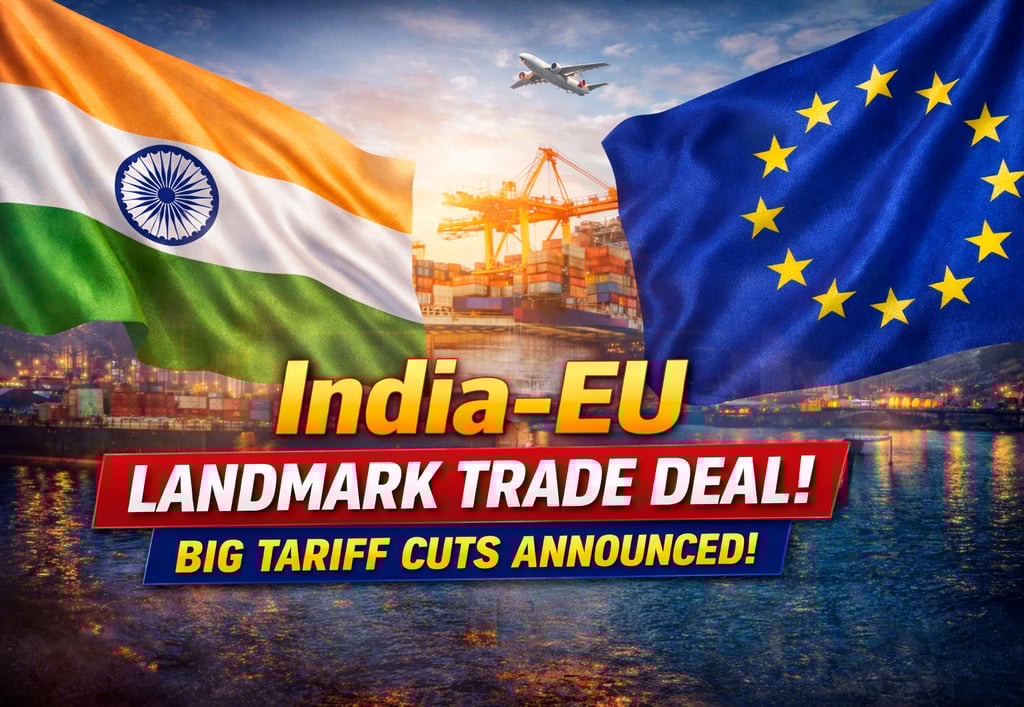
India–EU Landmark Trade Deal: A New Chapter in Global Commerce
India and the European Union reached a historic free trade agreement on 27 January 2026, marking one of the most significant economic partnerships in recent global trade history. The deal, concluded after nearly two decades of negotiations, aims to dramatically reduce trade barriers by cutting or eliminating tariffs on most goods, opening new opportunities for businesses, investors, and consumers on both sides.
Economic analysts have described the agreement as a game-changer for international trade, particularly at a time when global supply chains are being restructured and countries are seeking reliable, long-term economic partners.
A Deal Years in the Making
Negotiations for an India–EU free trade agreement first began in 2007 but were repeatedly stalled due to disagreements over tariffs, market access, regulatory standards, and protection of sensitive domestic sectors. Talks were revived in recent years amid shifting global economic realities, rising geopolitical tensions, and the shared interest of both sides in strengthening strategic and economic cooperation.
The agreement brings together two major economic blocs that collectively account for around one-quarter of global GDP and nearly one-third of world trade, making it one of the most consequential trade deals signed in the last decade.
Major Tariff Reductions Across Sectors
The core feature of the deal is a sweeping reduction in tariffs. Under the agreed framework, approximately 96–97% of traded goods between India and the EU will see tariffs either completely removed or substantially lowered over a phased period.
European exporters are expected to save billions of euros annually in reduced duties, while Indian consumers and manufacturers will benefit from lower input costs and increased competition. The European Union estimates tariff savings alone could exceed €4 billion per year once the agreement is fully implemented.
Breakthrough in the Automotive Sector
One of the most notable elements of the deal is the breakthrough on automobiles. India has historically imposed some of the world’s highest import duties on foreign vehicles, with tariffs reaching up to 110%. Under the new agreement, tariffs on European cars will be gradually reduced to around 10%, subject to quota arrangements.
This move is expected to significantly boost the presence of European automakers in the Indian market, while giving Indian consumers access to a wider range of high-quality vehicles at more competitive prices. Industry experts believe this could also encourage technology transfer and local manufacturing partnerships.
Wine, Spirits, and Industrial Goods
The agreement also addresses long-standing disputes over alcohol imports. Tariffs on wine, previously as high as 150%, will be cut sharply in the initial phase and reduced further over time. Duties on spirits and other premium beverages will also be lowered, benefiting European producers and India’s hospitality sector.
Beyond consumer goods, tariffs on textiles, leather products, chemicals, machinery, base metals, gems and jewellery, and marine products will be eliminated or reduced to zero. These measures are expected to significantly enhance India’s export competitiveness in European markets.
Expanding Trade and Investment Flows
In 2024, trade in goods between India and the EU stood at approximately €120 billion, with services trade adding another €60 billion. With the implementation of the new agreement, economists forecast a substantial expansion in bilateral trade over the next decade.
The deal goes beyond goods, covering services, digital trade, investment protection, intellectual property, and regulatory cooperation. It is expected to facilitate greater mobility for professionals, strengthen cooperation in information technology and finance, and encourage European investment in India’s fast-growing economy.
Sensitive Sectors Remain Protected
Despite its broad scope, the agreement includes safeguards for sensitive sectors. Certain agricultural products—such as rice, dairy items, beef, and select farm goods—have been excluded from full liberalization to protect domestic farmers and rural livelihoods in India. These exclusions helped pave the way for political consensus on the deal.
Strategic and Global Significance
The India–EU trade agreement carries weight far beyond economics. It comes at a time of heightened global uncertainty, trade fragmentation, and shifting alliances. For the European Union, the deal supports efforts to diversify supply chains and reduce over-dependence on single markets. For India, it reinforces the country’s ambition to position itself as a global manufacturing and export hub.
Leaders on both sides have emphasized that the agreement strengthens not only economic ties but also long-term strategic cooperation, reinforcing shared values around stability, sustainable growth, and rules-based trade.
What Comes Next
Although the agreement has been finalized, it must still undergo legal review and ratification by the European Parliament, EU member states, and India’s parliament. This process is expected to take several months, with full implementation likely in late 2026 or early 2027.
Conclusion
The India–EU landmark trade deal represents a decisive step toward deeper economic integration between two of the world’s most important markets. By slashing tariffs, expanding market access, and strengthening strategic ties, the agreement is set to reshape trade flows, boost investment, and create long-term opportunities for businesses and consumers alike. As global commerce enters a new phase, this deal positions India and the European Union at the center of the evolving international economic order.
Stay informed with the latest national and international news.
© 2026. All rights reserved.