
Hidden Power Plants Behind ChatGPT and AI Data Centers: America’s Growing Energy Crisis
Discover how ChatGPT, AI data centers, and tech giants like Meta, Amazon, and xAI are driving a massive energy boom in America. Learn about hidden power plants, rising electricity demand, environmental concerns, public backlash, and the growing impact of AI infrastructure on local communities and pollution.
Raja Awais Ali
6/16/20269 min read
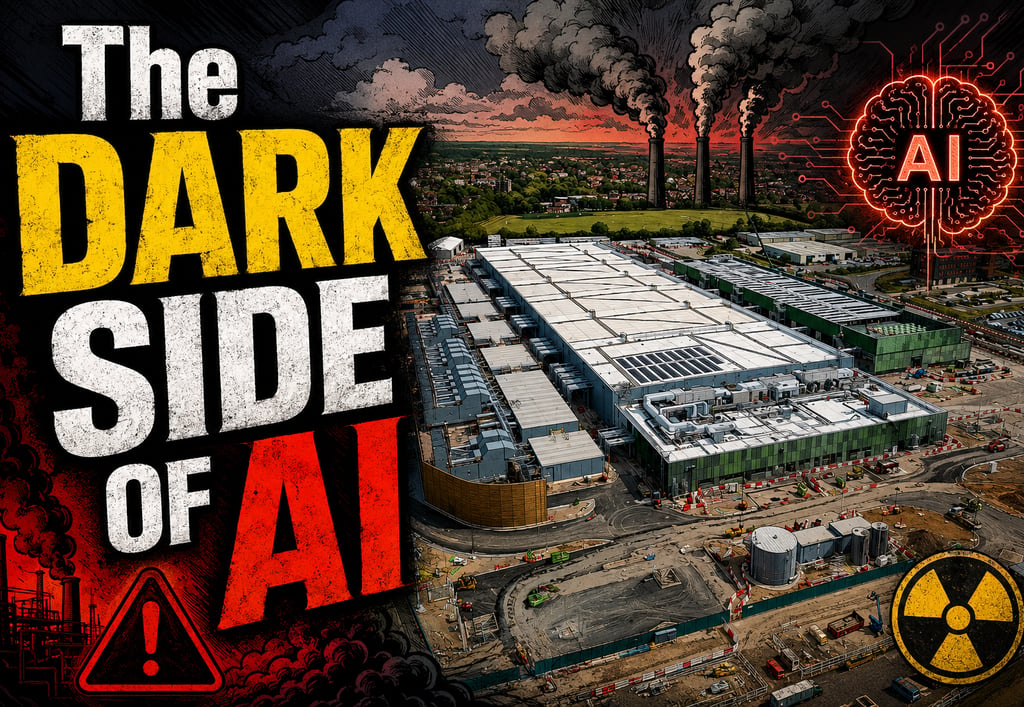
Hidden Power Plants Behind ChatGPT and AI Data Centers: America’s Fast-Growing Energy, Pollution, and Transparency Crisis
Artificial intelligence is rapidly reshaping the global economy, transforming industries, governments, workplaces, and daily life faster than many experts predicted. Tools like ChatGPT, AI search systems, AI video generators, cloud computing platforms, autonomous software, and advanced machine-learning models are now deeply integrated into modern digital infrastructure. But behind this technological revolution lies a massive and increasingly controversial issue that most people never see: the enormous amount of electricity required to power artificial intelligence.
While millions of users interact with AI tools every day, very few realize that every AI prompt, search request, generated image, automated workflow, or machine-learning process depends on gigantic data centers operating around the clock. These facilities contain thousands of advanced processors, GPUs, networking systems, and cooling technologies that consume extraordinary levels of electricity every second. As the United States races against China to dominate the future of AI, major technology companies are no longer competing only for better AI models — they are also competing for energy.
That growing energy demand is now triggering one of the largest hidden infrastructure expansions in modern American technology history. Across the United States, dozens of private off-grid power plants are rapidly being developed specifically to support AI data centers. Many of these projects are powered by natural gas and are moving forward at unusually high speed, often with limited public scrutiny, minimal environmental review, and reduced transparency for nearby communities.
Recent investigations identified at least 57 off-grid power plants currently proposed or under construction across the United States to support individual AI and cloud data center projects. Together, these facilities are expected to generate approximately 73,000 megawatts of electricity, enough to power tens of millions of homes. Industry experts believe this number could continue growing rapidly as AI systems become larger, more complex, and more energy intensive over the next decade.
The rapid expansion reflects a simple reality: artificial intelligence requires massive computing power. Every ChatGPT request triggers advanced computing operations across large server networks. AI image and video generation systems require enormous GPU workloads. Cloud-based AI services process billions of calculations continuously. Large language models train on massive datasets for weeks or months at a time, consuming electricity at levels once associated mainly with heavy industrial sectors.
Experts increasingly warn that the future energy demands of AI infrastructure may rival or exceed the electricity consumption of some nations. This has pushed technology companies to seek independent energy solutions rather than relying entirely on public utility grids. As a result, many firms are now building dedicated private power systems directly connected to their own data centers to guarantee uninterrupted electricity supply.
However, the speed and secrecy surrounding many of these projects have raised growing concerns among researchers, environmental experts, local officials, and residents living near proposed facilities.
One of the most controversial cases emerged in Middleton Township, Ohio, where local resident Breanne Kidd discovered that a large natural gas power plant was being constructed alongside Meta’s massive new data center project. Kidd operates a home daycare center and says her quiet rural surroundings have rapidly transformed into a heavy industrial construction zone filled with cranes, steel structures, trucks, dust, and nonstop development activity.
The project includes Meta’s approximately 800-acre Bowling Green data center complex as well as a major natural gas facility known as Apollo Generating Station. The plant is expected to generate enough electricity to power roughly 100,000 homes. For many nearby residents, the biggest shock was not only the scale of the project but also how quickly it received approval and how little information was publicly available during early development stages.
The Apollo facility reportedly received approval from the Ohio Power Siting Board on February 3, less than three months after project plans were submitted. Under normal circumstances, major power infrastructure projects often require years of permitting reviews, environmental studies, technical evaluations, and public hearings before construction begins. In this case, however, approval moved forward at extraordinary speed.
Records also showed that the project’s draft air-quality permit reportedly was not made publicly available until March, after construction activities had already begun. Residents living nearby say they were left with little notice regarding potential air pollution, industrial safety concerns, environmental impact, or emergency risks associated with the facility.
Another detail that attracted attention was the use of a separate entity known as Liames LLC in project paperwork rather than directly identifying Meta during earlier planning stages. Critics argue that the use of subsidiaries and shell companies can make it more difficult for communities to understand who is behind major infrastructure projects being developed near residential areas.
Breanne Kidd described the situation as deeply unsettling because the facility is located directly across from her home and daycare business. She said her biggest concern is protecting the safety of her family and the children she cares for each day. According to Kidd, the sudden industrial expansion has left many nearby residents feeling powerless and excluded from decisions that may permanently affect their environment and quality of life.
Concerns about these AI-related energy projects extend far beyond Ohio. Across the United States, multiple off-grid power systems linked to AI data centers are moving forward at accelerated speed. More than a dozen such projects reportedly received approval in under a year, often with limited public attention or reduced hearing requirements.
Some facilities are already operational. One project near Memphis supports Elon Musk’s xAI infrastructure, including the company’s Colossus AI data center operations. Another facility in Ashburn, Virginia, supplies power to Vantage Data Centers, located in one of the world’s largest data center regions.
Most of these projects rely heavily on natural gas generation, which environmental experts say could create serious long-term pollution concerns. Natural gas plants release nitrogen oxides, greenhouse gases, and fine particulate matter into the atmosphere. Medical experts have linked these emissions to respiratory illness, asthma, cardiovascular disease, lung complications, and other public health risks.
Researchers studying pollution and environmental health warn that AI-driven energy infrastructure could become one of the least examined yet fastest-growing industrial pollution risks in the country. Some experts believe the rapid pace of AI development is moving faster than environmental oversight systems designed to monitor large industrial energy projects.
Harvard University researcher Michael Cork warned that private natural-gas generation linked to AI data centers is emerging as one of the country’s largest underexamined air-quality risks. Environmental advocates argue that while AI companies emphasize innovation and economic growth, the environmental consequences of rapidly expanding energy infrastructure remain insufficiently studied.
Community members in regions targeted for hyperscale data center expansion are increasingly worried about cumulative effects. Residents fear that multiple data centers combined with several gas-powered facilities could eventually transform rural or suburban areas into heavily industrialized energy corridors with worsening air quality and rising health concerns.
Ohio resident Lauren Berlekamp warned that one gas plant and one data center might be manageable, but several facilities concentrated in the same region could eventually become what she described as a “regional public health event.”
Despite growing criticism, technology companies and industry groups strongly defend these projects. Representatives argue that reliable electricity infrastructure is essential for the future of artificial intelligence and that separate energy systems can reduce pressure on public utility grids.
The Data Center Coalition, which includes companies such as Meta, Amazon, and Microsoft, says developers remain committed to being responsible neighbors while securing critical power supplies for future AI operations. Industry supporters also argue that if AI companies relied entirely on public electricity systems, rising demand could increase energy prices for ordinary consumers.
Political support for accelerated AI infrastructure development has also grown rapidly in recent years. Federal and state officials increasingly view artificial intelligence as both an economic opportunity and a strategic national priority, particularly as competition with China intensifies.
The Trump administration has openly supported faster permitting and infrastructure expansion for AI-related projects, arguing that the United States must move quickly to maintain technological leadership. Environmental agencies and state governments have also proposed policies designed to accelerate approval processes for energy infrastructure tied to AI development.
The U.S. Environmental Protection Agency stated that it is pursuing a governance-focused approach while helping position America as “the AI Capital of the World.” However, the agency also noted that many permitting decisions remain under state and local jurisdiction.
Ohio became one of the clearest examples of accelerated AI infrastructure policy after lawmakers approved legislation allowing certain power projects to receive approval in as little as 45 days without requiring full public hearings. Critics argue that such policies significantly reduce opportunities for local residents to question or challenge major industrial developments before construction begins.
Supporters of the policy claim rapid approvals are necessary because hyperscale AI companies require certainty, speed, and reliable power access before investing billions of dollars into regional development.
Northwest Ohio has emerged as a major target for future hyperscale expansion because of its large land availability, water access, and proximity to natural gas pipelines. Economic development officials hope the region could eventually attract around 10 major hyperscale data centers.
The Apollo project itself is being developed by Will Power LLC, a subsidiary of pipeline company Williams Cos. Company representatives said similar facilities could potentially be constructed within 18 to 24 months and emphasized that the projects comply with state regulations. The company also noted that Ohio’s Environmental Protection Agency eventually held a public hearing related to Apollo during April.
However, criticism surrounding secrecy and transparency continues to grow. Reports indicate that some projects operated under confidential development names while local governments signed nondisclosure agreements limiting public disclosure.
Meta’s Bowling Green project reportedly operated under the codename “Project Accordion” for nearly two years before becoming publicly associated with the company. Critics argue that such secrecy reduces transparency and prevents communities from understanding the scale of industrial activity planned near residential areas.
Microsoft also faced criticism over confidentiality agreements tied to certain projects in Wisconsin and later announced plans to stop using nondisclosure agreements nationwide after backlash from local communities and public-interest groups.
Meanwhile, Ohio lawmakers approved additional provisions shielding certain large projects, including data centers, from public-record disclosure requirements. Critics argue that such measures weaken democratic transparency and public accountability by making it more difficult for journalists, researchers, and residents to obtain information related to environmental or economic impacts.
The confidentiality measure reportedly was inserted into an unrelated college athletics bill by Republican state Senator Brian Chavez. Campaign finance records later showed that two of Chavez’s top donors included a construction union supporting data center development and utility company NiSource, both contributing $10,000 during 2025.
Supporters of confidentiality laws argue that companies must protect sensitive business information during site-selection processes. Critics counter that excessive secrecy undermines public trust and limits meaningful community participation in decisions involving major industrial projects.
Political scientist Andrew Kear warned that reducing transparency surrounding AI infrastructure projects threatens fundamental democratic principles of accountability and public oversight.
Local resident Christine Coultrip, a retired police officer living in Perrysburg Township, said neighbors near her community had already been approached regarding property sales connected to potential future data center development. However, she said officials provided few details about what exactly was being planned nearby.
Questions surrounding oversight have also emerged in multiple other states. In Tennessee and Mississippi, Elon Musk’s xAI faced scrutiny after operating gas turbines connected to its Colossus AI infrastructure without traditional permits. The company argued the turbines qualified as temporary systems and therefore were exempt from certain regulatory requirements because they were not directly connected to the public grid.
In West Virginia, lawmakers passed legislation exempting certain data center microgrids from local zoning laws, limiting the ability of communities to oppose industrial energy projects. A major proposed gas facility in Tucker County reportedly received an air permit while some technical details in public documents remained redacted for confidentiality reasons.
Another controversy emerged near Columbus, Ohio, where local officials said they recently learned about plans for what could become the largest gas fuel-cell power plant of its kind in the United States. The facility is reportedly intended to support an Amazon Web Services data center.
Brian Rothenberg, a township trustee near the proposed site, said local officials were attempting to obtain additional safety information because the project is located near an elementary school. According to Rothenberg, community leaders wanted reassurance regarding emergency planning and potential industrial risks before the project moved forward further.
Rothenberg said his primary concern was protecting public health and safety, adding that he did not want residents becoming “lab rats” if problems emerged in the future.
Utility company AEP stated that emergency information had been provided directly to local fire departments and first responders. Ohio environmental officials also reportedly said they could not publicly discuss certain aspects of the project because legal challenges connected to permits remained ongoing.
As artificial intelligence continues expanding worldwide, the hidden infrastructure supporting it is rapidly becoming one of the defining energy stories of the modern technology era. What began as a race to develop smarter AI tools has evolved into a much larger struggle involving electricity supply, industrial expansion, environmental impact, public transparency, and community trust.
ChatGPT and modern AI systems may represent the future of technology, but behind the convenience of AI-powered tools lies a growing network of private energy infrastructure reshaping communities across America. The rapid rise of off-grid natural gas plants, accelerated permitting systems, limited public oversight, and increasing environmental concerns has sparked a major national debate over the true long-term cost of the AI boom.
As the demand for artificial intelligence grows, so does the demand for electricity. And for many communities now living beside massive data centers and power plants, the future of AI is no longer only about innovation — it is also about pollution, energy, transparency, public health, and the hidden industrial systems powering the digital world behind the scenes.
Stay informed with the latest national and international news.
© 2026. All rights reserved.