
Global Oil Shock 2026: Iran War, Strait of Hormuz Crisis Push Fuel Prices Higher in the US, Pakistan, and India
Oil prices surged above $90 per barrel amid the Iran-Israel-US conflict and Strait of Hormuz tensions. Here’s how the crisis is driving petrol and diesel prices higher in the US, Pakistan, and India.
Raja Awais Ali
3/8/20264 min read

Global Oil Shock 2026: Iran War and Strait of Hormuz Crisis Drive Fuel Prices Higher Worldwide
The global energy market is experiencing a sharp wave of volatility as geopolitical tensions in the Middle East intensify. In early March 2026, the escalating conflict involving the United States, Israel, and Iran has begun to reshape global oil markets, pushing crude prices sharply higher and triggering a rise in petrol and diesel prices across multiple regions.
Energy analysts warn that the current situation could evolve into a broader oil supply shock if disruptions continue around one of the world’s most critical energy chokepoints — the Strait of Hormuz.
The surge in oil prices has already started affecting consumers from North America to South Asia, raising transportation costs, fueling inflation concerns, and increasing pressure on governments that rely heavily on imported energy.
From Stable Prices in January to a March Oil Spike
At the beginning of 2026, global oil markets were relatively stable. According to international energy data, the average price of Brent crude in January 2026 hovered around $67 per barrel, while West Texas Intermediate (WTI) crude traded near $60 per barrel.
At that time, analysts expected oil prices to remain mostly within the $60–$65 range for much of the year due to balanced global supply and moderate demand.
However, the situation changed dramatically in late February and early March when military tensions in the Middle East intensified. The growing risk of disruptions to oil shipments quickly triggered a strong reaction in global energy markets.
By the first week of March 2026, U.S. crude futures surged to about $90.90 per barrel, marking one of the largest price jumps since 2020 and pushing oil to multi-year highs.
Strait of Hormuz: The World's Most Critical Oil Route
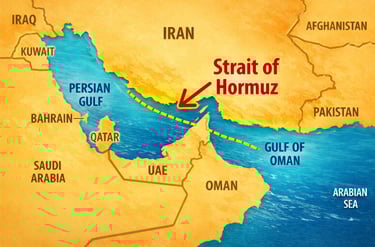
A central factor behind the sudden price spike is the strategic importance of the Strait of Hormuz, a narrow maritime corridor located between Iran and Oman.
The strait plays an essential role in global energy supply.
Approximately 20 percent of the world’s oil trade passes through this route, with an estimated 17 to 20 million barrels of crude oil transported daily through the waterway.
Major oil-exporting countries including Saudi Arabia, Iraq, the United Arab Emirates, Kuwait, and Iran rely heavily on this corridor to deliver crude oil to global markets.
As tensions in the region escalated, concerns about shipping safety increased. Some oil tankers have slowed operations or altered routes due to security risks, while maritime insurance costs have risen significantly.
These developments have tightened expectations of future supply and pushed oil prices higher across international markets.
Fuel Prices Climb in the United States
Although the United States is currently the world’s largest oil producer, American consumers are still feeling the impact of global energy market fluctuations.
As of early March 2026, the national average price of regular gasoline reached about $3.32 per gallon, while diesel climbed to roughly $4.33 per gallon.
Gasoline prices have jumped more than 10 percent in a single week, reflecting the rapid rise in crude oil costs and increasing global demand for U.S. energy exports.
Energy analysts warn that if oil prices continue trending upward, the national gasoline average in the United States could soon reach $3.50 to $3.70 per gallon.
The increase is already becoming a political and economic issue as households face higher transportation costs and businesses adjust to more expensive fuel.
Why Diesel Prices Matter for the Global Economy
The rise in diesel prices is particularly significant because diesel powers much of the global economy.
It is widely used in:
freight transportation
shipping and logistics
agriculture and farming equipment
industrial manufacturing
construction and infrastructure
When diesel becomes more expensive, transportation costs increase and supply chains become more costly. This often leads to higher prices for consumer goods, food products, and construction materials.
Energy analysts warn that sustained diesel price increases could add new inflationary pressure worldwide.
Pakistan Faces Sharp Fuel Price Increase
Countries that rely heavily on imported oil are experiencing the strongest impact from the latest price surge.
Pakistan has already implemented a significant increase in fuel prices following the jump in global oil markets.
As of March 8, 2026, the approximate fuel prices in Pakistan are:
Petrol: Rs321.17 per litre
High-Speed Diesel: Rs335.86 per litre
Both fuels increased by around Rs55 per litre, marking one of the most substantial price hikes in recent years.
Higher fuel costs in Pakistan often translate directly into rising transportation fares, higher electricity generation costs, and increased food prices, putting additional financial pressure on households.
India Monitors Energy Security
India, the world’s third-largest oil importer, is also closely monitoring developments in the Middle East.
In major Indian cities during early March 2026:
Petrol prices range roughly between ₹96 and ₹104 per litre
Diesel prices range between ₹89 and ₹94 per litre
To protect against potential supply disruptions, India maintains strategic petroleum reserves containing about 250 million barrels of crude oil and petroleum products.
These reserves could help sustain the country’s energy needs for several weeks if global supply routes were disrupted.
Indian energy officials have also been exploring alternative import routes to reduce reliance on shipments passing through the Strait of Hormuz.
Global Markets Remain on Edge
Energy markets remain extremely sensitive to developments in the Middle East conflict. Any escalation that threatens shipping lanes or oil infrastructure could push prices even higher.
Analysts outline several possible scenarios in the coming weeks:
If tensions stabilize, oil prices could fall back toward $80 per barrel.
If limited disruptions continue, prices may remain around $90 to $100 per barrel.
If the Strait of Hormuz faces serious disruption, oil prices could potentially surge beyond $120 per barrel.
For now, markets remain cautious as traders, governments, and energy companies closely watch military developments in the region.
The Bottom Line
The oil price surge of 2026 highlights how interconnected the global energy system has become. A geopolitical crisis in the Middle East can quickly affect fuel prices in countries thousands of miles away.
As long as tensions remain high around the Strait of Hormuz and the broader Iran conflict continues, global energy markets are likely to remain volatile.
For consumers around the world, that uncertainty may translate into higher petrol prices, rising transportation costs, and increased pressure on household budgets in the months ahead.
Stay informed with the latest national and international news.
© 2026. All rights reserved.