
Germany Moves to Restrict Social Media Access for Children as Online Safety Concerns Grow
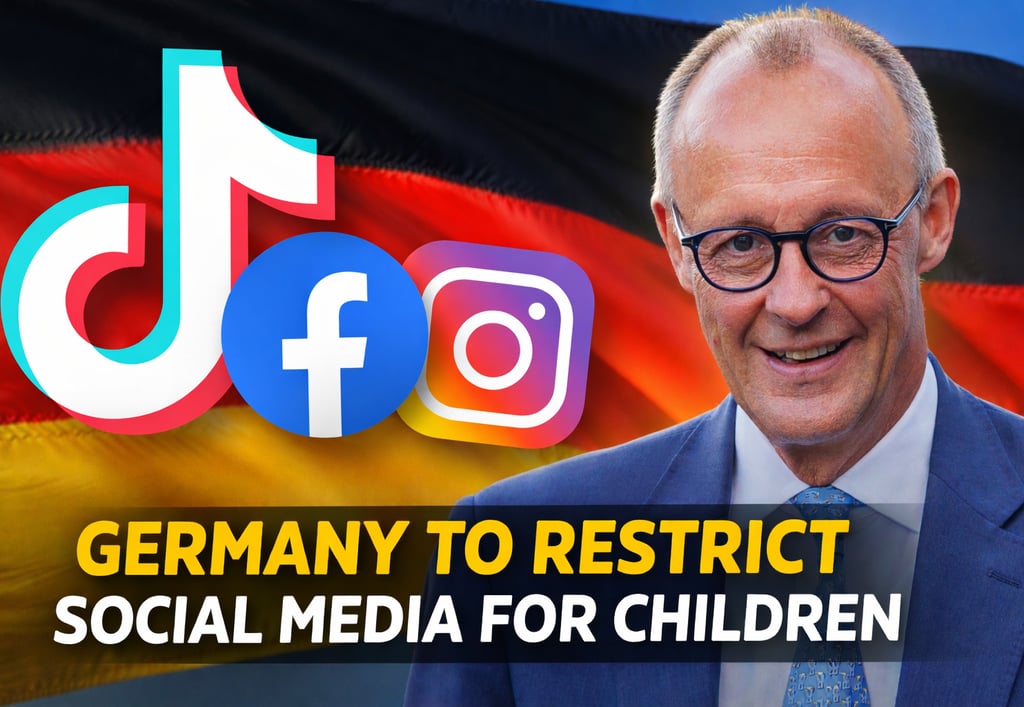
Germany’s ruling party supports strict social media limits for children under 14, citing mental health risks and online safety concerns in 2026.
Raja Awais Ali
2/21/20263 min read
Germany Backs Social Media Restrictions for Children: A Major Shift in Digital Safety Policy (February 21, 2026)
Germany has taken a decisive step toward strengthening online child protection as the country’s ruling political party formally backed stricter social media regulations for minors. On February 21, 2026, the Christian Democratic Union (CDU) publicly supported limits on children’s access to social media platforms, citing rising concerns over mental health, online addiction, and exposure to harmful digital content.
This move reflects a broader shift in European policy discussions, where governments are increasingly questioning whether existing online safeguards are sufficient to protect children in an algorithm-driven digital environment. Germany’s decision is being closely watched across Europe and could influence future regulations at the continental level.
Under the proposal supported by the CDU, children under the age of 14 would face strict limitations on access to major social media platforms, while teenagers aged 14 to 18 would be subject to robust age-verification requirements. Party officials argue that current age checks are largely symbolic and can be bypassed easily, leaving children vulnerable to content that is inappropriate for their age and emotional development.
The ruling party emphasized that responsibility should not rest solely on parents, as the scale and complexity of modern digital platforms make individual supervision increasingly difficult. Instead, lawmakers believe that technology companies must be legally required to implement effective systems that genuinely prevent underage access.
One of the key drivers behind this policy shift is the growing body of evidence linking excessive social media use to declining mental well-being among children and adolescents. Recent studies in Germany suggest that more than 20 percent of young users engage with social media in ways considered harmful or excessive. Around 6 to 7 percent show signs of pathological use, a condition associated with anxiety, sleep disorders, reduced academic performance, and social withdrawal.
Experts warn that short-form video platforms and engagement-based algorithms are particularly problematic. These systems are designed to maximize screen time, often exposing young users to a continuous stream of emotionally charged or misleading content. Over time, this can impair attention spans and contribute to long-term psychological stress.
German Chancellor Friedrich Merz acknowledged that he was initially hesitant about imposing outright restrictions. However, he stated that the scale of the problem and the latest data on child mental health made government intervention unavoidable. According to Merz, the digital landscape has evolved faster than regulation, leaving children exposed to risks that were unimaginable just a decade ago.
He also highlighted the growing influence of artificial intelligence in shaping online content. AI-driven recommendations, deepfake videos, and rapidly spreading misinformation pose unique dangers to young users who may lack the critical thinking skills needed to distinguish reality from manipulation.
Germany’s stance aligns with a wider international trend. Countries such as Australia, France, and the United Kingdom are also reviewing or tightening regulations around children’s social media use. What sets Germany apart, however, is its push for coordinated action at the European level. The CDU has called for harmonized age standards across the European Union, arguing that fragmented national rules allow platforms to exploit regulatory gaps.
If adopted across the EU, such standards would force social media companies to redesign access systems for millions of users. Failure to comply could result in heavy financial penalties, potentially amounting to several percent of a company’s global annual revenue. This would mark one of the strongest regulatory responses yet to the influence of Big Tech on children.
Public reaction in Germany has been mixed but largely supportive. Many parents and educators welcome the move, saying it provides long-overdue backing for families struggling to manage their children’s online habits. Teachers report that excessive social media use is increasingly affecting concentration, classroom behavior, and overall academic performance.
At the same time, critics argue that education and digital literacy should be prioritized over restrictions. They warn that outright limits could push children toward unregulated platforms or create enforcement challenges. Policymakers respond by stressing that regulation and education are not mutually exclusive and must work together.
Mental health professionals largely support the initiative, noting that early intervention can prevent long-term psychological harm. They estimate that effective enforcement of age-appropriate access could significantly reduce anxiety-related disorders among young users within a few years.
In conclusion, Germany’s support for social media restrictions on children represents a major turning point in digital policy. It signals a growing recognition that online platforms are not neutral tools but powerful systems capable of shaping behavior, emotions, and development. By taking a firm stance, Germany aims to create a safer digital environment for children while setting a precedent that could reshape social media regulation across Europe. Whether this approach becomes a global model will depend on how effectively it is implemented and enforced in the years ahead.
Stay informed with the latest national and international news.
© 2026. All rights reserved.