
Formula One 2026 AI Revolution: How Artificial Intelligence is Transforming F1 Racing Strategy and Performance
Explore how artificial intelligence is transforming Formula One in 2026, from real-time race strategy and data analysis to major AI partnerships driving team performance and innovation.
Raja Awais Ali
5/4/20263 min read
Formula One 2026: When Speed, Data, and Artificial Intelligence Start Winning Races Together
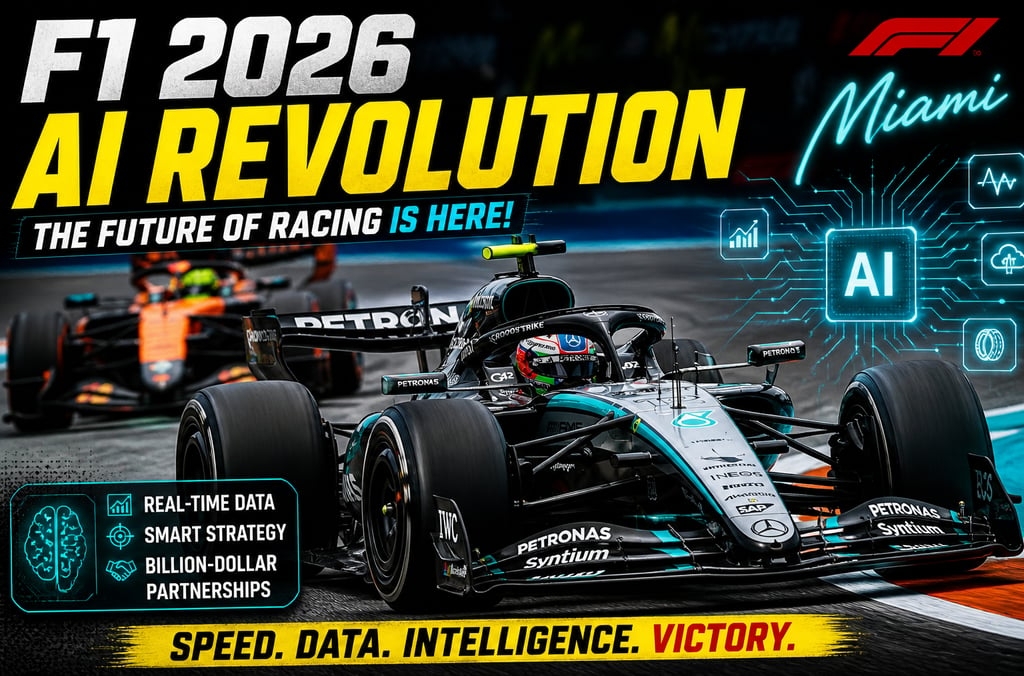
In the world of motorsports, Formula One has always been a symbol of cutting-edge technology. However, in 2026, the sport has reached an entirely new level where Artificial Intelligence (AI) is no longer just working behind the scenes—it is actively influencing race outcomes. Owned by Liberty Media, this global championship and its 11 teams have integrated AI so deeply into their systems that Formula One is no longer just a contest of speed, but a battle of data and intelligence. The recent Miami Grand Prix clearly showcased this transformation, where every move on the track was backed by complex algorithms operating in real time.
Over the past six months, the signing of eight new AI partnerships highlights a major shift in investment priorities within Formula One. Teams are no longer focused solely on engine upgrades; AI upgrades are now just as critical. According to Ampere Analysis, this trend is rapidly accelerating and AI is set to become a fundamental requirement for every team. A strong example is the Atlassian Williams F1 Team, which has partnered with Anthropic. Through this collaboration, the Claude AI model is supporting team operations, data analysis, and race strategy. According to team leadership, this partnership is far more than marketing—it is a competitive weapon aimed at bringing the team back to the top.
In the past, Formula One cars were dominated by tobacco branding, but today that space has been taken over by AI and technology companies. These partnerships not only provide global exposure but also deliver real competitive advantages. One of AI’s greatest strengths lies in its ability to process massive amounts of data instantly. During a race, millions of data points are generated—covering tire conditions, engine performance, weather, and fuel usage. AI systems analyze this information within seconds, enabling engineers to make faster and more accurate decisions.
Oracle Red Bull Racing has taken this integration even further through its collaboration with Oracle. AI is now embedded at the core of the team’s operations, evolving from simple data analysis to decision-making support systems. For a team led on track by four-time world champion Max Verstappen, success is no longer driven by driver skill alone—AI-powered strategies play an equally important role. According to team insiders, AI allows engineers to move away from repetitive tasks and focus on high-value decision-making, significantly improving overall performance.
Spending on technology in Formula One has also surged dramatically. Last season alone, teams invested approximately $769 million in technology, marking a 41% increase compared to the previous year. According to SponsorUnited, AI and machine learning companies are now among the top 15 new investors in the sport. One notable example is CoreWeave, valued at around $65 billion, which has partnered with the Aston Martin F1 Team.
Looking at the broader financial picture, Formula One team sponsorship reached $2.54 billion in 2025, making it one of the highest-earning sports properties in the world. Only the National Football League surpassed it, generating $2.7 billion. These figures clearly demonstrate that AI is not just a technological advantage but also a massive business opportunity within the sport.
The role of AI extends far beyond the racetrack. It is increasingly being used in administrative operations and in interpreting complex sporting and technical regulations. Formula One rules are highly detailed and often difficult to navigate, but AI systems can now process these regulations quickly and provide immediate guidance to teams. This allows for faster and more precise decision-making during races—something that would have been impossible just a few decades ago.
Major technology companies are also using Formula One as a global platform to showcase their AI products. Google, for instance, has expanded its partnership with McLaren by introducing advanced tools like Google Gemini. This not only enhances team performance but also allows the company to demonstrate its AI capabilities to a global audience.
Formula One as an organization has also embraced AI at multiple levels. Through its partnership with Amazon Web Services, generative AI is now being used in live broadcasting to enhance viewer experience. In 2024, generative AI was even used in designing the Montreal Grand Prix trophy, showcasing how AI is expanding beyond data analysis into creative domains.
Additionally, Lenovo plays a key role in supporting Formula One with AI-powered laptops and devices. These tools enhance mobility, remote collaboration, and productivity, ensuring that teams can operate efficiently across different locations during race weekends. This highlights that AI is not just helping win races—it is improving the entire ecosystem of the sport.
In conclusion, Formula One has entered a new era where humans and machines are working together to redefine success. Where once driver skill alone determined victory, today winning without AI is becoming increasingly difficult. As technology continues to evolve, the sport will become even more digital, faster, and unpredictable. The day may not be far when a significant part of race-winning decisions will rest in the hands of intelligent algorithms.
Stay informed with the latest national and international news.
© 2026. All rights reserved.