
European Reaction to Rubio’s Munich Speech on Transatlantic Ties
European leaders react to Marco Rubio’s Feb 14, 2026 Munich Security Conference speech on transatlantic ties, NATO, security, and global cooperation.
Raja Awais Ali
2/14/20263 min read
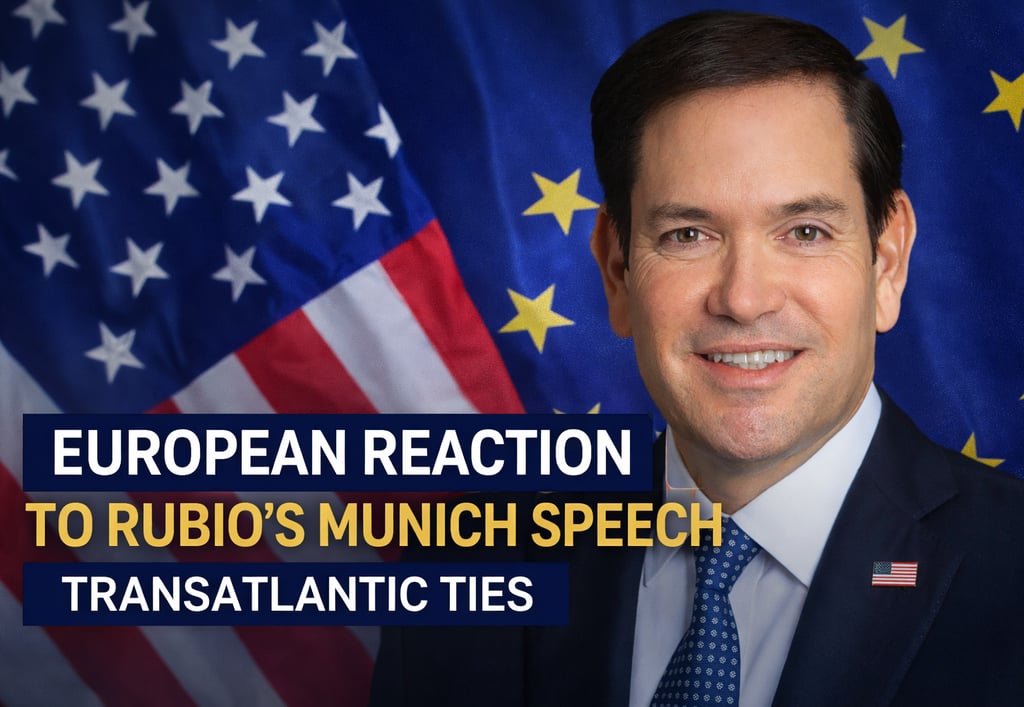
European Reaction to Marco Rubio’s Speech on Transatlantic Ties at the Munich Security Conference
On February 14, 2026, U.S. Senator Marco Rubio delivered a closely watched speech at the Munich Security Conference, addressing the current state and future direction of transatlantic relations. His remarks came at a critical moment for Europe–U.S. ties, shaped by geopolitical tensions, economic uncertainty, and ongoing security challenges. Rubio’s speech triggered a broad and cautious reaction across European capitals, combining guarded optimism with clear expectations for concrete action.
Rubio emphasized that the transatlantic partnership is not a relic of the past but a living alliance rooted in shared history, democratic values, and collective security interests. He rejected narratives suggesting an inevitable decline in U.S.–European cooperation, arguing instead that Europe’s stability and prosperity remain deeply connected to American strategic interests. According to Rubio, the United States and Europe must adapt their partnership to meet 21st-century challenges rather than question its relevance.
A significant portion of Rubio’s speech focused on economic security and global competition. He highlighted vulnerabilities in global supply chains, warning that overdependence on strategic rivals poses long-term risks for both the U.S. and Europe. Rubio called for closer coordination on industrial policy, advanced manufacturing, and critical technologies, stressing that economic resilience should be treated as a core security priority. He argued that joint investment and policy alignment are essential to maintaining Western competitiveness in a rapidly shifting global order.
Rubio also addressed migration, climate policy, and the role of international institutions. He acknowledged differences between the United States and Europe on these issues but urged open dialogue rather than disengagement. On global governance, he called for reforms within international organizations to ensure they remain effective and responsive, warning that outdated structures could weaken collective responses to emerging threats. However, he stopped short of advocating withdrawal, instead framing reform as a shared responsibility.
European reactions were measured but largely constructive. Officials from the European Union welcomed Rubio’s reaffirmation of transatlantic unity, interpreting it as a signal that Washington continues to view Europe as a strategic partner. At the same time, European leaders reiterated their commitment to strategic autonomy, making clear that cooperation with the United States does not negate Europe’s right to pursue independent policy decisions in defense, trade, and diplomacy.
European Commission President Ursula von der Leyen described Rubio’s speech as an encouraging basis for renewed dialogue. She emphasized the importance of U.S. engagement in European security, particularly in light of ongoing instability in Eastern Europe and broader global tensions. Nevertheless, she reaffirmed that Europe would maintain firm positions on human rights, climate commitments, and international law.
Germany, France, and several Nordic countries responded positively to the tone of the speech, noting its contrast with earlier periods of strain in transatlantic relations. German officials stated that while Rubio’s message was reassuring, credibility would ultimately depend on follow-through. They pointed to defense cooperation, joint military exercises, and technological collaboration as areas where tangible progress would be needed to rebuild long-term trust.
The speech also reignited debate over the future role of NATO. European leaders broadly agreed with Rubio’s assertion that NATO remains central to collective security but stressed that Europe must shoulder a greater share of responsibility. Several governments reiterated plans to increase defense spending and strengthen domestic defense industries, aiming for a more balanced partnership within the alliance.
Not all reactions were positive. Critics within Europe argued that parts of Rubio’s remarks on migration and climate policy risked placing external pressure on domestic political debates. These voices cautioned against allowing transatlantic cooperation to blur the line between partnership and interference. As a result, multiple European governments emphasized that future collaboration must respect national sovereignty and democratic decision-making.
Foreign policy analysts concluded that Rubio’s speech marked a rhetorical step toward stabilizing transatlantic relations, but warned that words alone would not be sufficient. Sustainable progress, they argued, will depend on consistent engagement, clearly defined goals, and practical cooperation in areas such as energy security, defense production, digital infrastructure, and trade.
In summary, Marco Rubio’s February 14, 2026 address at the Munich Security Conference was received in Europe as a cautiously positive signal. While it reassured allies of America’s continued commitment, European leaders made clear that lasting partnership will require concrete policies, mutual respect, and shared responsibility. The coming months will determine whether this renewed emphasis on unity translates into meaningful action or remains primarily a diplomatic gesture.
Stay informed with the latest national and international news.
© 2026. All rights reserved.