
Europe Heatwave 2026 Creates Billion-Dollar Boom for Samsung, LG, Midea and Mitsubishi as Air Conditioner Demand Surges
Europe's 2026 heatwave is driving record temperatures and unprecedented air conditioner demand across France, Spain, Italy, Germany, and the UK. Discover how Samsung, LG, Midea, and Mitsubishi Electric are benefiting from Europe's growing cooling crisis.
Raja Awais Ali
6/25/20266 min read
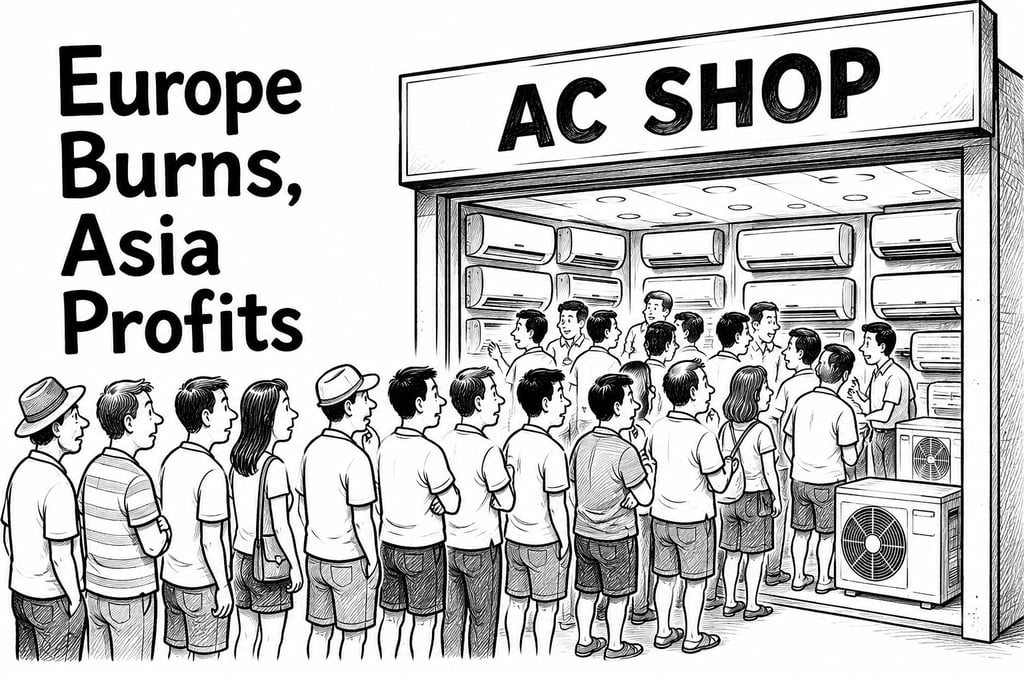
When Europe Started Burning, Asia Began Selling Cool Air for Billions: How the 2026 Heatwave Is Reshaping the Global Economy, the Climate Crisis, and the Future of the Air Conditioning Industry
The last week of June 2026 is quickly becoming one of the most dangerous weather periods in modern European history. As of June 25, 2026, Western and Central Europe remain trapped under a powerful heat dome that has pushed temperatures across many parts of the continent to extreme levels. France, Spain, Italy, Germany, the United Kingdom, Portugal, the Netherlands, Belgium, Austria, Switzerland, Poland, the Czech Republic, Hungary, and several other European nations are under red or orange heat alerts. More than 100 million people are estimated to be experiencing temperatures above 35 degrees Celsius.
Climate scientists warn this is not just a temporary heatwave. A heat dome is a weather system that traps hot air over a region for several days, sometimes weeks. This prevents cooler air from entering, causing temperatures to rise day after day. The result is a dangerous cycle of record-breaking heat, increasing wildfire risks, mounting pressure on electricity grids, rising hospital admissions, and serious disruption to daily life in cities across Europe.
By June 25, France had become one of the countries most affected by the extreme temperatures. Several regions recorded temperatures up to 44.3 degrees Celsius, while Paris reached around 40.9 degrees Celsius. Red alerts are in place in numerous areas. Hundreds of schools have adjusted their schedules or closed temporarily, and electricity supplies are under increasing strain. The extreme heat has even impacted parts of France's nuclear energy sector, forcing some reactors to reduce their electricity output due to river water used for cooling exceeding safety standards.
Spain has also seen some of the highest temperatures recorded during the heatwave. In Andujar and southern areas, temperatures climbed to 45.1 degrees Celsius. Madrid, Seville, and Cordoba have remained above 40 degrees Celsius for several consecutive days. Italy has issued red alerts in major cities like Rome, Milan, Florence, Turin, and Bologna, with temperatures between 38 and 41 degrees Celsius becoming more common.
Germany's southern and central regions have seen temperatures near 39 degrees Celsius. This has led to a significant increase in electricity demand as households and businesses try to cool their indoor spaces. The UK registered one of its hottest June days in history with temperatures hitting 36.1 degrees Celsius. Portugal reported temperatures of 42 degrees Celsius, Austria approached 39 degrees Celsius, and the Netherlands experienced temperatures ranging between 38 and 39 degrees Celsius. Belgium, Switzerland, Poland, the Czech Republic, and Hungary have also dealt with unusually intense heat.
The World Meteorological Organization has warned that Europe is warming about twice as fast as the global average. This makes future heatwaves more frequent, more intense, and longer-lasting than those seen in past decades.
Yet this story is not only about climate change. It is also becoming one of the biggest business stories of 2026.
While millions of Europeans struggle with dangerous temperatures, Asian air conditioning manufacturers are making billions from an unprecedented surge in demand. This reality has turned the June 2026 heatwave from a weather event into a major global economic shift.
South Korea's Samsung Electronics and LG Electronics, China's Midea, and Japan's Mitsubishi Electric have emerged as some of the biggest winners in Europe's cooling boom. Air conditioning has been a regular part of daily life in much of Asia for decades. However, Europe’s historically moderate climate meant that many homes and buildings were never designed for cooling systems.
Now, with temperatures breaking historical records, millions of European households must purchase air conditioning units for the first time.
Samsung reported strong double-digit growth in air conditioner sales in key European markets like Italy, Spain, and France during the first half of 2026. The company believes that weather forecasts indicate temperatures may stay elevated well past June. This increases the likelihood that demand will remain high until the end of the cooling season.
For Samsung, Europe is no longer just a small seasonal market. It is quickly becoming one of the fastest-growing opportunities in the global cooling industry.
LG Electronics also confirmed that its South Korean air conditioner manufacturing plants have been operating at full capacity since April to meet demand from domestic customers, European buyers, and other international markets.
Normally, manufacturers ramp up production right before summer. This year, however, the volume of European orders forced LG to operate its manufacturing lines at maximum capacity months earlier than usual.
Among the companies involved, China's Midea may be the biggest economic winner of the whole situation.
The company noted that demand for its PortaSplit Air Conditioner rose so quickly that in some European markets, second-hand units were selling for more than brand-new ones after retailers completely ran out of inventory.
Midea reported that the heatwave during the last two weeks of May created extraordinary demand for this model, leading to complete sellouts across multiple sales channels.
The figures clearly illustrate how rapidly consumer behavior in Europe is changing.
Sales on German e-commerce platforms rose by 37 percent in May compared to the same month last year. Shipments to Spain and France recorded an astonishing increase of 108 percent.
This story goes beyond just one successful product.
It represents a significant shift in European consumer attitudes.
People who only a few years ago viewed air conditioning as an unnecessary expense are now increasingly seeing cooling systems as essential for modern life.
Europe faces another major challenge beyond just demand: installation.
In much of Asia, new buildings are designed with cooling infrastructure integrated into their construction plans. Europe, however, has many of the world’soldest urban environments, with numerous cities filled with historical buildings and architecture.
Installing external air conditioning units often requires special approval from local authorities, particularly in protected historical areas. Older electrical systems and outdated building structures also complicate installation and make it considerably more expensive.
Industry estimates suggest that installing an air conditioning system in Europe can cost over one thousand euros per unit.
Consequently, demand for portable air conditioners has skyrocketed because these units can operate without permanent installation. This helps avoid many of the regulatory and technical challenges that come with traditional units.
According to the International Energy Agency, only around 20 percent of homes and buildings in Europe currently have air conditioning.
In contrast, air conditioning rates in major cities across China, Japan, and South Korea are several times higher.
This difference has evolved into a multi-billion-dollar market opportunity for Asian manufacturers.
If European summers keep getting hotter at this pace, the air conditioning industry will likely continue to expand for many years.
Extreme heat is also prompting businesses to rethink employee safety.
Many European companies have started providing delivery workers and outdoor staff with cooling boxes, chilled towels, water-activated cooling bands, UV protection neck guards, and extra drinking water supplies to mitigate the risks of heat exhaustion and heatstroke.
Japan's Mitsubishi Electric has confirmed exceptionally strong growth in demand in France, Spain, the UK, and Germany.
According to the company, European consumers no longer see climate change as a temporary issue or a far-off concern. Instead, they view it as a permanent reality that requires immediate action. This shift in perception is rapidly influencing purchasing decisions across the continent.
However, there's another aspect to this story.
Air conditioners undoubtedly protect people from dangerous temperatures. Still, the rising number of cooling systems also places enormous pressure on electricity networks.
If that electricity is generated from coal, natural gas, or other fossil fuels, higher demand for cooling can lead to increased carbon emissions, which, in turn, speed up climate change.
The world may be entering a dangerous cycle where rising temperatures create higher demand for air conditioning, while greater air conditioning use boosts energy consumption and possibly contributes to further warming.
Because of this, energy experts are focusing on the need for efficient, environmentally friendly, and smart cooling technologies. These technologies can reduce electricity consumption while maintaining comfortable indoor temperatures.
The European heatwave of June 2026 has highlighted a reality that governments, businesses, and investors can no longer ignore.
Climate change is no longer just an environmental issue.
It is changing international trade, global investment patterns, industrial production, energy policy, urban planning, and consumer behavior.
China, Japan, and South Korea invested in cooling technologies, strengthened supply chains, and built up manufacturing capabilities years before Europe faced this challenge.
Now, as Europe desperately looks for cooling solutions, those same countries are turning a climate crisis into an economic opportunity while boosting their positions in the global market.
If current climate trends continue, air conditioning in Europe could become as necessary as electricity, clean water, and internet access instead of just a luxury item.
This change would not only bring steady revenue growth for Asian manufacturers but would also push Europe to invest billions of euros in construction standards, electricity infrastructure, renewable energy systems, urban planning projects, and long-term climate adaptation strategies.
The heatwave of 2026 is much more than a short-term spike in temperatures.
It might be seen as the point when climate change permanently changed the global economy and showed that the industries best equipped to understand and tackle climate-driven challenges could emerge as the biggest economic winners in the coming decades.
Stay informed with the latest national and international news.
© 2026. All rights reserved.