
EU Phases Out High-Risk Technology, Targeting Huawei and Chinese Firms | January 2026
The EU announces a phased ban on high-risk technology, targeting Huawei and Chinese firms to strengthen cybersecurity and digital sovereignty.
Raja Awais Ali
1/20/20263 min read
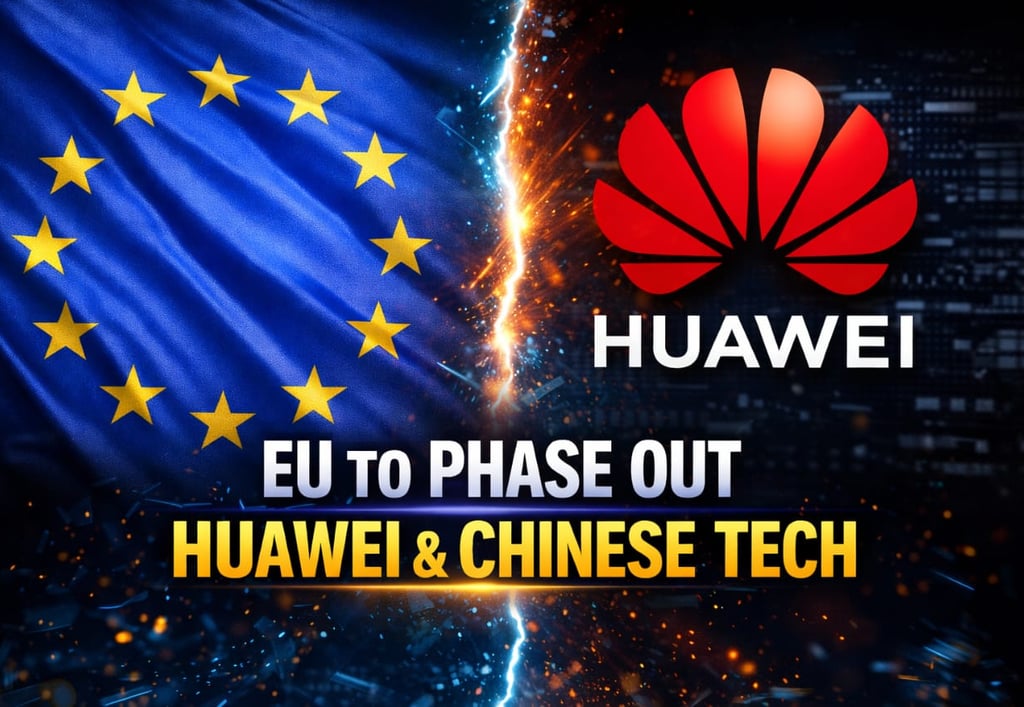
EU Moves to Phase Out High-Risk Technology, Targeting Huawei and Chinese Firms Over Security Concerns
The European Union has announced a major policy shift aimed at strengthening digital security across the bloc, unveiling plans to gradually phase out so-called “high-risk” technology from critical infrastructure. The decision, confirmed on 20 January 2026, primarily targets Chinese technology companies, most notably Huawei and ZTE, whose equipment is widely used across Europe’s telecommunications and energy networks.
EU officials stress that the move is not directed at any single country but is part of a broader effort to safeguard cybersecurity, data protection, and digital sovereignty at a time of rising geopolitical and technological tensions.
Under a draft framework presented by the European Commission, “high-risk technology” refers to equipment and systems that could expose sensitive data, disrupt essential services, or create vulnerabilities in national security. Policymakers argue that certain non-EU suppliers are subject to legal or political influence from foreign governments, raising concerns about transparency, control, and long-term reliability.
Scope of the New EU Policy
The proposed measures extend well beyond telecommunications. The EU has identified 18 sectors as critical infrastructure, including 5G and future mobile networks, electricity grids, energy supply systems, cloud computing, data centers, transport networks, medical devices, smart grids, renewable energy installations, and security screening technologies.
If equipment from high-risk vendors is found within these systems, member states will be required to systematically remove or replace it with alternatives from trusted suppliers. The policy is designed to ensure that Europe’s most sensitive systems are insulated from potential external interference.
Timeline for Phase-Out
According to the European Commission, once the final list of high-risk suppliers is formally adopted, telecom operators will be given up to 36 months—roughly three years—to remove such equipment from mobile networks. For other sectors, including fixed-line and satellite infrastructure, timelines will be defined separately to avoid disruption to essential services.
EU authorities say this phased approach is intended to balance security needs with economic and operational realities, allowing governments and companies time to adapt, secure alternative suppliers, and manage costs.
China’s Response
China has reacted sharply to the EU’s announcement, calling the policy discriminatory and politically motivated. Chinese officials have accused the bloc of “naked protectionism,” warning that the decision could undermine investment confidence and damage long-standing trade and technology cooperation between Europe and China.
Beijing has urged EU leaders to ensure a fair and open business environment, arguing that Chinese companies have played a key role in Europe’s digital development and have not been proven to pose security threats.
Economic and Industry Impact
Industry analysts note that the policy could significantly reshape Europe’s technology supply chains. In sectors such as solar energy and telecommunications, Chinese companies currently account for up to 80–90 percent of certain equipment supplies, meaning replacement will require major investment and careful planning.
In the short term, costs are expected to rise as operators upgrade networks and source alternative technologies. However, EU officials argue that long-term benefits—including stronger security, reduced dependency, and greater technological autonomy—outweigh the financial burden.
Strategic and Geopolitical Context
The decision reflects a broader strategic shift within the EU to reduce reliance on external suppliers in critical areas. It follows similar moves by several Western countries to reassess technology partnerships amid growing concerns over cybersecurity, data governance, and geopolitical risk.
European policymakers view the phase-out as a cornerstone of the bloc’s digital resilience strategy, aimed at ensuring that future infrastructure is built on secure, transparent, and trusted foundations.
Conclusion
The EU’s plan to phase out high-risk technology marks a pivotal moment in Europe’s digital and security policy. While the transition may prove costly and complex, officials believe it is a necessary step to protect critical infrastructure and strengthen digital independence. As the policy moves toward implementation, its impact is likely to be felt well beyond Europe, influencing global technology markets and international relations for years to come.
Stay informed with the latest national and international news.
© 2026. All rights reserved.