
Eiffel Tower History: Construction, Hitler’s Visit, World War II and Hidden Facts About Paris’ Iron Landmark
Discover the complete history of the Eiffel Tower, from its construction in 1887 to Hitler’s visit during World War II. Explore engineering facts, hidden secrets, wartime history, tourism impact and why the Eiffel Tower became the symbol of Paris.
Raja Awais Ali
6/9/20269 min read
Eiffel Tower History: Construction, Hitler’s Visit, World War II and Hidden Facts About Paris’ Iron Landmark
Few structures in the world instantly remind people of an entire country. When France is mentioned, the first image that appears in most minds is the Eiffel Tower. Standing in the heart of Paris, this giant iron monument is not only one of the most visited tourist attractions in the world but also a lasting symbol of engineering, creativity, ambition and modern civilization. Every year, millions of visitors travel to France to witness its beauty, yet many people do not know that the structure once faced harsh criticism and was considered a threat to the beauty of Paris.
Today, the Eiffel Tower represents French culture and identity, but during its construction many famous writers, artists and intellectuals opposed the project. Some described it as an ugly industrial skeleton that would ruin the elegance of Paris forever. Over time, however, the same monument became the greatest symbol of the city and one of the most recognizable landmarks on Earth.
The Origins of the Eiffel Tower
The story of the Eiffel Tower began during the late nineteenth century when France wanted to demonstrate its industrial progress and scientific achievements to the world. To celebrate the centennial of the French Revolution, the French government planned a grand international exhibition known as the 1889 Exposition Universelle in Paris. Officials wanted a structure that would amaze visitors and represent the future of engineering.
During the 1880s, the French government announced a competition for a unique monument to be built for the world fair. More than seven hundred proposals were submitted by engineers and architects. Among them, one design stood out from all the others. It was the proposal for a gigantic iron tower rising nearly 300 meters into the sky.
The original engineering concept was created by Maurice Koechlin and Emile Nouguier, two senior engineers working for the company of Gustave Eiffel. Architect Stephen Sauvestre later improved the visual appearance of the design by adding decorative arches and refinements. Eventually, the project was approved under the leadership of the famous French engineer Gustave Eiffel, whose company specialized in large metal structures and bridges. The tower later became known worldwide as the Eiffel Tower.
Gustave Eiffel and the Vision Behind the Project
Before the Eiffel Tower, Gustave Eiffel had already built a strong reputation in engineering. His company had successfully completed bridges, railway structures and metal frameworks across Europe and other parts of the world. When the design for the massive iron tower was presented to him, he immediately understood its historical importance and future potential.
Eiffel invested heavily in the project and dedicated his engineering teams to transforming the ambitious idea into reality. At the time, constructing a 300-meter iron structure sounded impossible to many critics. Modern construction technology, computers, laser measurements and advanced cranes did not exist. Everything depended on mathematical precision, skilled workers and careful planning.
Construction of the Eiffel Tower
Construction officially began on January 28, 1887. The project was considered one of the greatest engineering challenges of its era. The tower’s four massive iron pillars rise separately from the ground before curving inward and joining together into a single central structure.
Approximately 18,038 individual iron pieces were used during construction. What made the project remarkable was that all the metal components were prefabricated in factories before being transported to the construction site. Workers then assembled the parts with extraordinary accuracy.
Around 2.5 million rivets were used to connect the iron sections together. The metal framework alone weighed approximately 7,300 tons, while the complete structure exceeded 10,100 tons in total weight. For the nineteenth century, these numbers were extraordinary and demonstrated the incredible scale of the project.
Nearly 300 workers participated in the construction process. Safety standards during that era were limited compared to modern construction practices, yet the Eiffel Tower project maintained relatively advanced safety procedures for its time. Because of this careful planning, the number of fatal accidents remained extremely low, which was considered a major achievement during the industrial age.
The construction cost reached approximately 7.8 million French francs. In modern value, this would equal many millions of euros. The French government provided partial funding, while Gustave Eiffel personally invested a large amount of money through his company. In return, he received the commercial rights to operate the tower for twenty years, allowing him to recover his investment through tourism revenue.
Public Criticism and Opposition
As construction began, many well-known Parisian artists, authors and intellectuals publicly protested against the project. They believed the enormous iron structure would destroy the classical beauty of Paris. Newspapers published articles criticizing the tower, and several cultural figures signed petitions demanding the cancellation of the project.
Some critics described the structure as a “gigantic black smokestack” or an “iron monster.” They feared that Paris, famous for its historic architecture and artistic atmosphere, would lose its identity.
Gustave Eiffel strongly defended the project. He argued that the tower represented the future of science and engineering. According to Eiffel, modern architecture should not fear innovation. He believed time would eventually prove the importance of the monument, and history later confirmed his vision.
Completion of the Eiffel Tower
After two years, two months and five days of construction, the Eiffel Tower was officially completed on March 31, 1889. At the time, its height of 300 meters made it the tallest human-made structure in the world. It surpassed the Washington Monument in the United States and remained the tallest structure on Earth for forty-one years until the Chrysler Building was completed in New York in 1930.
The tower was opened to the public during the 1889 World’s Fair. Within the first few months, nearly two million visitors came to see the extraordinary structure. Many people who had initially opposed the project later became fascinated by it. Gradually, the Eiffel Tower transformed into the defining symbol of Paris.
Interestingly, the tower was never intended to remain permanently. According to the original agreement, it was supposed to be dismantled after twenty years in 1909. French authorities believed the structure would lose its purpose once the international exhibition ended.
However, scientists and military officials soon realized the tower’s height made it extremely valuable for radio communication and scientific experiments. Because of its usefulness in telecommunications, the decision to destroy the tower was canceled, ultimately saving one of the world’s greatest landmarks.
The Eiffel Tower During World War I
During the First World War, the Eiffel Tower played an important military role. Its height allowed France to transmit radio signals over long distances and monitor enemy communications. French military forces used the tower’s radio systems to intercept German messages and support strategic operations.
As radio technology advanced, the Eiffel Tower became increasingly important for broadcasting and communication. This practical value helped ensure its long-term survival.
Adolf Hitler, Nazi Occupation and the Eiffel Tower
The most dramatic chapter in the history of the Eiffel Tower came during the Second World War. In 1939, Europe entered a period of chaos and destruction as Adolf Hitler’s Nazi Germany expanded aggressively across the continent. Hitler wanted not only military dominance but also symbolic control over Europe’s greatest capitals, and Paris was one of his primary targets.
In 1940, German forces launched a major invasion of France. Despite resistance from French troops, Germany’s fast military strategy, modern tanks and powerful air force quickly overwhelmed the country. Within weeks, German troops approached Paris.
On June 14, 1940, Nazi Germany officially occupied Paris. The city fell into fear and uncertainty as German flags appeared across the French capital. For the French people, seeing Nazi soldiers marching through Paris was a painful national humiliation.
The Eiffel Tower, already recognized worldwide as the symbol of France, suddenly became a major political and psychological symbol during the occupation.
According to historical accounts, French resistance members cut the tower’s elevator cables before the arrival of Adolf Hitler and Nazi officials. Their goal was symbolic as much as practical. They wanted to prevent German leaders from easily reaching the top of France’s most famous monument.
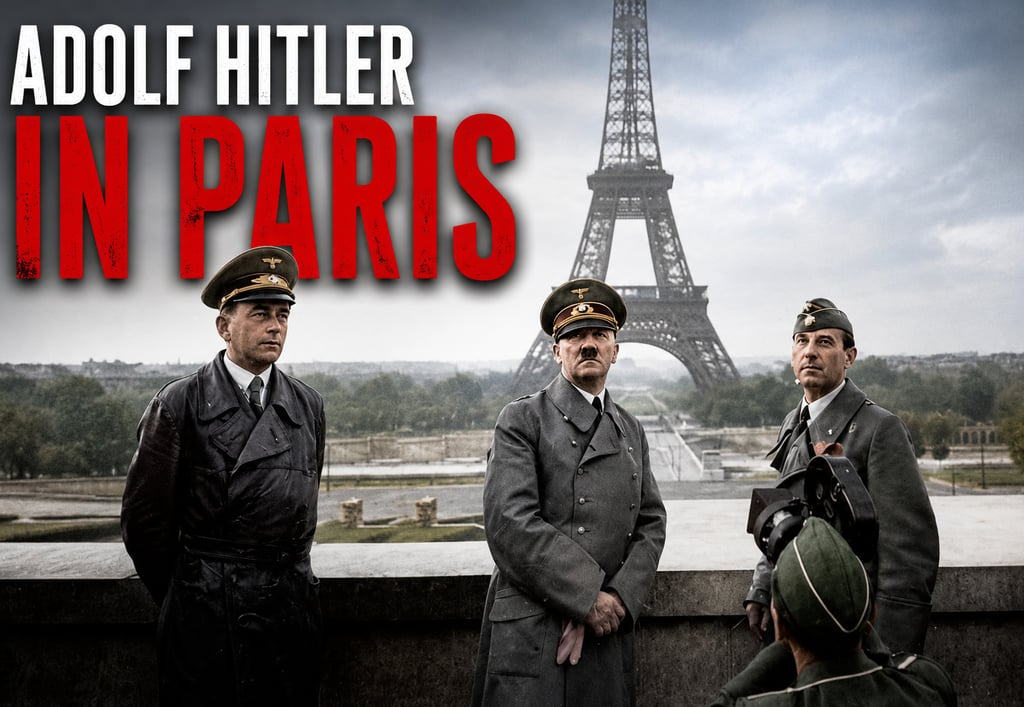
A few days later, Adolf Hitler personally visited Paris. Accompanied by senior Nazi officials and military commanders, Hitler toured several important landmarks including the Arc de Triomphe, the Paris Opera House and the Eiffel Tower. Historic photographs show Hitler standing near the Eiffel Tower during his visit.
Because the elevators were disabled, Hitler was unable to reach the top of the tower. German engineers reportedly attempted to repair the elevators, but they were not immediately successful. This event later inspired the famous statement that “Hitler conquered France, but he could not conquer the Eiffel Tower.”
During the Nazi occupation, German flags were raised on the Eiffel Tower. One of the first Nazi flags installed there was reportedly so large that strong winds tore it apart, forcing German authorities to replace it with a smaller version.
For the French public, this was one of the darkest periods in the history of Paris. Food shortages, military control and political oppression affected daily life throughout the occupation. At the same time, the French Resistance secretly organized sabotage missions and intelligence operations against German forces.
Because of its communication systems, the Eiffel Tower also held strategic military importance during the war. Radio transmissions from the tower were used for communication and military coordination, increasing its value for both the Germans and the Allies.
Hitler’s Orders to Destroy Paris
As Allied forces advanced toward France in 1944, Nazi control over Europe began collapsing. During the final phase of the war, Adolf Hitler reportedly ordered the destruction of Paris before it could fall into Allied hands. Bridges, railways and major historical monuments were included in the possible destruction plans.
According to several historical sources, Hitler repeatedly asked his commanders, “Is Paris burning?” He wanted the city destroyed rather than liberated.
The Eiffel Tower was among the landmarks that could have been lost forever.
However, the German military governor of Paris, General Dietrich von Choltitz, ultimately refused to fully carry out Hitler’s destruction orders. Historians continue to debate his motivations. Some believe he understood the historical importance of Paris, while others argue Germany’s collapsing military situation made the orders impossible to execute.
Whatever the reason, Paris survived largely intact, and the Eiffel Tower was spared from destruction.
On August 25, 1944, Paris was officially liberated. French citizens celebrated in the streets as the French flag was raised once again over the Eiffel Tower. The monument became not only a symbol of France but also a symbol of resistance, survival and national pride.
The Eiffel Tower in the Modern Era
Today, the Eiffel Tower stands at approximately 330 meters tall including its antennas. Over the decades, different broadcasting and communication equipment increased its original height.
The tower contains three public levels. The first level is around 57 meters above ground, the second level rises to 115 meters, and the highest public platform reaches approximately 276 meters. Above these levels are technical and broadcasting facilities.
Seven elevators transport visitors throughout the structure. Those who prefer climbing on foot must climb 1,665 stairs to reach the upper levels. Every year, thousands of tourists attempt the climb to experience panoramic views of Paris.
Maintaining the Eiffel Tower is a massive engineering task. To protect the iron structure from rust, the tower is repainted approximately every seven years. Nearly 60 tons of paint are required for each repainting cycle, and workers complete the process by hand over several months.
The color of the tower is carefully adjusted using different shades so that it appears visually balanced from top to bottom.
Temperature changes also affect the structure. During summer, heat causes the iron to expand, increasing the tower’s height by as much as 15 centimeters. In colder weather, the structure contracts slightly. This remains one of the most fascinating engineering characteristics of the monument.
Tourism, Culture and Global Fame
Today, the Eiffel Tower is more than a historical monument. It is also one of the world’s most powerful tourism symbols. More than seven million visitors travel to the site annually, making it one of the most visited paid monuments on Earth.
Tourism connected to the Eiffel Tower contributes significantly to the economy of Paris and France. Hotels, restaurants, transportation services and local businesses all benefit from the millions of international visitors who come each year.
At night, the tower becomes even more spectacular. Thousands of lights illuminate the structure, creating one of the most famous nighttime views in the world. In 2000, approximately 20,000 sparkling lights were installed to celebrate the new millennium. These lights continue to flash every hour, creating a memorable experience for visitors.
The Eiffel Tower has also become one of the most recognizable symbols in global popular culture. It appears in films, documentaries, advertisements and international events. Famous productions such as An American in Paris, The Da Vinci Code, Midnight in Paris, Mission: Impossible – Fallout and Ratatouille helped strengthen its worldwide reputation.
Engineering Facts and Final Legacy
The base of the Eiffel Tower covers an area of approximately 125 square meters. More than 18,000 iron components and 2.5 million rivets hold the structure together. Its total weight exceeds 10,000 tons, while its height reaches nearly 330 meters.
More than a century after its construction, the Eiffel Tower remains one of humanity’s greatest engineering achievements. What was once criticized as an ugly industrial project eventually became the defining image of Paris and one of the most admired monuments in history.
The story of the Eiffel Tower proves that revolutionary ideas often face resistance in the beginning. Over time, however, visionary creations can transform into timeless symbols of culture and human achievement.
Today, standing beneath the Eiffel Tower is more than a tourist experience. It is a reminder of human ambition, scientific innovation and the power of imagination. From its controversial beginnings to its survival through two world wars and Nazi occupation, the Eiffel Tower continues to rise above Paris as an unforgettable symbol of history, resilience and creativity.
Stay informed with the latest national and international news.
© 2026. All rights reserved.