
Dubai Safe-Haven Status in Crisis: Iran Strikes Test Investor Confidence | March 2026
Dubai faces its toughest test as Iranian retaliatory attacks disrupt airports, ports, and hotels, challenging its reputation as a Middle East safe-haven. Latest analysis and figures for March 3, 2026.
Raja Awais Ali
3/3/20262 min read
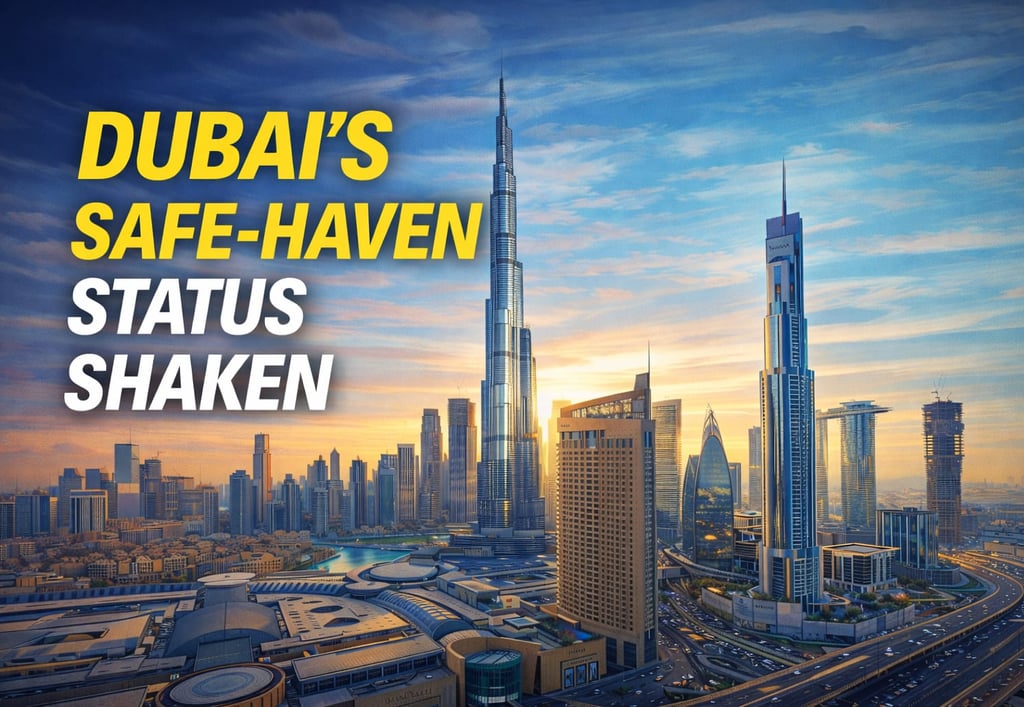
Dubai’s Safe-Haven Status Faces Its Toughest Test
For over four decades, Dubai has positioned itself as a stable, secure, and reliable hub in the Middle East. Tax-free salaries, world-class infrastructure, and transparent legal and financial frameworks made Dubai the preferred destination for investors, businesses, and high-net-worth individuals. However, recent Iranian retaliatory missile and drone strikes following U.S. and Israeli actions have put the city’s “safe-haven” image under its most severe test yet.
The attacks affected not only Dubai’s physical infrastructure but also its economic and psychological foundations. Dubai International Airport, one of the busiest airports in the world, was temporarily closed, while a berth at Jebel Ali Port, a critical trade hub, caught fire. Parts of Burj Al Arab were damaged by missile debris. Official reports confirmed three fatalities and 58 injuries. While UAE defense systems intercepted most threats, the attacks marked a rare moment of tangible vulnerability for the city.
Economic repercussions were immediate. Dubai and Abu Dhabi stock exchanges were closed for two consecutive days, an unprecedented measure. Banking and cloud services were temporarily disrupted, and airspace closures stranded thousands of travelers. Dubai’s economy relies almost entirely on non-oil sectors, including trade, tourism, aviation, real estate, and financial services. Any prolonged disruption threatens investor confidence and business stability. Gold demand surged, and some investment firms began considering relocation or scaling back operations in the UAE.
Dubai has historically weathered crises such as the global financial crash and COVID-19, emerging stronger each time. But this episode is unique because it directly challenges Dubai’s reputation as a safe and stable hub. Geographically, the city has always been exposed. The Strait of Hormuz, through which approximately 20% of the world’s seaborne oil passes, lies directly offshore, with Iran capable of disrupting Gulf commerce. Previously, investors assumed Dubai would remain shielded from direct retaliation in regional conflicts; that confidence has now weakened.
Dubai’s rise was deliberate and strategic. The launch of Emirates Airline in 1985, iconic projects such as Burj Khalifa, and the establishment of the Dubai International Financial Centre in 2004 attracted over 290 banks, 102 hedge funds, 500 wealth management firms, and 1,289 family offices. The city also benefited from crises elsewhere, attracting displaced capital and talent from the Arab Spring, the Syrian conflict, and the Ukraine war. By 2024, the UAE population had grown to around 11 million, and the country welcomed a record 9,800 relocating millionaires, more than any other nation globally.
So far, there is no evidence of significant capital flight. Dubai retains strong reserves, diversified revenue streams, global-standard governance, and rapid crisis-response mechanisms. However, if the conflict persists, investors may look to alternative hubs such as Riyadh or Istanbul. Dubai’s safe-haven status has not collapsed but is showing clear cracks. Whether these cracks are temporary or permanent depends on how quickly regional tensions ease and how effectively Dubai manages investor and resident confidence.
In conclusion, Dubai, which built its global reputation on stability and trust in an uncertain region, is now undergoing its most significant challenge. Its future depends on its ability to restore confidence while maintaining the economic and strategic fundamentals that have made it a preferred destination for global capital.
Stay informed with the latest national and international news.
© 2026. All rights reserved.