
Dr. Abdul Qadeer Khan and Pakistan’s Nuclear Program: The Untold Story Behind Pakistan’s Atomic Power
Discover the complete story of Dr. Abdul Qadeer Khan, the architect of Pakistan’s nuclear program. Explore Pakistan’s atomic journey, the Chagai nuclear tests, global pressure, secret operations, and the controversies that shaped South Asian history.
Raja Awais Ali
5/28/20268 min read

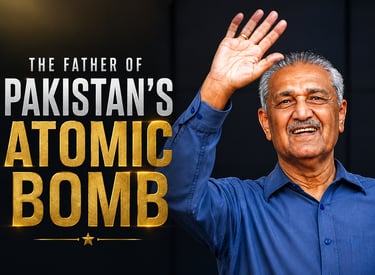
The Early Life of Dr. Abdul Qadeer Khan and Pakistan’s Need for Nuclear Power
Some moments in history do not only change politics — they change the psychology, confidence, and future of entire nations. For Pakistan, one of those moments came on May 28, 1998, when the mountains of Chagai in balochistan بلوچستان shook after a series of nuclear explosions. Those explosions were not just scientific tests. They were a declaration to the world that Pakistan was no longer weak, vulnerable, or defenseless. Behind that historic moment stood one man whose name became permanently connected with Pakistan’s nuclear identity — Dr. Abdul Qadeer Khan.
Today, millions of Pakistanis remember him as “Mohsin-e-Pakistan,” meaning the benefactor of Pakistan. But his story is far bigger than the image of a scientist standing beside nuclear technology. His journey represents fear, survival, national humiliation, geopolitical pressure, scientific ambition, and the desperate struggle of a country trying to protect its future in one of the world’s most dangerous regions.
Dr. Abdul Qadeer Khan was born on April 1, 1936, in Bhopal, British India. He belonged to an educated Muslim family where discipline and education were deeply valued. His father, Abdul Karim Khan, worked as a teacher, while his mother managed the household. From an early age, Abdul Qadeer Khan showed unusual curiosity. He was not satisfied with simply memorizing books. He wanted to understand how things worked. Machines, metals, industrial systems, and scientific concepts fascinated him.
Then came the partition of British India in 1947.
Like millions of Muslim families, his family migrated to the newly created Pakistan. The migration was painful. Families lost homes, land, businesses, and relationships. Pakistan itself was struggling to survive. The country lacked resources, industries, universities, and scientific institutions. But these difficult conditions helped shape Abdul Qadeer Khan’s personality. He developed patience, resilience, and a powerful determination to achieve something meaningful for his new homeland.
After settling in Karachi, he continued his education. Pakistan at that time had limited opportunities in science and research. There were few laboratories, little funding, and almost no advanced technological infrastructure. However, Abdul Qadeer Khan dreamed far beyond those limitations. He studied science in Karachi and later moved to Europe for higher education.
That decision changed his life forever.
In Europe, he studied metallurgical engineering in Germany, Belgium, and the Netherlands. For the first time, he experienced advanced scientific environments, modern laboratories, and industrial technology at the highest level. Europe was leading the world in nuclear research and engineering development. During this period, he not only gained academic knowledge but also learned how advanced technological systems operated behind the scenes.
While working in the Netherlands, he became associated with FDO, an organization linked to uranium enrichment technology. This was the moment when he gained exposure to centrifuge technology — one of the most sensitive technologies in the world. Uranium enrichment is one of the key processes required to develop nuclear weapons. Global powers such as the United States, the Soviet Union, Britain, and France treated this technology as a closely guarded secret because nuclear capability was directly connected to military power, geopolitical influence, and national survival.
At the same time, South Asia was becoming increasingly unstable.
The 1971 war between Pakistan and India had already left deep scars on Pakistan. East Pakistan separated and became Bangladesh. The psychological impact on Pakistan was enormous. The country appeared weak and divided. India emerged stronger and more confident in the region. Then, in 1974, India conducted its first nuclear test under the codename “Smiling Buddha.”
For Pakistan, this was more than a scientific achievement by a rival nation. It was a warning.
Pakistan’s leadership realized that without strategic military strength, the country’s future could remain under constant threat. Former Prime Minister Zulfikar Ali Bhutto famously declared:
“We will eat grass, even go hungry, but we will get our own atomic bomb.”
This statement later became the foundation of Pakistan’s nuclear doctrine.
When Abdul Qadeer Khan learned about India’s nuclear test, something changed inside him. He immediately contacted Pakistan’s leadership and offered his expertise. He wrote directly to Zulfikar Ali Bhutto and explained that Pakistan had the potential to rapidly develop nuclear capability if the right scientific direction was followed.
That letter changed Pakistan’s history.
In 1976, Dr. Abdul Qadeer Khan returned to Pakistan. But his return marked the beginning of a silent and dangerous struggle that would continue for decades.
Pakistan’s Secret Nuclear Program and the Road to Chagai
When Dr. Abdul Qadeer Khan returned to Pakistan, the country was already under international suspicion. Western governments feared that Pakistan was trying to secretly build nuclear weapons. Intelligence agencies, especially the CIA, closely monitored Pakistan’s activities. Global pressure increased, but Pakistan’s security concerns were also growing stronger after India’s nuclear ambitions became clear.
It was during this tense environment that Kahuta Research Laboratories was established. Later, it became widely known as Khan Research Laboratories or KRL.
Kahuta soon became one of Pakistan’s most secretive locations. Almost everything happening inside the facility was hidden from the public. Scientists worked under strict security. Their movement was controlled, experiments were classified, and foreign intelligence agencies constantly tried to gather information about the program.
Dr. Abdul Qadeer Khan worked day and night alongside a team of young Pakistani scientists and engineers. Unlike Western countries, Pakistan did not have access to advanced machinery or unlimited funding. In fact, many countries refused to sell Pakistan sensitive equipment because of international pressure.
This forced Pakistani scientists to rely on reverse engineering.
Instead of purchasing advanced machines, they studied existing systems and attempted to build their own versions. This was an extremely difficult process. Even the smallest technical mistake could destroy years of work. Centrifuges often failed during testing. Some experiments collapsed completely. Machines broke apart under pressure. But the scientists continued working.
According to several accounts, Dr. Abdul Qadeer Khan often stayed inside laboratories late into the night. For him, the project was not simply scientific work — it was a national mission.
By the 1980s, the international community had started realizing that Pakistan was making serious progress toward nuclear capability. Western newspapers began publishing reports about Pakistan’s secret program. The United States increased pressure and imposed sanctions. However, global politics unexpectedly helped Pakistan continue its efforts.
The Soviet Union had invaded Afghanistan in 1979, and the United States needed Pakistan as a strategic ally during the Cold War. Because of this geopolitical reality, Washington avoided direct confrontation with Islamabad. Pakistan used this opportunity to quietly strengthen its nuclear infrastructure.
Throughout the 1980s and early 1990s, Pakistan continued developing its nuclear capability in silence.
Then came May 1998.
India conducted another series of nuclear tests. Tensions exploded across South Asia. India presented itself as the dominant regional power, and Pakistan immediately faced enormous pressure from the international community not to respond.
The United States, Japan, and several European countries warned Pakistan against conducting nuclear tests. Economic sanctions were threatened. Pakistan’s economy at the time was fragile. Foreign reserves were low. Political discussions inside the government became intense.
But public opinion inside Pakistan was completely different.
People wanted Pakistan to stand equal to India.
Reports suggest that Dr. Abdul Qadeer Khan strongly assured the government that Pakistan was fully prepared.
Then came May 28, 1998.
In the mountains of Chagai, بلوچستان, balochistan extraordinary security arrangements were in place. Scientists, military officers, sensitive equipment, and secret codes surrounded the area. Deep inside the mountains, nuclear devices had already been installed.
Then the button was pressed.
Within seconds, the earth shook violently.
The mountains turned white.
Pakistan had officially become the seventh nuclear power in the world and the first Islamic nuclear state.
Celebrations erupted across the country. People distributed sweets, offered prayers of gratitude, and flooded the streets with national flags. But the emotional meaning of Chagai went far beyond military strength.
For many Pakistanis, it felt like the nation had finally recovered from the humiliation of 1971.
It was a psychological victory.
Pakistan had delivered a message to the world that it could no longer be treated as weak or defenseless.
After Chagai, Dr. Abdul Qadeer Khan became a national icon. Newspapers called him “Mohsin-e-Pakistan.” His photographs appeared in homes, schools, and offices. For millions of people, he symbolized patriotism, sacrifice, and national pride.
However, history shows that great success is often followed by controversy.
Global Controversies, International Pressure, and Dr. AQ Khan’s Final Years
After the Chagai nuclear tests, Dr. Abdul Qadeer Khan’s fame continued growing inside Pakistan, but internationally, concerns about him were also increasing. Western intelligence agencies were already monitoring Pakistan’s nuclear program, but after 1998, they became especially focused on AQ Khan himself.
The major controversy emerged between 2003 and 2004.
At that time, “nuclear proliferation” — the spread of nuclear technology to other countries — had become one of the world’s biggest security concerns. After the 9/11 attacks, the United States feared that nuclear technology could eventually reach hostile states or dangerous groups.
Then intelligence reports from the United States and Britain claimed that a secret international network had been supplying nuclear technology to multiple countries, and according to those reports, Dr. Abdul Qadeer Khan was allegedly at the center of it.
The first major case involved Libya.
In 2003, Libyan leader Muammar Gaddafi suddenly announced that Libya would abandon its secret nuclear program. When international investigators examined Libya’s facilities, they discovered centrifuge designs, uranium enrichment documents, and sensitive equipment. Western officials claimed that many of those designs resembled technology connected to Pakistan’s Kahuta program.
Soon, similar allegations emerged regarding Iran and North Korea.
According to Western media reports, Iran had allegedly received early centrifuge technology connected to AQ Khan’s network. North Korea was also accused of exchanging missile technology for nuclear knowledge. For Washington, this situation became extremely serious because both Iran and North Korea were already viewed as hostile states.
If those allegations were true, it meant nuclear technology had spread beyond official state control.
By 2004, Pakistan was under intense international pressure. General Pervez Musharraf’s government faced strong demands from the United States to investigate the matter completely.
Then came one of the most dramatic moments in Pakistan’s modern history.
In February 2004, Dr. Abdul Qadeer Khan appeared on Pakistani television and publicly accepted responsibility for certain decisions made “in his personal capacity.” He apologized to the nation.
The speech immediately became global breaking news.
Western media declared that Pakistan had effectively admitted nuclear technology transfers had taken place.
Inside Pakistan, however, many people viewed the situation very differently.
A large number of Pakistanis believed Dr. Abdul Qadeer Khan had been turned into a scapegoat in order to reduce international pressure on the country. His supporters argued that such large-scale technology transfers could never happen through the actions of a single individual alone, especially within a highly sensitive nuclear system involving military oversight and state security.
Some analysts also believed the United States was searching for a major symbol of “nuclear black market activity” during a period already dominated by the Iraq War, Iran tensions, and fears surrounding North Korea.
Western media soon began referring to AQ Khan as the “father of the nuclear black market.”
In Pakistan, those words created anger and emotional reactions because the public still considered him a national hero.
After the controversy, Dr. Abdul Qadeer Khan was effectively placed under house arrest. His movement became restricted. Meetings with foreign journalists were banned, and for several years he remained isolated from public life. Although some restrictions were later eased, his life had changed completely.
At one point, he had been Pakistan’s most celebrated hero.
Now he stood at the center of one of the world’s biggest nuclear controversies.
Despite everything, his popularity inside Pakistan never completely disappeared. Millions of Pakistanis still believe that without Dr. Abdul Qadeer Khan, Pakistan may never have achieved nuclear capability.
During his later years, he continued encouraging young Pakistanis to focus on science, technology, engineering, and education. He repeatedly argued that future wars would not only be fought with tanks and missiles but also through cyber systems, artificial intelligence, technological superiority, and scientific innovation.
According to him, Pakistan’s true future strength depended not only on nuclear weapons but also on education and research.
On October 10, 2021, Dr. Abdul Qadeer Khan passed away.
His death created deep sadness across Pakistan. Television channels aired special tributes. Millions of people posted emotional messages online. Many described him as the man who gave Pakistan strategic security and national confidence.
Even today, when Pakistan speaks about its defense strength, nuclear deterrence, or regional balance of power, the shadow of Kahuta, Chagai, and Dr. Abdul Qadeer Khan still remains present.
His story is not simply the story of a scientist.
It is the story of a nation that believed survival was impossible without strength.
It is the story of fear after 1971.
It is the story of silent laboratories, failed experiments, global sanctions, intelligence pressure, and national determination.
Most importantly, it is the story of how one man became permanently connected to Pakistan’s identity as a nuclear power.
Stay informed with the latest national and international news.
© 2026. All rights reserved.