
Doomsday Clock Moves Closest to Midnight Ever as Global Wars and Nuclear Risks Intensify
Atomic scientists have moved the Doomsday Clock to just 85 seconds before midnight in 2026, citing global wars, nuclear threats, climate change, and rising geopolitical tensions worldwide.
Raja Awais Ali
1/27/20263 min read
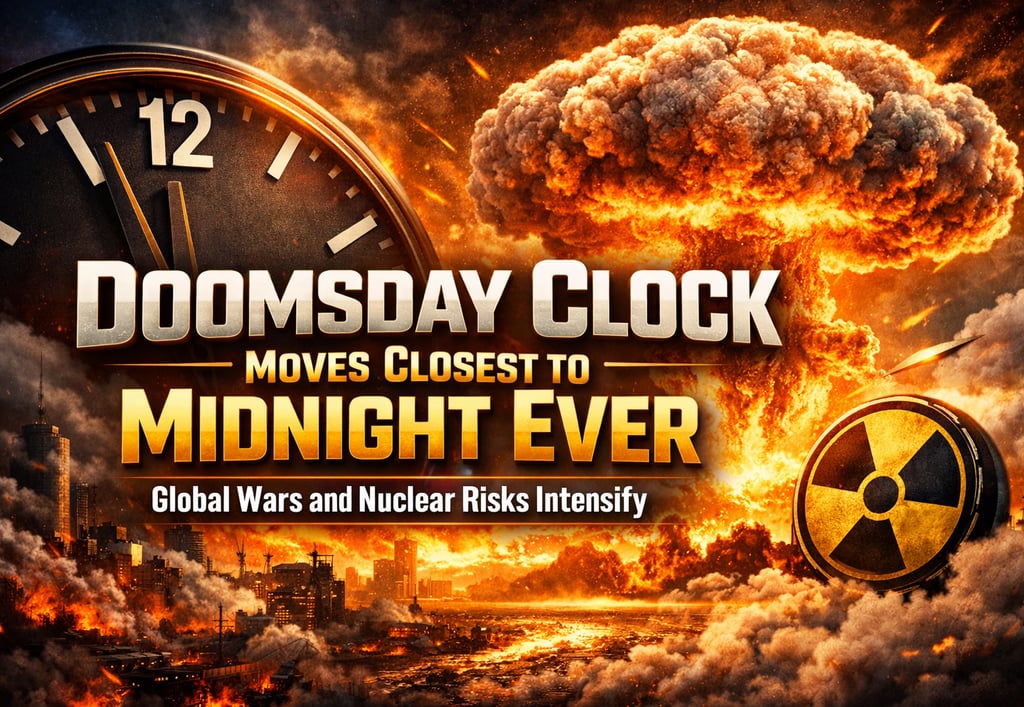
Doomsday Clock Set Closest to Midnight in History as Global Conflicts and Nuclear Threats Escalate
The world is standing at one of the most dangerous moments in modern history. On January 27, 2026, the Bulletin of the Atomic Scientists announced that the symbolic Doomsday Clock has been moved to just 85 seconds before midnight, the closest it has ever been since its creation. This historic decision reflects growing concerns over global wars, nuclear escalation, climate change, and emerging technological threats that together pose an unprecedented risk to humanity.
The Doomsday Clock is not a real timekeeping device but a symbolic warning system designed to show how close the world is to a human-made catastrophe. In this system, midnight represents global destruction, while the remaining seconds reflect how severe and immediate global threats have become. The closer the clock moves to midnight, the higher the danger level facing civilization.
Origins and Purpose of the Doomsday Clock
The Doomsday Clock was first introduced in 1947, shortly after World War II and the atomic bombings of Hiroshima and Nagasaki. At that time, scientists feared that the uncontrolled spread of nuclear weapons could lead to global annihilation. The clock was initially set at seven minutes to midnight to signal these dangers to world leaders and the public.
Its purpose has always been to alert humanity, not to frighten it — urging governments to pursue diplomacy, arms control, and international cooperation before it is too late.
Doomsday Clock Timeline: Key Years and Figures
Over the decades, the clock has moved back and forth depending on global conditions:
1949: After the Soviet Union’s first nuclear test, the clock moved to 3 minutes to midnight.
1953: U.S. and Soviet hydrogen bomb tests pushed it to 2 minutes, a Cold War record.
1963: Nuclear test ban agreements moved it back to 12 minutes.
1972: Arms control treaties kept it at 12 minutes.
1991: End of the Cold War moved it to 17 minutes, the safest point in history.
2002: Terrorism and nuclear fears brought it back to 7 minutes.
2015: Ukraine crisis and climate failures reduced it to 3 minutes.
2018: Global tensions pushed it to 2 minutes again.
2020: For the first time measured in seconds — 100 seconds to midnight.
2023: Russia-Ukraine war moved it to 90 seconds.
2026: Now set at 85 seconds, the closest ever.
Global Wars Driving the Clock Forward
Scientists say the main reason behind the latest shift is the increase in global conflicts over the past five years.
The Russia-Ukraine war, ongoing since 2022, remains the most dangerous conflict in Europe since World War II. With nuclear-armed powers indirectly involved and repeated nuclear rhetoric, the risk of escalation has remained alarmingly high.
In the Middle East, the ongoing Israel-Palestine war, particularly the devastation in Gaza, has destabilized the region. Rising tensions involving Iran, Israel, and regional proxy forces have further increased fears of a broader conflict with global consequences.
In South Asia, long-standing tensions between India and Pakistan, both nuclear-armed nations, continue to pose a serious risk, especially during periods of border escalation.
Meanwhile, China and Taiwan remain another flashpoint. Increased military drills, airspace violations, and U.S. involvement have raised concerns that any miscalculation could spark a major international crisis.
Additionally, North Korea’s ballistic missile tests and nuclear ambitions have added to global instability.
Beyond War: Other Global Threats
According to atomic scientists, war is not the only danger.
Climate change continues to accelerate, causing extreme weather, food insecurity, and environmental collapse.
At the same time, artificial intelligence, cyber warfare, and advanced military technologies are evolving faster than international regulations can control them.
The erosion of trust between global powers, the weakening of arms-control treaties, and the lack of unified leadership have further intensified these risks.
Final Warning to Humanity
Setting the Doomsday Clock at 85 seconds to midnight is not a prediction — it is a final warning. History shows that when nations cooperate, the clock can move backward. When conflict, arrogance, and neglect dominate global politics, humanity inches closer to disaster.
Scientists stress that there is still time, but the margin for error has never been smaller. The decisions made today by world leaders will determine whether the clock moves away from midnight — or strikes it.
Stay informed with the latest national and international news.
© 2026. All rights reserved.