
Crude Oil Prices Rise Slightly on US Inflation Easing & OPEC+ Outlook – Feb 2026
Global crude oil prices edged up on 15 Feb 2026 as easing US inflation boosts confidence, OPEC+ supply concerns persist, and Iran & Gulf countries influence markets.
Raja Awais Ali
2/15/20263 min read
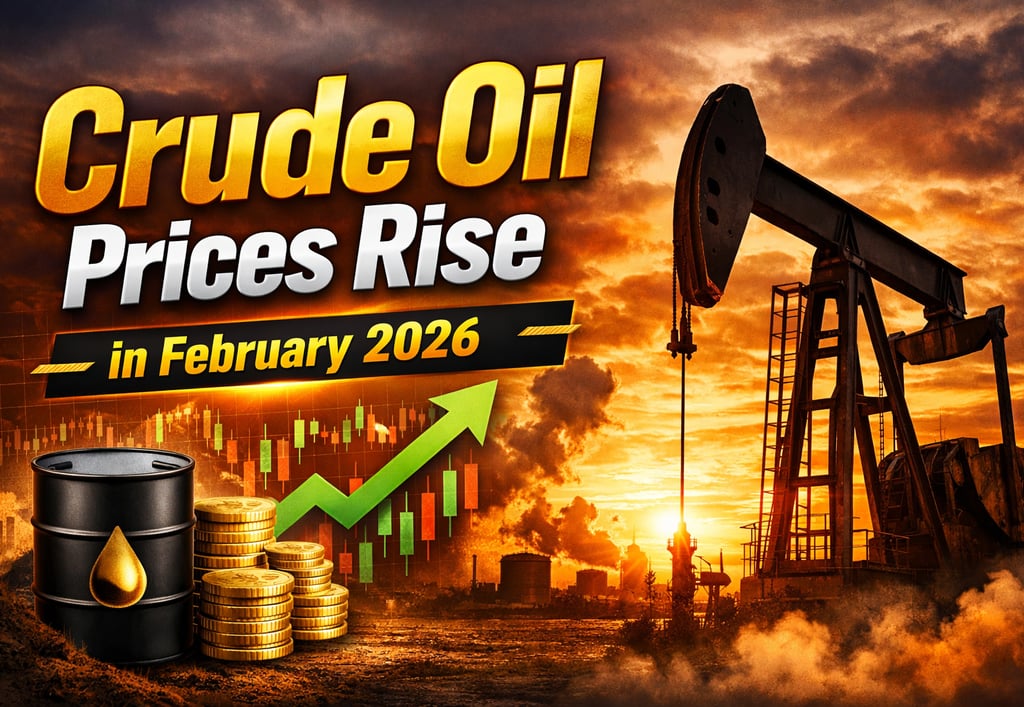
US Inflation Eases, OPEC+ Concerns, Iran and Gulf Countries Influence — Slight Rise in Crude Oil Prices
On 15 February 2026, global crude oil prices closed slightly higher as the latest US inflation data boosted investor confidence, temporarily offsetting concerns over a potential increase in OPEC+ supply. Brent crude settled at approximately $67.75 per barrel, while West Texas Intermediate (WTI) closed around $62.89 per barrel. Although a minor weekly decline was recorded, daily trading reflected stability and cautious optimism, signaling that investors are currently prioritizing macroeconomic data over supply concerns.
In the United States, the January 2026 Consumer Price Index (CPI) showed a year-on-year increase of approximately 2.9%, slower than the previous month. Core inflation also eased gradually, reinforcing the perception that the effects of stringent monetary policy are taking hold. Reduced pressure from energy and housing costs contributed to overall inflation moderation. Consequently, financial markets began to anticipate that the Federal Reserve might consider cutting interest rates by mid-2026. Potential rate cuts could support industrial activity, manufacturing, and the transport sector, stabilizing or increasing crude oil demand. This factor was a key driver behind the recent price increase.
The OPEC+ strategy continues to be a critical factor in the global market. The alliance is currently implementing approximately 2.2 million barrels per day (bpd) of voluntary cuts, with a total production restriction of around 5 million bpd in various phases since 2023. Reports suggest that gradual production increases may be considered from April 2026. While higher supply could put downward pressure on prices, improving global demand may balance this effect. Global daily oil demand reached approximately 103 million bpd by the end of 2025, up from around 91 million bpd during the 2020 pandemic slowdown.
Iran, a key OPEC member, produced approximately 3.1–3.2 million bpd of crude oil by the end of 2025. A significant portion of Iran’s exports is directed toward Asian markets, particularly China. Iran accounts for roughly 3–4% of global oil supply. The Strait of Hormuz in the Persian Gulf channels about 18–20 million barrels of oil daily, representing nearly 20% of global oil trade. Any geopolitical tension in this region could trigger immediate price increases; however, recent months have seen relative easing, keeping the risk premium limited.
Gulf countries, including Saudi Arabia, UAE, Kuwait, Qatar, and Oman, are among the largest producers and exporters globally.
Saudi Arabia produces approximately 10 million bpd and, as the world’s largest exporter, can stabilize global prices by adjusting output under OPEC+.
UAE averages 3.1 million bpd, exporting around 2.5–3 million bpd.
Kuwait produces roughly 2.8 million bpd, with 2.6 million bpd exported.
Qatar is primarily known for LNG and gas production, producing around 1.7 million bpd of crude.
Oman produces approximately 1 million bpd.
Under OPEC+, Gulf countries are currently providing 1.5–2 million bpd of voluntary cuts, stabilizing the global market. They adjust production according to global demand to prevent unnecessary price volatility. Together with Iran, these regions account for nearly 40% of global oil supply, giving them significant influence over market pricing. Iranian crude, often transported via shadow or unofficial routes through neighboring Gulf ports, reaches global markets, allowing Iran to sell its production despite sanctions.
Five-Year Global Oil Market Review
The global oil market has experienced significant volatility over the past five years:
2020: COVID-19 reduced global demand by ~9 million bpd; WTI fell to -$37/bbl; Brent averaged $41/bbl.
2021: Economic recovery; Brent averaged $70/bbl, WTI $68/bbl.
2022: Russia-Ukraine war; Brent peaked at $139/bbl, WTI $123/bbl; annual average ~$100/bbl.
2023: Global economic slowdown; Brent averaged $82/bbl, WTI $77/bbl.
2024–2025: Relatively stable; Brent $65–80/bbl, WTI $62–75/bbl; annual average ~$78/bbl.
Global Financial Market Impact
The recent developments also influenced global financial markets. Asian and European stock markets saw modest gains in energy company shares, while the US dollar remained stable, helping balance import costs. For major importers like China, India, and the EU, even minor price fluctuations can affect trade balances and currency stability.
For emerging economies like Pakistan, the situation is critical. Pakistan imports approximately 1.2 million bpd of crude oil and petroleum products daily. Every $5 increase per barrel can significantly raise the annual import bill. In 2023, when global prices exceeded $90/bbl, petrol in Pakistan rose above PKR 330 per liter, pushing inflation to 38–40%. Therefore, even slight price increases provide important signals for policymakers.
Conclusion
Overall, the situation on 15 February 2026 highlights the delicate balance of the global oil market. US inflation moderation has temporarily boosted confidence, but OPEC+ production strategies, Iran and Gulf countries’ geopolitical and economic influence, US production, dollar trends, and shifting global supply-demand dynamics remain key price drivers. The coming weeks will determine whether crude oil prices remain stable or adjust as global supply and demand evolve.
Stay informed with the latest national and international news.
© 2026. All rights reserved.