
Big Food Spends Millions on Rebrands as Obesity Drugs Transform U.S. Eating Habits in 2026
Big Food companies are pouring millions into rebrands as GLP-1 obesity drugs reshape U.S. food demand in 2026. Full analysis with data.
Raja Awais Ali
2/18/20263 min read
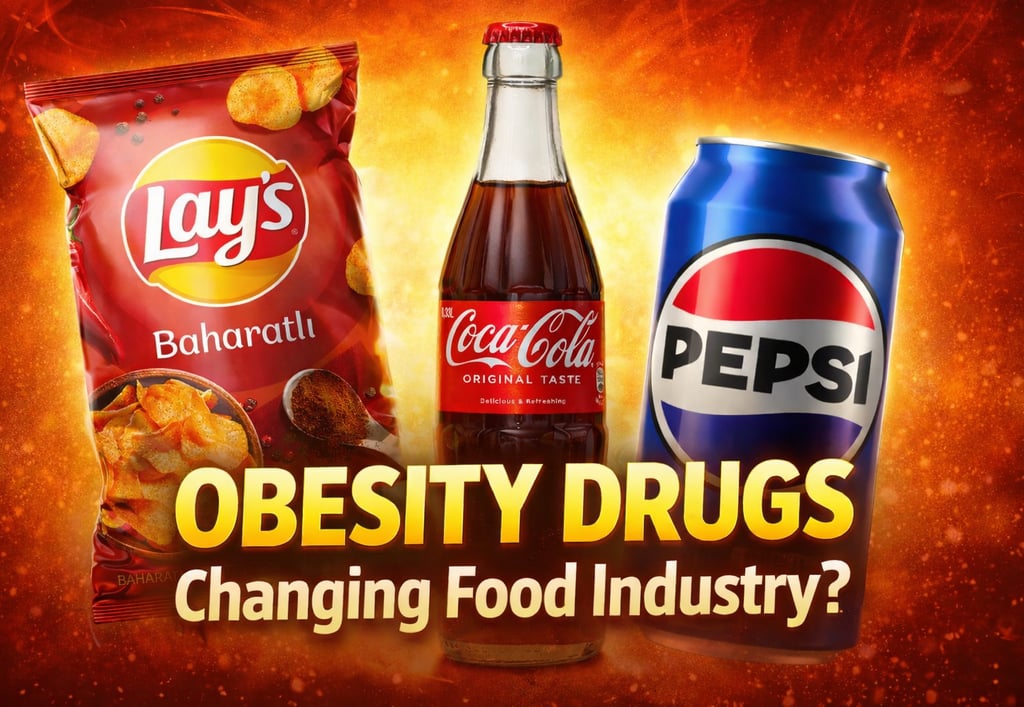
Big Food Rushes Into Costly Rebrands as Obesity Drugs Reshape U.S. Food Demand
As of 18 February 2026, the rapid rise of obesity and weight-loss drugs has begun to fundamentally reshape the American food market. Major food and beverage companies are now spending hundreds of millions of dollars on rebranding, reformulation, and research as consumer eating habits shift dramatically due to the growing use of GLP-1 medications. What was once a niche medical treatment has now become a powerful force influencing grocery sales, product sizes, and long-term corporate strategy across the U.S. food industry.
GLP-1 drugs work by suppressing appetite and increasing feelings of fullness, leading users to eat significantly less. Recent industry estimates suggest that nearly one in five U.S. households now includes at least one person using a GLP-1 drug. This has triggered a sharp decline in demand for high-calorie snacks, sugary beverages, and large portion packaged foods—categories that historically generated enormous profits for Big Food companies.
Consumer data from 2025–2026 shows that people using these medications consume 30–40% fewer daily calories, cut dessert and sweet snack purchases by up to 80%, and increasingly favor foods high in protein, fiber, and nutritional density. Grocery baskets are getting smaller, and impulse snack buying is falling. For food manufacturers built on volume and repeat snacking, this shift represents a serious structural threat.
In response, companies such as PepsiCo, The Coca-Cola Company, and Kraft Heinz have launched aggressive rebranding campaigns. These efforts go far beyond new logos or packaging colors. Brands are redesigning product formulas, shrinking package sizes, simplifying ingredient lists, and rewriting their marketing language to emphasize health, balance, and moderation.
PepsiCo has reformulated several snack and beverage lines with reduced sodium, lower sugar, and higher fiber, while promoting “lighter satisfaction” messaging in advertising. Coca-Cola has shifted focus away from large bottles toward smaller portion sizes and zero-sugar options, positioning them as compatible with appetite-suppressing medications. Kraft Heinz announced plans to invest over $600 million in modernizing its core products to align with evolving nutritional expectations.
At the same time, spending on research and development has surged. Industry analysts estimate that Big Food companies increased R&D budgets by 20–25% in 2026, targeting products that deliver satiety in smaller quantities. The goal is clear: adapt to a future where consumers eat less overall but demand higher quality, cleaner labels, and functional nutrition.
This transformation is not limited to multinational corporations. Health-focused meal services and fresh-food startups are also capitalizing on the trend. Companies like Snap Kitchen have redesigned menus to include higher protein, fiber-rich meals in smaller portions, specifically targeting GLP-1 users seeking convenience without excess calories.
The financial implications are substantial. Analysts warn that if GLP-1 adoption continues at its current pace, the U.S. snack and sugary beverage market could lose $10–12 billion in annual sales over the next decade. This risk has accelerated decision-making across boardrooms, forcing companies to evolve now rather than face long-term decline.
However, Big Food does not see this shift as purely negative. Many executives describe the moment as a rare opportunity to reset brand identity and rebuild consumer trust. Younger consumers, in particular, favor transparency, health awareness, and portion control—values that are now being embedded into new product strategies.
By 2026, the concept of “less but better” is becoming a defining principle of the American food market. Obesity drugs have not only changed how people lose weight; they have changed how the entire food industry thinks about demand, value, and relevance. For Big Food, rebranding is no longer optional—it is a survival strategy in a world where appetite itself is being medically redefined.
As obesity drugs continue to reshape eating habits, global sugar consumption is now clearly declining in 2026. Data shows intake has fallen by 6.7% in Western Europe and 4.4% in the United States, while global growth has slowed to just 0.5%, marking a major shift in consumer behavior. Medications like Wegovy and Zepbound are reducing appetite and sugar cravings, cutting calorie intake significantly, while soft drink taxes are pushing both consumers and manufacturers toward lower-sugar options. At the same time, cold drinks remain a major health risk, with a single soda containing around 40 grams of sugar—well above daily recommended limits—contributing to obesity, diabetes, heart disease, and other long-term issues.
👉 For a deeper breakdown of how sugar consumption trends are changing globally, read more: https://blinknews.blog/weight-loss-drugs-soft-drink-taxes-reduce-sugar-2026
Stay informed with the latest national and international news.
© 2026. All rights reserved.