
Bank of England Set to Hold Rates on Feb 5 as Economists Eye Possible March Cut
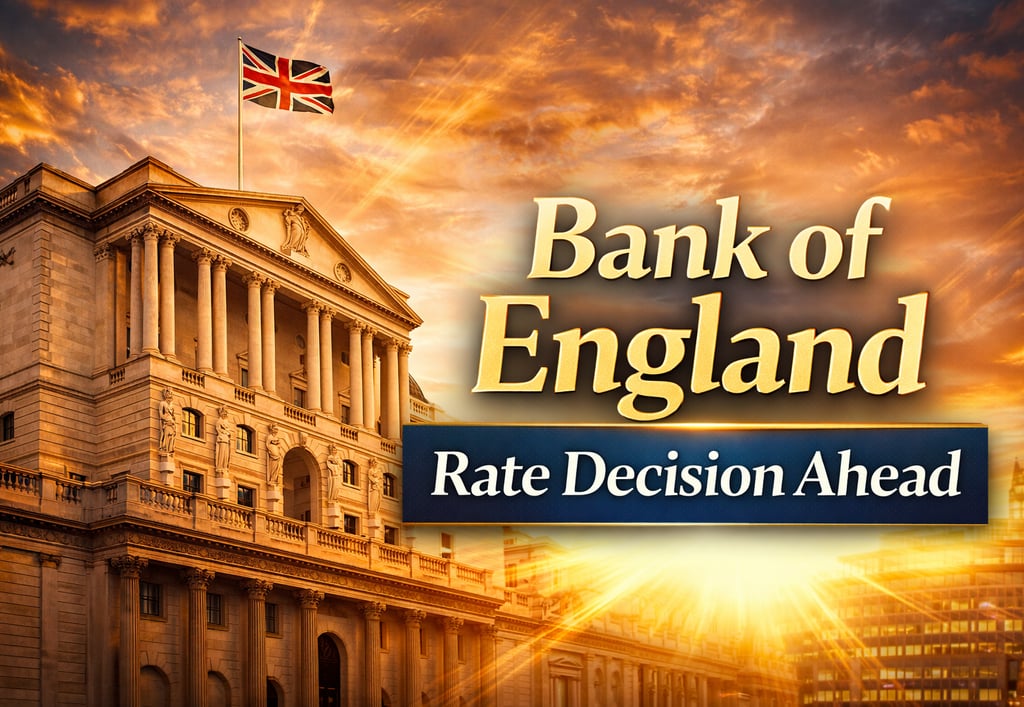
The Bank of England is expected to keep interest rates unchanged on Feb 5, with a slim majority of economists forecasting a rate cut in March 2026.
Raja Awais Ali
1/26/20262 min read
Bank of England Likely to Hold Rates in February, Slim Majority Anticipate March Cut
As of January 26, 2026, global financial markets are closely watching the Bank of England’s next policy move, with strong expectations that the central bank will keep interest rates unchanged at its February 5 meeting. However, a slim majority of economists believe that a rate cut could follow as early as March, provided inflationary pressures continue to ease and economic data weakens further.
The Bank of England’s benchmark interest rate currently stands at 3.75 percent, following a 25-basis-point reduction in December 2025. Recent surveys of economists indicate that approximately 55 percent expect another 25-basis-point cut in March 2026, while the remaining analysts believe the central bank will maintain its current stance throughout the first quarter of the year.
Policy makers are walking a delicate line between supporting economic growth and preventing inflation from re-accelerating. While headline inflation has eased noticeably from previous highs, pressures linked to wage growth and the services sector remain elevated. In December 2025, consumer price inflation was recorded at 3.4 percent, still well above the Bank of England’s 2 percent target, reinforcing the need for a cautious policy approach.
The current stance reflects lessons learned over the past few years. During 2023 and 2024, the Bank of England pursued one of the most aggressive tightening cycles in decades to combat surging inflation. Interest rates were raised to multi-year highs, increasing borrowing costs and slowing economic activity across the UK economy.
By 2025, however, signs of economic strain became increasingly evident. Slower growth, weakening consumer demand, and early signs of softness in the labour market prompted the central bank to pivot toward a more supportive stance. In mid-2025, rates were lowered to 4.25 percent, followed by another cut in December that brought the benchmark rate down to 3.75 percent.
Entering 2026, the UK economy remains at a fragile juncture. Inflation is trending downward, but not fast enough to eliminate concerns entirely. Wage growth, while moderating, continues to outpace productivity gains, and service-sector inflation remains stubborn. These factors have led policymakers to favor holding rates steady in February while awaiting clearer signals from upcoming data releases.
The decision on whether to cut rates in March will depend heavily on forthcoming economic indicators. Inflation reports, wage growth figures, and consumer spending data over the next several weeks will play a critical role in shaping expectations. Should these indicators show continued cooling, the case for easing monetary policy would strengthen. Conversely, any resurgence in inflation could delay further cuts.
Financial markets are currently pricing in a cautious easing cycle. Expectations suggest that one or two additional rate cuts could occur later in 2026, though policymakers have emphasized that decisions will remain data-dependent. Officials are keen to avoid premature easing, which could risk reigniting inflationary pressures and undermining hard-won progress.
Overall, the February meeting is expected to signal stability rather than immediate change, while March remains a potential turning point for UK monetary policy. The Bank of England’s strategy reflects a balanced effort to support economic recovery without compromising long-term price stability. The coming months will be crucial in determining whether the path toward lower interest rates can safely continue.
Stay informed with the latest national and international news.
© 2026. All rights reserved.