
Balochistan Terror Attacks February 2026: 145 Militants Killed, India-Pakistan Tensions Rise
On February 1, 2026, coordinated terrorist attacks in Balochistan killed 145 militants. Pakistan blames external involvement, India denies claims. Full analysis, locations, casualties, and security response.
Raja Awais Ali
2/1/20263 min read
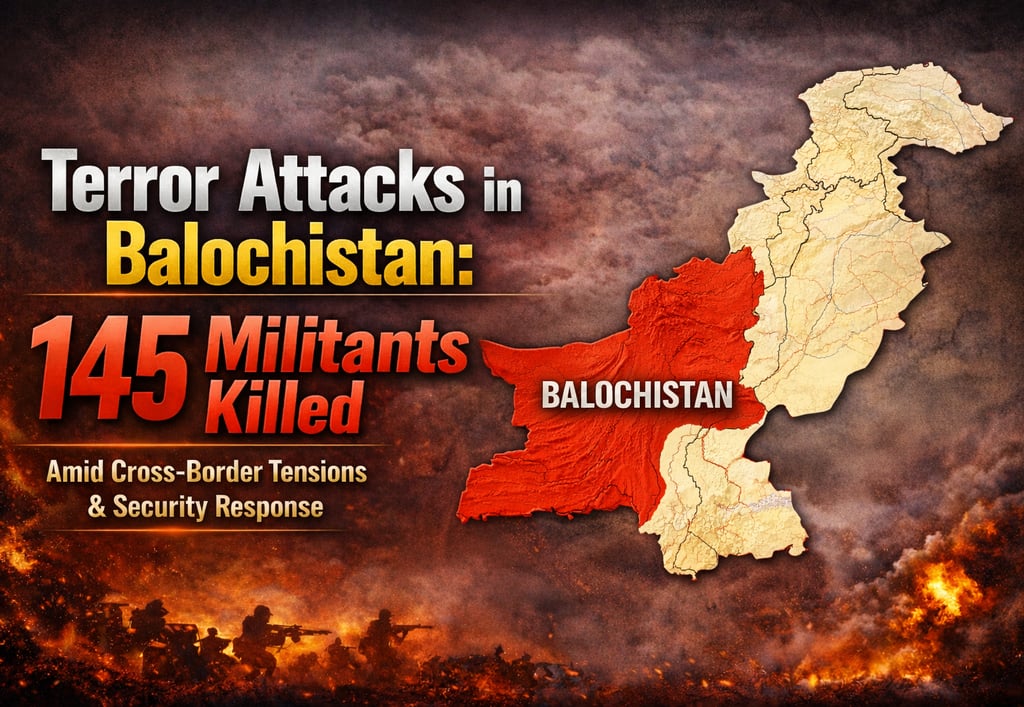
Terror Attacks in Balochistan: 145 Militants Killed Amid Cross-Border Tensions and Security Response
On February 1, 2026, Balochistan, Pakistan, was rocked by a series of highly coordinated and deadly terrorist attacks. Beginning on the evening of January 31, these assaults targeted multiple districts simultaneously, prompting an immediate and large-scale response by Pakistani security forces. Over the course of the operations, 145 militants were reportedly killed, making this one of the most severe security incidents in the province in recent years.
The attacks started around 7 PM on January 31, when armed groups moved in small, organized units targeting police stations, Frontier Corps checkpoints, national highways, railway lines, and urban centers. Civilians traveling on major roads were also attacked, spreading panic and disrupting normal life.
The most affected areas included Quetta, Gwadar, Mastung, Noshki, Dalbandin, Khuzdar, Panjgur, Temp, and Pasni. In Quetta, attacks occurred near the Saraiab Road and police lines. In Gwadar, blasts targeted areas near the port, while Mastung and Noshki saw assaults along major highways. These regions are critical for both economic and strategic purposes, particularly Gwadar, which is central to the China-Pakistan Economic Corridor (CPEC).
Security analysts point to several factors behind the attacks. One primary reason is opposition to CPEC and Gwadar’s rapid development, which terrorist groups perceive as a threat to their control. Local socioeconomic deprivation and unemployment have also been exploited by militant groups to recruit and radicalize youth. The region’s proximity to the Afghan border, along with the resurgence of banned militant outfits, further contributed to the complexity of the situation.
The attacks resulted in substantial human and material losses. Official sources reported 17 security personnel and 31 civilians killed, with dozens more injured, including women and children. Several government buildings were damaged, railway tracks were disrupted, and numerous vehicles were destroyed. Businesses were forced to close, causing significant economic loss.
The Baloch Liberation Army (BLA) claimed responsibility for the attacks, naming the operation “Heroff” or “Black Storm,” aimed at targeting security forces and state infrastructure. Pakistani authorities allege that the group has received external support, including financial aid and advanced weaponry, without which such large-scale attacks would not have been possible.
Following the attacks, Pakistan also accused India of supporting proxy groups operating in Balochistan, claiming that the assaults were intended to destabilize the region and disrupt CPEC projects. However, the Indian Ministry of External Affairs strongly denied the allegations, stating that India does not support any terrorist activity and urged Pakistan to focus on its internal security and governance challenges rather than making baseless claims.
In Islamabad, the Pakistani government responded firmly, emphasizing that concrete evidence of external involvement exists and will be presented through diplomatic channels. Officials stated that the facilitators of the attacks would be held accountable, regardless of whether they operate domestically or from abroad. The Prime Minister highlighted the government’s commitment to safeguarding citizens and maintaining state authority, warning that no external or proxy attempts to destabilize Pakistan would be tolerated.
Security forces, including the Pakistan Army, Frontier Corps, police, and the Counter-Terrorism Department (CTD), launched joint operations immediately after the attacks. Intelligence-led raids targeted militant hideouts across the Makran and Quetta divisions. Self-explosive vests, heavy weaponry, and communication equipment were recovered, effectively dismantling key terrorist networks.
The public reacted with grief and anger. Schools temporarily closed, Gwadar port increased security measures, and transport systems were disrupted. Citizens demanded decisive action against the facilitators and financial backers of terrorist groups to prevent future attacks.
Experts emphasize that long-term peace in Balochistan cannot be achieved through military action alone. Economic development, employment opportunities, education, political inclusion, and social reforms are essential to prevent youth from being radicalized. Diplomacy is also critical to managing cross-border tensions and ensuring regional stability.
Overall, the events of February 1, 2026, demonstrate that terrorism remains a significant threat in Balochistan. The swift and effective response by security forces neutralized the militants’ objectives, but sustained peace requires a combination of security, social, and political measures. Pakistan’s determination to protect its citizens, alongside long-term reforms, will be key to ensuring lasting stability in the province.
Stay informed with the latest national and international news.
© 2026. All rights reserved.