
Adolf Hitler: Life, Nazi Ideology, WWII, and Historical Legacy
Explore Adolf Hitler’s life, Nazi ideology, WWII strategies, personal life, Mein Kampf, Holocaust, and historical impact in this comprehensive analysis.
Raja Awais Ali
1/10/202610 min read
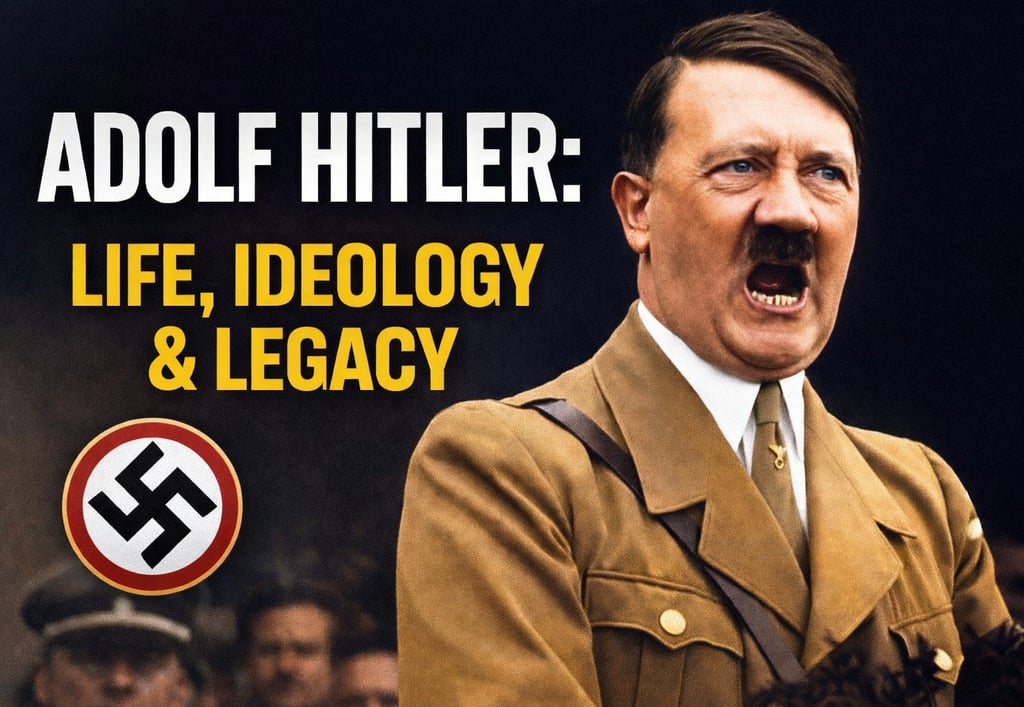
Adolf Hitler: The Complete Life, Ideology, and Legacy
Early Life and Family Background
Adolf Hitler was born on April 20, 1889, in Braunau am Inn, a small town in Austria, near the German border. He was the fourth child of Alois Hitler, a customs official, and Klara Pölzl. Hitler’s early years were marked by personal loss, as three of his siblings—Gustav, Ida, and Otto—died in infancy. Alois Hitler’s stern personality contrasted sharply with Klara’s warmth and devotion, leaving a lasting impression on young Adolf. He spent much of his childhood in Linz, Austria, after his father’s retirement, where he developed a complex relationship with authority, a disdain for formal education, and an early fascination with the arts. Despite his passion, his academic performance was poor, and he eventually dropped out of high school.
In pursuit of his artistic ambitions, Hitler applied twice to the Vienna Academy of Fine Arts but was rejected both times. These failures, combined with the deaths of his parents—Alois in 1903 and Klara in 1907—had a profound psychological impact on him. The loss of his mother, in particular, left him emotionally adrift, fueling feelings of isolation and resentment. During this period, Hitler moved to Vienna, living in relative poverty while painting and selling his artwork. He remained socially withdrawn but became increasingly exposed to nationalist and anti-Semitic ideologies circulating in the city. This environment played a crucial role in shaping the beliefs that would later underpin his political ideology.
During his time in Vienna, Hitler absorbed a mix of cultural, political, and racial ideas that laid the groundwork for his worldview. He developed a sense of racial superiority, particularly focused on the concept of the Aryan race, while simultaneously harboring prejudice against Jews and other minority groups. His experiences of rejection, combined with a sense of personal and national grievance, were reflected in his later writings and speeches. The years in Vienna were formative, providing both the intellectual and emotional foundations for the extremist ideologies he would adopt and later propagate.
Service in World War I
In September 1914, at the outbreak of World War I, Hitler volunteered to serve in the Bavarian army. He was stationed primarily on the Western Front, including in Belgium, where he distinguished himself for bravery and dedication. During the conflict, Hitler was wounded twice: first in 1916 at the Battle of the Somme, and later in 1918 near Ypres due to a mustard gas attack that temporarily impaired his vision. He received several awards, including the Iron Cross First Class, a rare honor for someone of his rank.
World War I profoundly influenced Hitler’s perception of politics and society. He internalized the “stab-in-the-back” myth, believing that Germany’s defeat was due not to military failures but to internal traitors, particularly socialists, communists, and Jews. This narrative of betrayal became central to his political rhetoric, framing his later anti-Semitic and nationalist ideology. The psychological and ideological impact of the war was immense, leaving Hitler with a deep sense of personal and national grievance that would drive his future ambitions.
After the armistice, Hitler returned to Munich, angry and disillusioned by Germany’s defeat. He refused to accept the official reports of surrender and blamed domestic enemies for the nation’s humiliation. His time in the military instilled a rigid sense of discipline and hierarchy, which later informed the paramilitary structure of the Nazi Party and his approach to governance.
Rise in the Nazi Party
Following World War I, Hitler joined the German Workers’ Party (DAP) in 1919. Known for his compelling oratory and magnetic presence, he quickly rose through the ranks. By 1920, he assumed responsibility for the party’s propaganda and oversaw its expansion and transformation into the National Socialist German Workers’ Party (NSDAP), widely known as the Nazi Party. The adoption of the swastika emblem symbolized a unified nationalist and racial identity, central to Hitler’s ideology.
In 1921, Hitler became the undisputed leader of the Nazi Party, capitalizing on widespread discontent with the Weimar Republic and economic instability. He established the Sturmabteilung (SA), a paramilitary organization tasked with protecting party meetings and intimidating political opponents. The SA became an essential tool for consolidating Hitler’s influence and enforcing party ideology through intimidation and violence.
On November 8, 1923, Hitler led the Beer Hall Putsch, an attempted coup in Munich aimed at overthrowing the Weimar government. Although the coup failed and Hitler was arrested, the event elevated his public profile and cemented his reputation as a nationalist figure. During his imprisonment, he began writing Mein Kampf, a manifesto outlining his political views, racial ideology, and expansionist ambitions. The book provided the ideological foundation for the Nazi Party and would later become a central text in promoting its doctrines.
Consolidation of Power
After his release from prison, Hitler focused on restructuring the Nazi Party and building political alliances. He leveraged the economic turmoil caused by the Great Depression to garner widespread support, particularly from industrialists, conservative elites, and military figures. By the early 1930s, Hitler had positioned himself as a leading political force, advocating for strong centralized leadership and national revival.
In 1932, Hitler gained the most votes in the German elections, and by January 1933, President Paul von Hindenburg appointed him Chancellor. Following the Reichstag fire and subsequent political maneuvers, the Enabling Act of March 1933 granted Hitler dictatorial powers, effectively dismantling democratic structures. In 1934, after Hindenburg’s death, Hitler combined the roles of Chancellor and President, assuming the title of Führer. He swiftly eliminated political rivals during the “Night of the Long Knives” in June 1934, consolidating his absolute control over Germany and establishing a totalitarian regime.
The Nazi regime enforced ideological conformity through censorship, propaganda, and suppression of dissent. Hitler’s leadership style relied on centralized authority, cult of personality, and control over every aspect of political and social life. His government transformed Germany into a single-party state, where loyalty to Nazi ideology was mandatory and opposition was ruthlessly suppressed.
Nazi Ideology: Aryan Supremacy, Anti-Semitism, and Lebensraum
Hitler and the Nazi Party’s ideology rested on three central pillars: the supremacy of the Aryan race, the hatred of Jews, and the concept of Lebensraum, or “living space,” for German expansion. Hitler emphasized the Aryan race as superior, seeing it as destined to rule the world. This belief formed the foundation of Nazi racial policies and shaped laws, education, and social life in Germany. He depicted non-Aryans as inferior and unworthy, justifying discrimination, exclusion, and eventual extermination.
Anti-Semitism was another core component. Hitler held Jews responsible for Germany’s perceived failures and societal problems. He blamed them for economic crises, political instability, and cultural “degeneration.” This ideology ultimately laid the groundwork for the Holocaust. Under Hitler, millions of Jews were forcibly confined to ghettos, deported to concentration camps, and systematically killed. The Holocaust became the horrific realization of Nazi racial ideology, targeting Jews, Romani people, disabled individuals, and political opponents alike.
The third principle, Lebensraum, was rooted in the belief that Germany required territorial expansion to sustain its population and economy. Hitler viewed Eastern Europe, particularly the Soviet Union, as the natural space for German settlement. This expansionist policy justified invasions and mass displacement of local populations. Lebensraum was not just about resources; it reflected a worldview that combined racial superiority with imperial ambition, shaping Hitler’s military strategy and foreign policy.
Hitler’s ideology intertwined nationalism, militarism, and racism. It permeated German society, from education to cultural institutions, creating a state that demanded loyalty to the Aryan ideal and the Führer. Propaganda, rallies, and media campaigns reinforced these ideas, ensuring widespread acceptance and compliance.
Chancellor to Führer: Absolute Power and Totalitarian Rule
Upon becoming Chancellor in January 1933, Hitler rapidly consolidated power. The Reichstag fire provided a pretext to suppress political opposition and implement emergency measures. The Enabling Act of March 23, 1933, gave him the authority to enact laws without parliamentary approval, effectively establishing dictatorial rule. By 1934, following President Hindenburg’s death, Hitler merged the positions of Chancellor and President, proclaiming himself Führer.
Hitler’s regime ruthlessly eliminated dissent. The Night of the Long Knives (June 1934) targeted SA leaders, including Ernst Röhm, and other political opponents. These purges secured loyalty among the military and removed potential threats. Nazi control extended to media, education, and public life. Newspapers, books, theater, and radio were used to spread propaganda, glorifying Hitler and reinforcing Nazi ideology. Public rallies, posters, and youth programs indoctrinated citizens from an early age, shaping attitudes and behavior to align with state objectives.
The totalitarian system demanded conformity and suppressed independent thought. Opposition was met with imprisonment, torture, or execution. Political parties, trade unions, and religious organizations were co-opted or dismantled. This absolute control allowed Hitler to implement radical policies, including rearmament, territorial expansion, and racial laws, without institutional resistance.
World War II: Expansion, Conquest, and Conflict
World War II began on September 1, 1939, when Germany invaded Poland. Britain and France declared war in response, marking the start of a global conflict. Germany employed Blitzkrieg tactics—rapid, coordinated attacks combining infantry, armor, and air power—to quickly overwhelm opponents. In 1939, the Polish army was defeated within weeks. By 1940, Germany had conquered Denmark, Norway, Belgium, the Netherlands, and France, forcing Allied troops to retreat from Dunkirk.
In 1941, Hitler launched Operation Barbarossa, a massive invasion of the Soviet Union. Millions of Soviet soldiers and civilians were killed, and the campaign was marked by extreme brutality, including massacres of Jews and political commissars. That same year, following Japan’s attack on Pearl Harbor, Germany declared war on the United States, further escalating the global conflict.
The initial successes of Nazi Germany were significant. By 1941, German forces controlled much of Europe and North Africa. However, by 1942-43, critical defeats at Stalingrad and El Alamein turned the tide. Allied forces advanced from multiple fronts, liberating occupied territories. Despite Hitler’s insistence on unwavering resistance, Germany faced mounting military and logistical challenges. By April 1945, Allied forces had encircled Berlin, signaling the imminent collapse of the Nazi regime.
The Holocaust and War Crimes
The Holocaust was the most horrific manifestation of Hitler’s ideology. Under Nazi rule, approximately six million Jews were systematically murdered. Millions of other victims—including Romani people, disabled individuals, Poles, Soviets, and political opponents—were also killed. Concentration and extermination camps such as Auschwitz, Birkenau, Sobibor, and Treblinka became the epicenters of industrialized mass murder. Prisoners were subjected to forced labor, starvation, medical experiments, and systematic execution, often in gas chambers.
Nazi Germany’s war crimes extended beyond genocide. Civilians and prisoners of war across Europe suffered mass executions, forced labor, and atrocities under German occupation. Estimates indicate that up to 28 million military personnel and 19.3 million civilians were killed as a result of Hitler’s policies and military campaigns. The Nuremberg Trials after the war held Nazi leaders accountable, though Hitler himself had committed suicide before capture.
Personal Life, Health, and Relationships
Adolf Hitler’s personal life was complex and marked by intense relationships that shaped his psychological and emotional world. Two women played pivotal roles: his niece Geli Raubal and his longtime companion, Eva Braun. Between 1929 and 1931, Hitler became emotionally involved with Geli Raubal, who tragically committed suicide. Her death deeply affected Hitler, leaving a lasting emotional scar that he never publicly recovered from.
In the 1930s, Hitler met Eva Braun, who worked at a Munich photography studio. Their relationship was private, and she rarely appeared in public alongside him. Despite decades together, Hitler married Eva Braun only shortly before their deaths, on April 29, 1945. The following day, both committed suicide in the Führerbunker in Berlin—Hitler with a firearm, Eva with cyanide. Their bodies were cremated by close aides to prevent them from becoming symbols.
Hitler’s health was fragile throughout his life. He suffered from gastrointestinal issues, insomnia, and chronic headaches. Reports suggest he may have had Parkinson’s disease in his later years, resulting in tremors and impaired mobility. His personal physician, Theodor Morell, administered a cocktail of medications, including amphetamines, barbiturates, opiates, and other compounds, in an attempt to sustain Hitler’s energy and mental focus. Despite his obsession with physical activity, sports, and a disciplined routine, his health remained poor, and he was highly dependent on medical interventions.
Nazi Propaganda and Media Control
Propaganda was central to Nazi rule. The regime sought to control public perception, shaping citizens’ beliefs and behaviors to align with Hitler’s ideology. Joseph Goebbels, appointed as Minister of Propaganda, centralized media control under the Reich Ministry of Public Enlightenment and Propaganda. Newspapers, radio, literature, theater, and cinema were all used to glorify Hitler and the Nazi Party while silencing opposition.
The regime also targeted youth through organizations like the Hitler Youth, instilling loyalty, militarism, and Aryan ideology. Public rallies, posters, postcards, and broadcasts ensured that Hitler’s image and ideology reached every corner of Germany. Books deemed “un-German” were burned, and publications promoting alternative perspectives were banned. These strategies reinforced the perception of Hitler as the infallible leader and created a society in which dissent was virtually impossible.
Influence in South Asia and Muslim Political Thought
Hitler’s ideology had limited but notable influence in South Asia during the 1930s and 1940s. Nazi propaganda was translated into local languages, including Urdu, Hindi, and Bengali, and disseminated among political and intellectual circles. Some Hindu nationalists, such as Vinayak Savarkar and members of the Hindu Mahasabha, praised Hitler for his nationalist and anti-British stance.
Nazi representatives attempted to engage Muslim leaders, presenting Hitler as a supporter of Islamic military strength while simultaneously fostering anti-British sentiment. German businesses and officials funded pro-German newspapers, spreading content that aligned with Nazi political goals. These campaigns were selective, aimed at influencing certain ideological groups while promoting Germany’s image as a global power opposed to British colonial rule.
Despite these efforts, the influence of Nazi ideology in South Asia was primarily political and propagandistic, rather than cultural or social. The admiration for Hitler’s anti-colonial rhetoric did not translate into wholesale adoption of Nazi racial policies.
Mein Kampf: Ideological Foundation
Hitler’s Mein Kampf (My Struggle) was both an autobiography and a political manifesto, written during his imprisonment in Landsberg in 1924-25. The book articulated the ideological foundations of Nazism: Aryan racial superiority, anti-Semitism, anti-communism, and the pursuit of Lebensraum in Eastern Europe. It also included Hitler’s personal experiences, political theories, and revolutionary strategies.
The book became a tool for spreading Nazi ideology, with over 12 million copies sold between 1925 and 1945. Mein Kampf remains controversial, criticized for historical inaccuracies, distorted arguments, and blatant hate speech. Modern critical editions provide context and analysis, highlighting the dangerous impact of its ideas and connecting them to the atrocities committed during the Holocaust.
Death and Historical Legacy
By the end of the Battle of Berlin, Hitler understood that Germany’s defeat was inevitable. On April 29, 1945, he married Eva Braun in the Führerbunker. The following day, both committed suicide. Their bodies were burned, and on May 1, 1945, German radio announced Hitler’s death. Nazi Germany collapsed shortly after, with formal surrender to the Allies on May 8, 1945.
Historically, Hitler is remembered as one of the most infamous figures in world history. His regime was responsible for the deaths of six million Jews, nearly 20 million civilians, and over 28 million military personnel during World War II. His ideological and political legacy serves as a stark reminder of the dangers of racial hatred, authoritarianism, and totalitarian rule.
Hitler’s life demonstrates how ideology, propaganda, and personal ambition can converge to create catastrophic consequences. His actions left an indelible mark on history, providing lessons on the importance of vigilance, ethical leadership, and the protection of human rights.
Stay informed with the latest national and international news.
© 2026. All rights reserved.